
Is Substack Worth It? A Creator’s Guide to Monetizing Your Writing in 2025
How much you can earn, how monetization actually works, and how to keep subscribers long-term.

If you’ve ever wondered how much money you can actually make writing on Substack and whether it’s worth putting more energy into the platform, you’re not alone.
In this post, I’ll break down:
How Substack monetization really works
What the most successful publications are doing differently
And what it actually takes to turn your writing into a predictable income stream
You’ll also get a behind-the-scenes look at our journey with Write • Build • Scale: what’s worked, what hasn’t, and how we’ve grown to over 600 paying subscribers in less than a year:
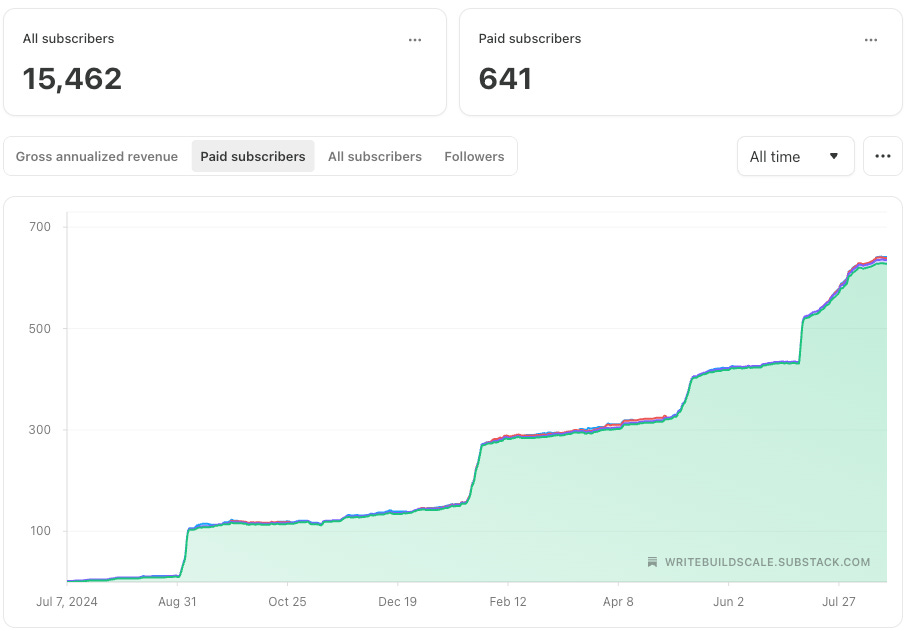
Because let’s be honest: While some Substack publications are earning seven figures per year, the truth is that most writers are struggling to make even a few hundred dollars a month.
Let’s dive in and uncover how more creators can actually get paid for doing what they love:
How Substack Monetization Works
Before we talk about numbers, let’s quickly clarify how writers actually get paid on Substack.
It’s easy: On Substack, you’re essentially selling low-ticket subscriptions directly to your audience.
Here’s the typical model:
You publish free content to build trust and grow your email list.
You offer a paid tier (monthly or yearly) that unlocks premium posts, resources, or community access.
Most creators charge between $5–$10 per month, or $50–$100 per year.
When someone subscribes, their payment is processed through Stripe.
Substack takes a 10% platform fee. Stripe takes ~3%.
The rest goes to you.
So if you charge $10 per month and have 100 paid subscribers, here’s what you earn:
Total revenue: $1,000
Substack fee: $100
Stripe fee: $30
Your income: $870
How Much Are Top Substack Creators Earning?
Some of the biggest Substack publications earn multi-6-figures or over $1M/year — after platform fees.
The easiest way to spot these high-earning publications is to take a closer look at Substack's Bestseller badges.
These give you a clue into how many paying subscribers a publication has:
⚪️ White Badge = 100+ paying subscribers
🟠 Orange Badge = 1,000+ paying subscribers
🟣 Purple Badge = 10,000+ paying subscribers
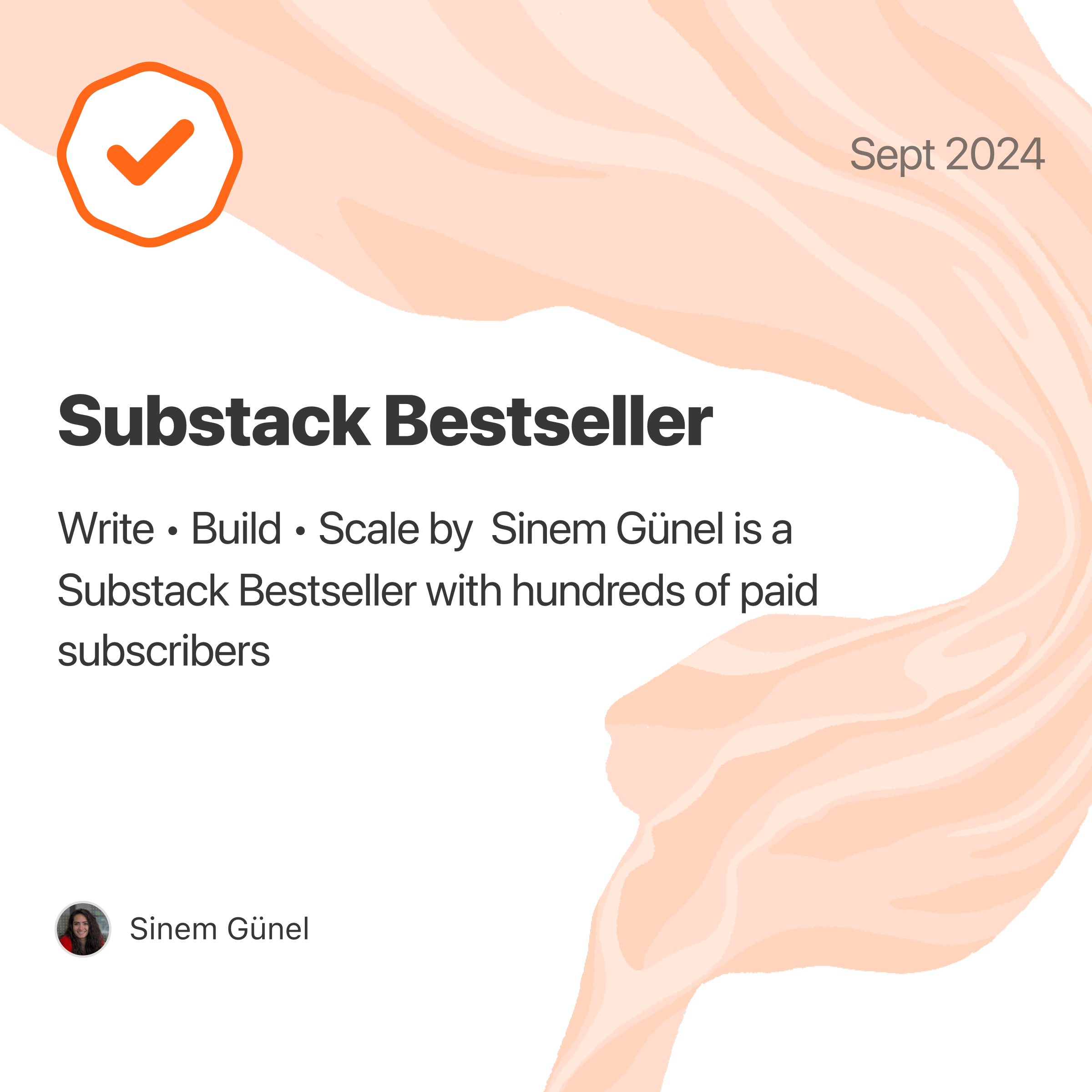
Let’s do some quick math to get a better understanding of what these badges can mean.
If a writer has 10,000 paid subscribers at $10/month, that’s $100,000 per month, or over $1M per year after fees.
Of course, that’s only the top 1% and 10,000 paid subscribers is a massive number that can't be achieved overnight. But it shows what's possible if monetizing through a Substack subscription is one of your primary goals.
A more achievable milestone for most creators is:
100 paid subscribers = ~$12,000/year
500 paid subscribers = ~$60,000/year
1,000 paid subscribers = ~$120,000/year
That being said, let's not forget that most creators will push slightly discounted annual subscriptions and might also run promotions where they give away access to their paid tier for less than their usual monthly fee, which would reduce these numbers.
But here’s the bigger challenge for most creators:
If you want people to actually pay you, your work has to be worth paying for.
This is where most creators fall short.
Free Platforms vs. Paid Platforms
On social media, people pay with their attention.
If your content sucks, they just keep scrolling.
But on Substack, people pay with their money.
That means two things:
Most new subscribers will test you with a monthly plan before committing to a yearly one.
You have to keep delivering to make sure they don’t cancel.
Even if you do a phenomenal job, there will always be a small number of people canceling their paid subscriptions simply because they don't need your content anymore, or they are rotating between different paid publications to consume a variety of content.
This means your goal is to ensure that your growth rate is significantly higher than the cancellation rate because you want to ensure that you are outpacing the number of cancellations every single month.
Our Experience: From 0 to 600+ Paid Subscribers
At Write • Build • Scale, we reached 100 paying subscribers within less than 60 days through a simple promotion:

Today, we’re serving over 600 paid members — and we didn’t get there by accident.
We ran intentional launch campaigns, strategically promoted our paid tier, and focused heavily on retention.
![How to Keep Your Paid Members [Ft. Ciler Demiralp]](https://substackcdn.com/image/fetch/$s_!KrKZ!,w_140,h_140,c_fill,f_webp,q_auto:good,fl_progressive:steep,g_auto/https%3A%2F%2Fsubstack-post-media.s3.amazonaws.com%2Fpublic%2Fimages%2F7b8d996e-c9ba-4ef4-bf7e-d150f65d7910_1456x1048.png)
Here’s why that matters:
If you gain 20 new subscribers in a month but lose 15, you’re only growing by 5 new subscribers.
This makes long-term growth painfully slow unless you fix your churn.
Retention is where the real money is.
Why?
Because someone who stays for 12 months is worth 12x more than someone who only stays for 1.
To keep subscribers around, we:
Publish consistently
Make our members feel like insiders
Regularly ask for feedback
Give our community access to more than just newsletters
We offer premium posts, private chats, live calls, and meaningful ways to connect with each other and with us.
Remember: Substack isn’t just a publishing tool.
It’s a fully-blown marketing and business platform.
How to Promote Your Paid Tier (Without Feeling Salesy)
Let’s be honest: Most creators hate selling.
That’s why they avoid promoting their paid tier altogether or do it so vaguely that no one takes action.
Here’s the good news:
You don’t have to feel “salesy” to attract paid subscribers.
Here are three subtle strategies we use that work incredibly well:
1. Content Funnels
Start with a free post that delivers real value.
Inside that post, link to a premium resource — like a guide, toolkit, or deep-dive article behind the paywall.
If readers are interested, they’ll click. When they hit the paywall, they’ll make their own decision.
No hard sell required.

2. Premium Content Library
Create a page that lists all your exclusive content in one place.
Free readers get curious.
Paying members get a convenient dashboard of everything they’ve unlocked.
It builds desire and improves retention.
🔗 Click here for the Write • Build • Scale Premium Content Library.
3. Custom “Become a Member” Page
Substack’s default upgrade page is quite basic and unattractive:

By building your own page, you can explain your offer clearly, add testimonials, compare free vs. paid features, and show people exactly what they’ll get.
Each of these methods focuses on showing value, not begging for sales.
Let your content speak for itself.
🔗 Click here for the Write • Build • Scale Become A Member page.
Substack Is Not the Endgame
As you’ve seen, Substack can be an incredibly powerful growth and monetization engine for your work.
But relying on it as your only income stream?
That’s risky.
Just like with any other platform, you don’t want to rely on only one place to drive traffic or make money.
That’s why we recommend using Substack as your home base, not your entire business.
Here’s what we do at Write • Build • Scale:
Grow our email list with free content
Filter our audience through the paid tier (paid subscribers are our hottest leads)
Use Substack to promote higher-ticket offers like courses, templates, and coaching
Our paid plan isn’t the finish line, it’s the entry point.
From there, readers can dive deeper into our ecosystem.
And that’s how you build a sustainable business around your writing.
So… How Much Money Can You Make?
Here’s the honest answer:
If you consistently publish, promote your paid tier, and retain subscribers, you can make up to six or even seven figures a year directly on Substack or by monetizing the attention you gain on Substack.
But for anyone who wants to build a sustainable business and create content for a living, the paid tier is not the end game. It's just a starting point and a door opener for many more opportunities outside of Substack.
Let me know in the comments if you have any questions or thoughts - I’d love to hear from you!
— Sinem 🧡
I’ve been plateaued at around 200 paid subscribers for a while now, which is frustrating since I’m so close to making a full living from this work. Up until now, everything I’ve written has been free, but I’m considering moving to a full paywall.
Fantastic piece. What stood out most for me is your emphasis on retention and the ecosystem beyond Substack. In my work with solopreneurs, I see the same blind spot: too much focus on acquisition and not enough on depth. I often use what I call the “margin mirror.” If your paid tier is not just covering costs but also extending customer lifetime value, then you are building a sustainable engine rather than a treadmill. Your 600+ subscriber journey illustrates that principle brilliantly.