


If you're a business owner or coach who's been watching the old social media playbook get harder every month, this post is for you.
What you're seeing isn't a bad week or a broken algorithm: The whole attention-chasing model is winding down, and a different growth engine has quietly taken its place.
Here’s what’s actually working right now, and the strategic mistake we see serious business owners make that stops them from ever building real income.
The old growth model is over
For most of the last decade, growing an audience meant feeding the algorithm.
You post, you hope, you perform for reach, you do it again tomorrow.
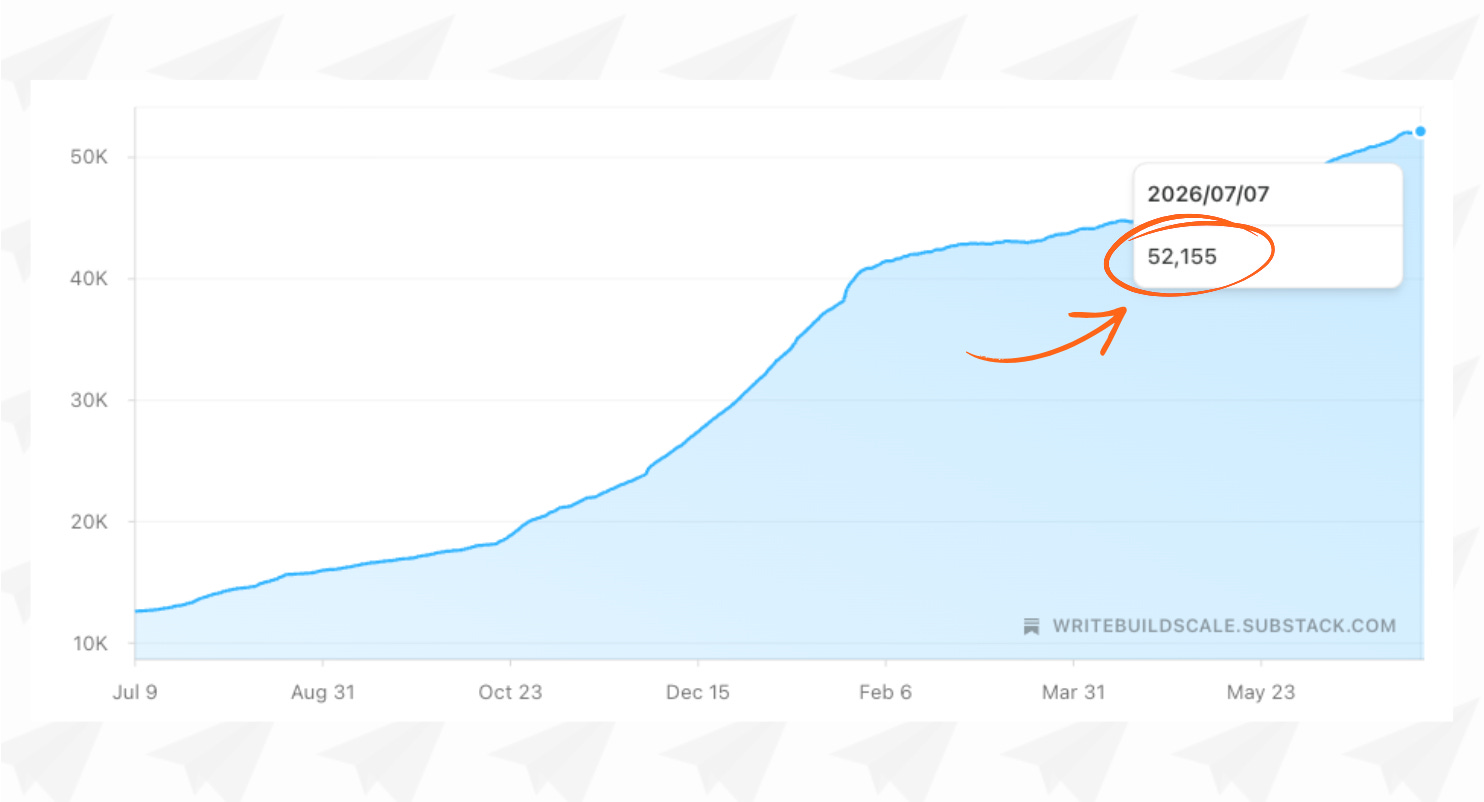
That model still runs, but it’s getting more expensive to play and less predictable to win. Every platform gets more ad-loaded, every post gets less organic distribution, and the followers you built rarely belong to you the moment the platform decides to change the rules, so we stopped playing it. The result is our best growth run in 11 years of running online businesses: Over 50,000 subscribers and 1,800+ paying members in under 2 years, without a single Instagram dance or hook-fishing short.
The reason it worked isn’t a clever tactic. It’s a structural shift in what platform we chose to build on.
What Substack actually gives you
Everything on Substack is built to make you independent, and that’s the piece most creators miss when they first look at it.
Followers on Facebook, Instagram, X, and LinkedIn stay useful right up until the platform changes its algorithm. Then the audience you spent years building becomes a rounding error overnight.
On Substack, you don’t get followers, you get subscribers, and their email addresses are yours. Payments run through Stripe. The platform is ad-free, so readers open your posts without wading through a mall of promotions first. And you can actually message people directly, which on the other social platforms has become an anti-signal.
That combination of subscriber ownership, direct messaging, and an ad-free reading environment, means you actually own your audience instead of renting it from a platform that can change the rules on you tomorrow.
The mistake almost every creator makes
The structural advantage is real, but what most creators do with it is the mistake.
They optimize the entire publication for paid subscribers. They obsess over the paywall. They stress about their conversion rate. They read every article on Substack growth and ask the same question: How do I turn more free readers into $8/month?
That’s a fine question, but it’s the smaller game.
If you already run a business or a coaching practice, your paid subscribers are almost never the biggest revenue line your Substack produces.
What Substack actually gives you is trust at scale with the exact people who could become clients for your real offers.
The paid tier is an arm-raiser: It tells you who’s serious, who’s ready to spend, who’s leaning in. Some of those people will stay paid subscribers for years. Others will book a call, buy a course, or hire you. Most of the real revenue lives downstream of the paid tier, not inside it.
Optimize for that, and every decision you make about your publication changes.
What actually belongs inside your paid tier
Once you stop treating paid subscriptions as the finish line, the next question is what you put behind the paywall.
Most people believe that the answer is to just publish more posts and put them behind the paywall, but that’s the worst way to think about your paid tier.
Nobody becomes a paid subscriber because they wanted another email in their inbox.
They pay because they want transformation faster, premium access, a shortcut. When someone joins our paid tier, they get a Notion database we use every day, bestseller interviews, behind-the-scenes access, and a set of resources that would look absurd for $85 a year on any other platform. It’s built that way on purpose, because the paid tier isn’t the offer. It’s the door to a longer relationship.
Pricing is only one lever in the free-to-paid problem, and it’s the one most creators guess at. Our Substack Free-to-Paid Playbook is full of 100+ tested strategies for turning free readers into paying members, filtered by subscriber stage, so you find the right strategy in minutes.
The mechanics that compound trust
Once the strategy is right, a small number of mechanics do most of the work. These are the ones that reliably moved the needle for us.
Personalize at scale
Every new subscriber gets a personal message asking why they subscribed and what they want to build. Not an automated welcome sequence, but an actual message. Some conversations lead nowhere. Some lead to paid subscribers. Some lead to coaching clients. All of them teach you what your audience actually wants, which is worth more than any market research you’ll ever run.
Go live
In the age of AI, almost everything can be faked: The image, the voice, the video, the writing. What can’t be faked yet is a live stream. Get on camera at least once a week, miss your words occasionally, answer real questions in real time. That’s how trust compounds now, because it’s the one signal your audience rarely confuses with a bot.
Publish one skyscraper article per quarter
Every so often, put 5x the normal effort into a single post. A deep, definitive piece that people save, share, and come back to. One of ours documented 365 lessons from our first year on the platform. It went viral, brought a flood of new subscribers, and we paired it with a birthday promotion that filled our annual tier in days. You can’t do this every week, but you should do it a few times a year.

Use Notes as pointers, not as your product
Notes are signposts on the road into your town. Their job is to send passers-by toward your publication, not to build your entire brand on their own. Post them consistently, keep them tied to the same core message as your publication, and treat them as awareness rather than depth.
Focus is what makes all of it work
None of this compounds if you’re doing it across 5 different topics at once. We get asked constantly whether someone should run 3 to 5 different newsletters because they’re interested in a lot of things. If Substack is a hobby for you, do whatever you want. If it’s a business, you want one publication.
You want to be known for one thing. You want to be the person someone recommends when a specific problem comes up. That rarely happens when your energy is spread across five topics, and it doesn’t happen when you try to be a generalist on a platform that rewards depth.
Start in a niche so narrow it feels almost embarrassing. We started by teaching people who already wrote on Medium how to make more money from their writing. From there, we expanded to writing online, then building audiences, then scaling income. The niche was the on-ramp, and the expansion came later, once we owned the ground we started on.
The window is still open
Substack isn’t LinkedIn yet. It isn’t Instagram. It may never be, and honestly, that’s the point: A platform that stays this good is one that doesn’t try to become everything for everyone. Traffic is up, the network effects are working, and most creators, especially outside the US, still have no idea what it is.
Two years from now, that won’t be true. The people who take Substack seriously right now will have a compounding advantage the latecomers rarely buy their way out of.
If you already run a business or a coaching practice, and you’d rather not spend the next year figuring Substack out by trial and error, that’s what we built the Substack Accelerator for. It’s direct coaching from the Write • Build • Scale team, applied to your specific publication, built around one outcome: Becoming a Substack Bestseller and building real income on top of it.
It’s application-based, because we only take people we’re confident we can get there.
If that sounds like you, apply here: substackcoaching.com


