


If you feel like every social platform you’ve tried is asking you to become someone you’re not, this post is for you.
There’s a structural problem with platforms built around algorithmic attention, and it’s the reason most coaches, consultants, and writers with decades of credibility never build the audiences and visibility their work deserves.
Ellen Newhouse spent years inside that problem before she walked out of it.
5 weeks on Substack, she’s at over 200 subscribers, 2 paid supporters she never asked for, and the early foundations of the next chapter of a 36-year career.
This is the case study of what happens when the platform stops asking you to perform, and you can finally show up with your unique strengths and advantages.
Why this story matters
Ellen has been in private practice for 36 years. She works with women and men on personal growth and healing, and she’s been doing it long enough to have built credibility most online creators never reach.
She’s a published memoirist. She’s currently writing her first album. She runs her practice, she sees patients, she’s in the middle of a creative expansion that includes a new book, shows around the album launch, and the kind of work that requires deep focus, not constant content production.
Before Substack, her writing and her work lived on platforms she’d grown to resent. The Facebook community she’d built. The Instagram following she’d added later. Both gave her audience, but neither gave her the thing she actually wanted, which was a way to know who was on the other side of the screen.
What pushed her away from Instagram wasn’t the platform itself. It was the feeling that every time she opened it, the message was that she needed to act differently, look different, produce more reels, and follow a format that had nothing to do with the depth of work she’d built her career on.
For experienced practitioners, coaches, consultants, and writers who recognize this pattern, Ellen’s story is the case study of what happens on the other side of the decision to stop fighting algorithms and start building somewhere that rewards depth instead.
Why Substack worked when other platforms didn’t
Ellen resisted Substack the same way most experienced creators resist any new platform: she didn’t need another app to manage, and she’d heard Substack described as an email tool.
What changed her mind was a single introduction from another creator she trusted. She signed up, walked in, and within a few days realized the platform wasn’t the email tool she’d been told it was. It was the opposite of the platforms she’d come from.
The difference she felt immediately was qualitative, not quantitative.
On Instagram, a reel might pull 1,000 likes from people she’d never interact with again.
On Substack, a single Note might pull fewer likes, but the people leaving them were subscribers, sometimes paid subscribers, who had read her work in their inbox and chosen to engage.
The math of attention was different. The quality of attention was different. The kind of person paying attention was different.
This is the unlock most experienced creators don’t expect when they finally try Substack: the platform doesn’t reward the same behaviors Instagram and TikTok reward, which is exactly why it works for people who couldn’t stomach those behaviors in the first place.
For coaches, consultants, healers, writers, and experts who already have deep professional credibility but have struggled to translate that depth into an online audience, Substack changes the geometry of the work. You don’t have to perform. You have to publish. The work itself becomes the asset.
What happened in her first 5 weeks
Ellen joined Substack from zero. No imported list. No platform transfer from Facebook or Instagram. No launch sequence. She set up her publication, started writing, and showed up consistently.
In a little over a month, she crossed 200 subscribers across her free list.
2 of them upgraded to paid without her ever turning on a paid tier promotion, without her promoting upgrades in her posts, and without her even fully intending to monetize the publication.
But the numbers are not the result we want to highlight here; it’s the encouragement of being on the right track.
5 weeks is the timeframe in which most new Substack creators are still figuring out whether the platform is worth their time.
By week 5, Ellen had a working publication, a real audience, paid supporters, and a rhythm she could sustain alongside a full clinical practice and an album in production:

Most importantly, Ellen didn’t try to figure Substack out alone. After watching one of our Substack Accelerator members reference us as her mentors, Ellen reached out, joined the program, and got immediate access to the work that most creators waste 6 to 12 months learning by trial and error.
The structural choices you make in the first 30 days on a new platform determine what’s possible in the next 6 months. Ellen made hers with a team in her corner.
If this is the path you want to be on, apply for the Substack Accelerator and book a discovery call here. We’ll look at where you are right now, where you want to go, and tell you honestly whether you’re a fit for the program.
3 things Ellen is doing that drive her growth
Fast growth on Substack is rarely a single tactic. It’s a small number of repeated practices, done consistently, that compound.
For Ellen, there are 3 worth naming:
She publishes 3 Notes per day, scheduled in batches
Notes are the highest leverage growth tool Substack has built so far. The publications that grow fastest in our coaching program treat Notes as a daily practice, not an occasional one.
Ellen publishes 3 per day. She batches them. She schedules them in advance, which removes the daily friction of figuring out what to post in the moment. She leaves room for the spontaneous Note when something hits her at the gym or on a walk, but the baseline rhythm is automated.
Her name appears in the Notes feed often enough that readers start to recognize her, and the work compounds because Notes don’t disappear in 24 hours the way Instagram stories do. Some of her early Notes are still pulling new subscribers in for her today, several weeks after she published them.
She reads other creators before expecting them to read her
The opposite of cold outreach is genuine resonance, followed up.
Ellen pursues collaborations and connections actively. She reads other Substack creators’ work. When something lands for her, she comments. In several cases, she sends a direct message. She suggests Zoom calls. She invites collaboration. She treats Substack as a community of real people doing real work, not as a content distribution channel.
This is the practice most new creators skip because it feels slower than tactical growth hacks. It’s also the practice that produces the highest quality growth, because every connection compounds into more visibility, more collaborations, and more inbound subscribers over time.
She uses Substack Lives as a growth multiplier
For creators who love being with people more than they love editing perfect drafts, Substack Lives are the fastest way to grow.
Ellen does Lives with other creators. Both audiences see them. Both audiences grow. She can’t hide on a Live. She can’t polish or edit out mistakes. What people see is who she actually is, which builds a kind of trust that long-form writing alone can’t.
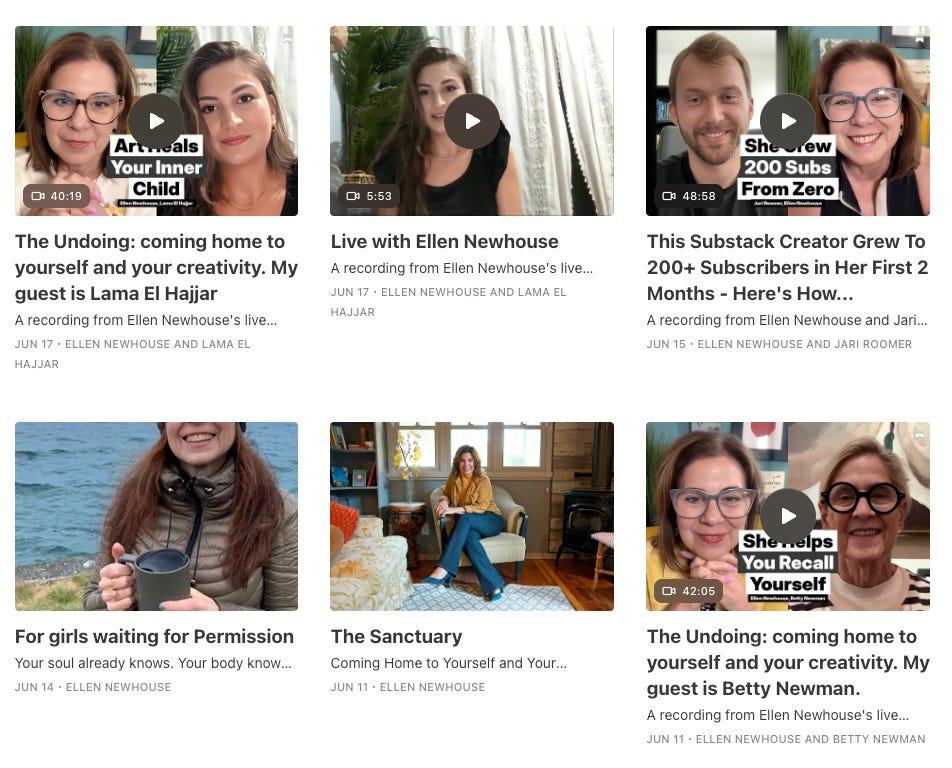
For experienced practitioners whose credibility comes through most clearly in real time, this is the feature on Substack that other platforms don’t have an equivalent of.
The paid subscriber moment that changed her thinking
Ellen had no intention of monetizing her Substack when she started.
She turned on paid subscriptions almost by accident, when one of her readers reached out and asked if there was a way to pay her. She set up the basic infrastructure, said yes, and within a week had her first paid supporter. The following Sunday, she had her second.
Neither of those subscribers got special content. There was no premium tier. There was no launch. There were no perks. They chose to pay because they valued her free work and wanted to support it.
This is the pattern we recommend to almost every new Substack creator, and the one most creators resist. Turn on paid subscriptions from day 1, even at zero subscribers, even with no premium content planned. Not because you’re promising anything, but because you’re giving the readers who already love your work a way to support it if they choose to.
Here’s the math that reframes the whole thing: the shift that happens in your own head when someone pays you for your work is one of the most underrated mechanics on Substack. It moves you from publishing into the void and hoping someone notices, to running a business with paying customers and a responsibility to keep building. That mental shift is the foundation everything else gets built on top of.
For experienced entrepreneurs who have spent a career giving freely, the work of receiving is often harder than the work of giving. Ellen’s story is the case study of what happens when you let yourself be paid for work you already love doing.
You almost never give away too much for free
The most common question we get from creators setting up paid subscriptions is where to draw the line between free generosity and paid content.
The honest answer is that you almost never give away too much in your free content.
If your free content is genuinely transformational, the readers who get value from it don’t feel cheated. They become superfans. They share your work. They buy your books, your products, and your coaching when you offer them. The free content is the trust-building engine. The paid offers are what they choose when they’re ready to go deeper.
Where the line actually sits is access, not content.
Paid subscribers shouldn’t get slightly better versions of your free posts. They should get something structurally different. Templates. Workshops. Group coaching. Community access. Downloadables. The kind of perks that don’t compete with your free content because they’re a different category of value altogether.
For Ellen, this becomes the structural question we’re working through inside the Substack Accelerator.
She’s planning to offer a 3-month intensive coaching container. She’ll likely build a paid tier with workshops, sound healings, and member-only sessions. None of that requires her to hold back her best writing. All of it amplifies the work the free content already does.
Perfectionism is the silent reason most creators stall
There’s a pattern we see across new Substack creators stalling out: posting less frequently because every post has to be perfect, watching engagement drop because the cadence is too slow, then concluding that Substack doesn’t work.
The actual problem is almost always that the creator is over-engineering each post, holding the next one until it feels “ready,” and missing the consistency required for an audience to form expectations of when to hear from them.
Here’s how to think of it instead:
Publish weekly.
Use Notes daily to fill the space between long-form posts.
Stop treating each post as a make-or-break event.
Most posts creators delay because they don’t feel finished are already 80% there, and the 80% version published this week will outperform the 100% version published in 3 weeks.
For experienced creators who care deeply about the quality of their work, the discipline isn’t lowering the standard. It’s accepting that consistency at a high standard beats perfection at an inconsistent one.
What Ellen’s story tells us about Substack right now
If you’ve been a serious coach or entrepreneur for years, and you’ve been frustrated by what social media demanded from you to get visibility, here’s the part of Ellen’s story worth sitting with:
She had 36 years of credibility, a published book, an album in production, a thriving practice, and a real audience on other platforms. She still couldn’t have built her Substack to where it is now in 5 weeks if she’d tried to figure it out alone.
The platform-specific work requires platform-specific guidance.
The creators we coach who compress months of trial and error into weeks of focused execution aren’t smarter, more talented, or more credentialed than the ones who don’t. They’re the ones who decided early that the right system and the right team in their corner were worth more than another year of guessing.
Substack rewards depth, and it favors the creators who treat it like the serious business it can be. For experienced entrepreneurs who already have the depth and now need the platform mechanics, the right structure from day 1 makes the difference between a publication that takes 18 months to find its footing and one that takes 5 weeks.
Final thought
If this is the path you want to be on, the Substack Accelerator is our hybrid coaching program where we work with you personally to build your Substack into a real business.
It’s a full year of working with us, because growing a publication you can build a career on requires more than a 12-week course and a wave goodbye.
What’s worth taking from Ellen’s story is that an experienced professional who’d already written off social media gave Substack a real chance, found the right team to build alongside, and within 5 weeks had the early foundations of the next chapter of her career.
Instead of trying to figure it out alone, she found the people who’d already walked the path, which allowed her to move fast.
We’re currently accepting applications for the Substack Accelerator. If you have the credibility, the expertise, and the decision to take Substack seriously, we’d love to talk to you about whether you’re a fit for the program.


