
I Analyzed 94,391 Substack Posts. Here's What Actually Grows a Publication.
Titles, subtitles, length, structure, timing.


Substack isn’t just a writing platform anymore. It’s one of the most powerful tools a business owners can use to attract customers and scale.
If you want to know how Substack could work for your business, fill out this form, and we’ll get back to you with a personalized assessment. 🔍
What if the reason your Substack posts aren’t getting any traction is because of your titles?
Specifically: the length, the framing, the one word you're probably not including, and the structural pattern that outperforms everything else by 60%.
Most Substack growth advice is based on gut feelings and individual experiences.
Here, we do the opposite by breaking down an analysis of almost 100k Substack post titles, so you know exactly what to do differently in the future.
Some of these findings validated things we already believed. Others made us want to go back and rewrite half our archive.
We have seven surprising findings and a clear checklist for you, so let’s dive in!
1. Title Length: The Sweet Spot Is Bigger Than You Think
The conventional wisdom is “short titles win.”
In practice, longer titles significantly outperform short ones — and the relationship is almost perfectly linear.
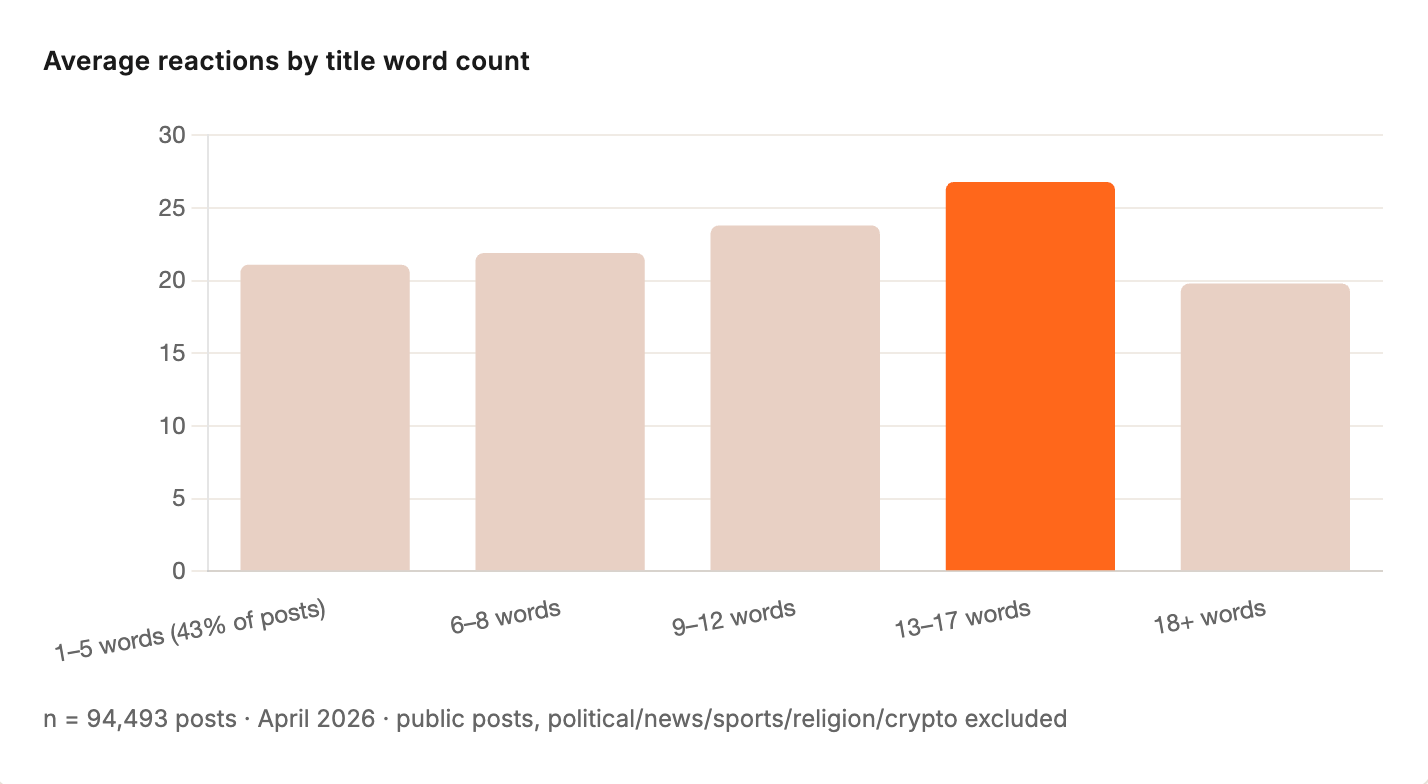
Titles with 13–17 words average 26.8 reactions.
Titles with 1–5 words average 21.1 reactions. That’s a 27% gap.
The largest bucket by far is 1–5 words (43% of all posts), which means most creators are writing the least effective title length.
18+ word titles are the one exception where performance drops off. There seems to be a real ceiling around 17 words. Past that, the title starts to read like a summary rather than a hook.
27%
Reaction gap between 13–17 word titles (avg 26.8) and 1–5 word titles (avg 21.1). The majority of creators are writing the shorter, lower-performing length.
Why this happens: A short title like “On Grief” gives the reader nothing to grab onto before the click decision.
A longer title like “The Thing About Grief That Nobody Prepares You For” delivers a partial payoff in the subject line itself — and subjects that deliver something get opened. More words also create more surface area for specificity, which earns more trust.
Three real exemplars in the 13–17 word range from April 2026:
Once you understand neuroplasticity your life will never be the same again
And the story of a woman who didn’t like her brain and built a new one
7,454 reactions · 2,511 words · 12-word title
The Real Reason Dating is So Hard Right Now (That No One is Naming)
The currency of need has officially switched sides. But dating culture hasn’t caught up to reality.
3,883 reactions · 3,648 words · 14-word title
Something Is Brewing in the Pacific That Nobody in Washington Wants to Talk About
A super El Niño is forming in the same week federal climate policy is being dismantled.
3,577 reactions · 2,434 words · 14-word title
All three follow a pattern: the title makes a claim the reader can’t fully evaluate without clicking. None of them summarize the article. All of them create mild discomfort — something is unresolved, something is missing. That feeling is the reason the click happens.
2. The Question Mark Is a Drag, Even on Posts
Our Notes study found question marks cut subscriber conversion by 35%. Posts tell a similar story, just quieter:
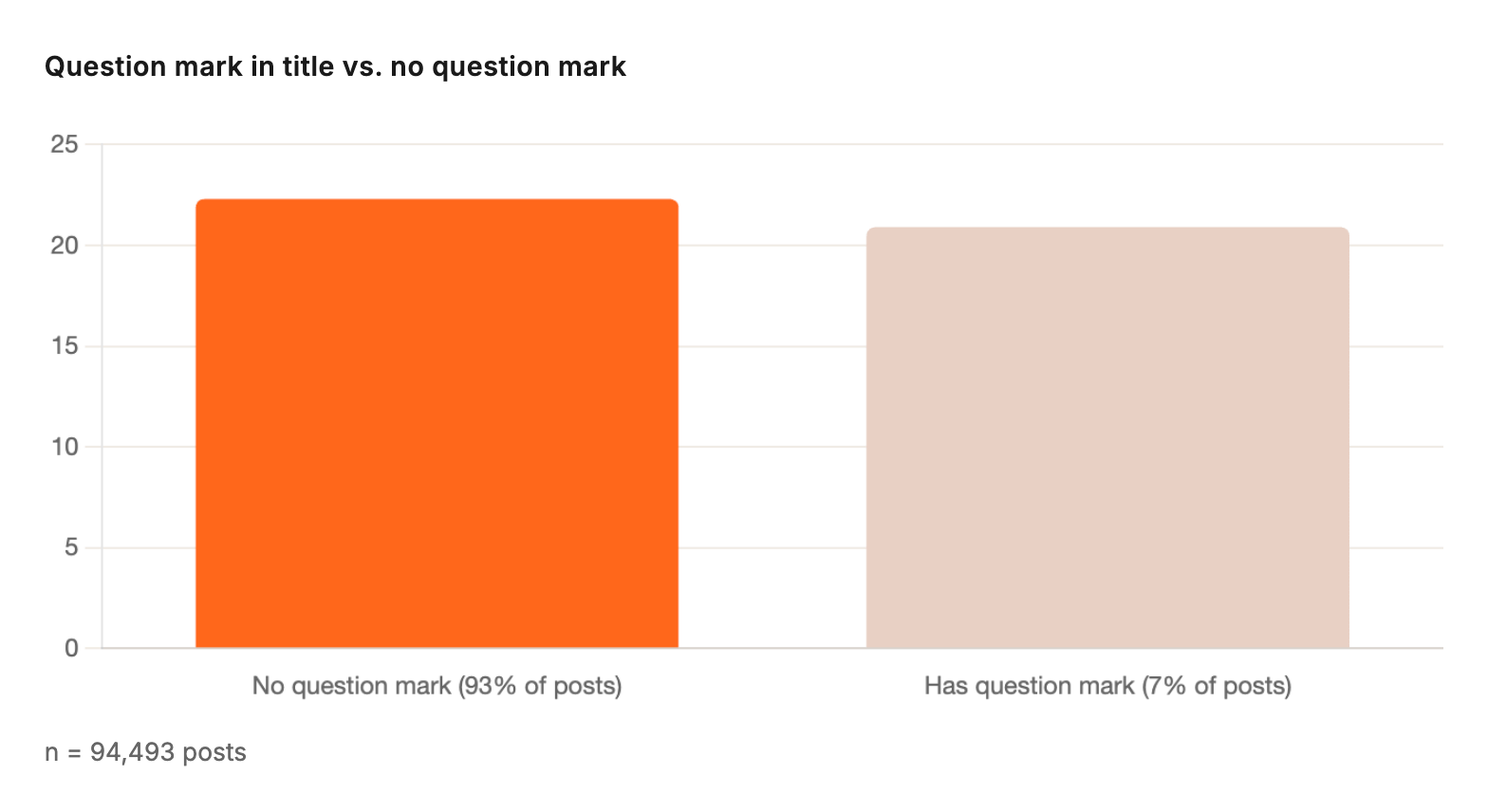
Posts with a question mark in the title average 20.9 reactions.
Posts without average 22.3 reactions — a 6.7% drop.
It’s a smaller drag than in Notes, probably because post readers are more committed (they opened the email or searched Substack; they’re already in). But the direction is the same.
The comment behavior is more interesting. Question-mark titles pull more comments per reaction (ratio of 0.314 vs 0.263 for declarative titles). Questions make people want to answer. They are comment magnets, not applause magnets. If you’re trying to spark conversation, a question title has some value. If you’re trying to grow, it doesn’t.
Anomaly: “Are Americans Just Stupid...” (with ellipsis, not a question mark) hit 7,983 reactions and 1,245 comments.
The trailing ellipsis created a stronger curiosity gap than a question mark would have — it implied a question without explicitly asking one, and left the provocative word hanging. The structure is: state the taboo framing, then trail off.
3. First-Person Titles Are the Single Strongest Pattern in the Clean Data
Across 94K posts, titles that include “I” or “My” outperform everything else by a wide margin, including second-person (”you/your”) titles.
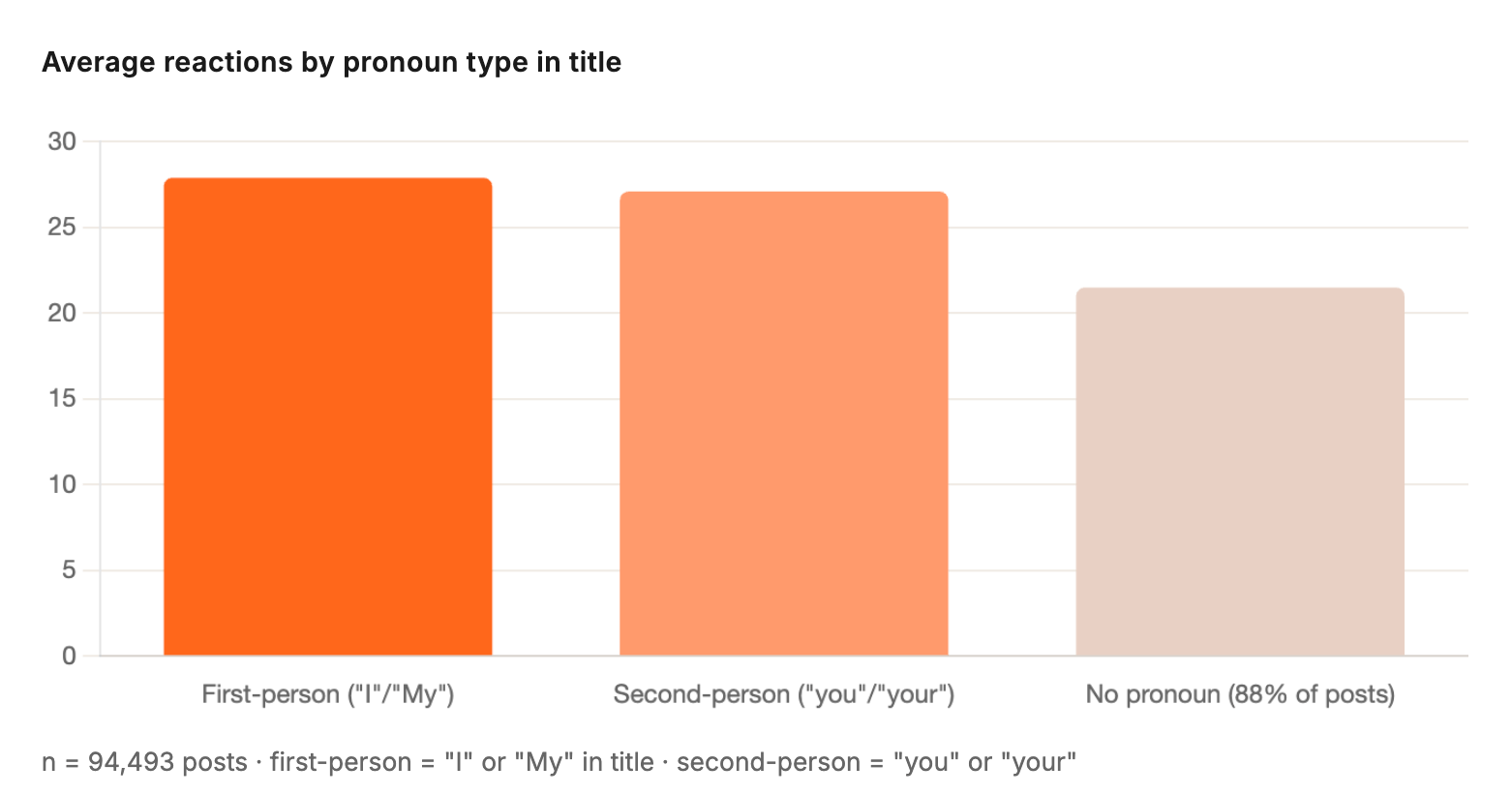
First-person titles average 27.9 reactions.
Second-person average 27.1 reactions.
Neither-pronoun average 21.5 reactions. The gap between first-person and no-pronoun is 30%.
The comment story amplifies this. First-person titles have a comment-to-reaction ratio of 0.335 — the highest of any group. They pull discussion proportionally more than any other format.
“I Got Good at Makeup and I’m Telling You Everything” (2,006 reactions) is a clean example.
“I’m begging you to write more essays” (2,147 reactions).
“I Was in DC During the Shooting. Here’s the Perverse Irony” (4,067 reactions).
30%
More average reactions for first-person titles vs. titles with no pronoun. First-person titles are only 5.5% of all posts — massively underused.
Why this happens: A first-person title makes a promise: someone is going to tell you something from direct experience. It signals testimony, not opinion.
“I Lied My Way Into a MAGA Focus Group” (4,453 reactions) works not because of the topic but because the “I” in the title says: this person was physically present, this is primary source. That’s a more credible offer than an abstract claim.
Only 5.5% of posts use a first-person title. 88% use neither pronoun. The math is simple: a high-impact move is sitting almost completely unused.
4. Post Length: Longer Wins on Raw Reactions, But Short Has Something Else
This is the clearest pattern in the dataset, and the least surprising. Longer posts get more reactions, with near-perfect linear progression up to around 3,500 words.
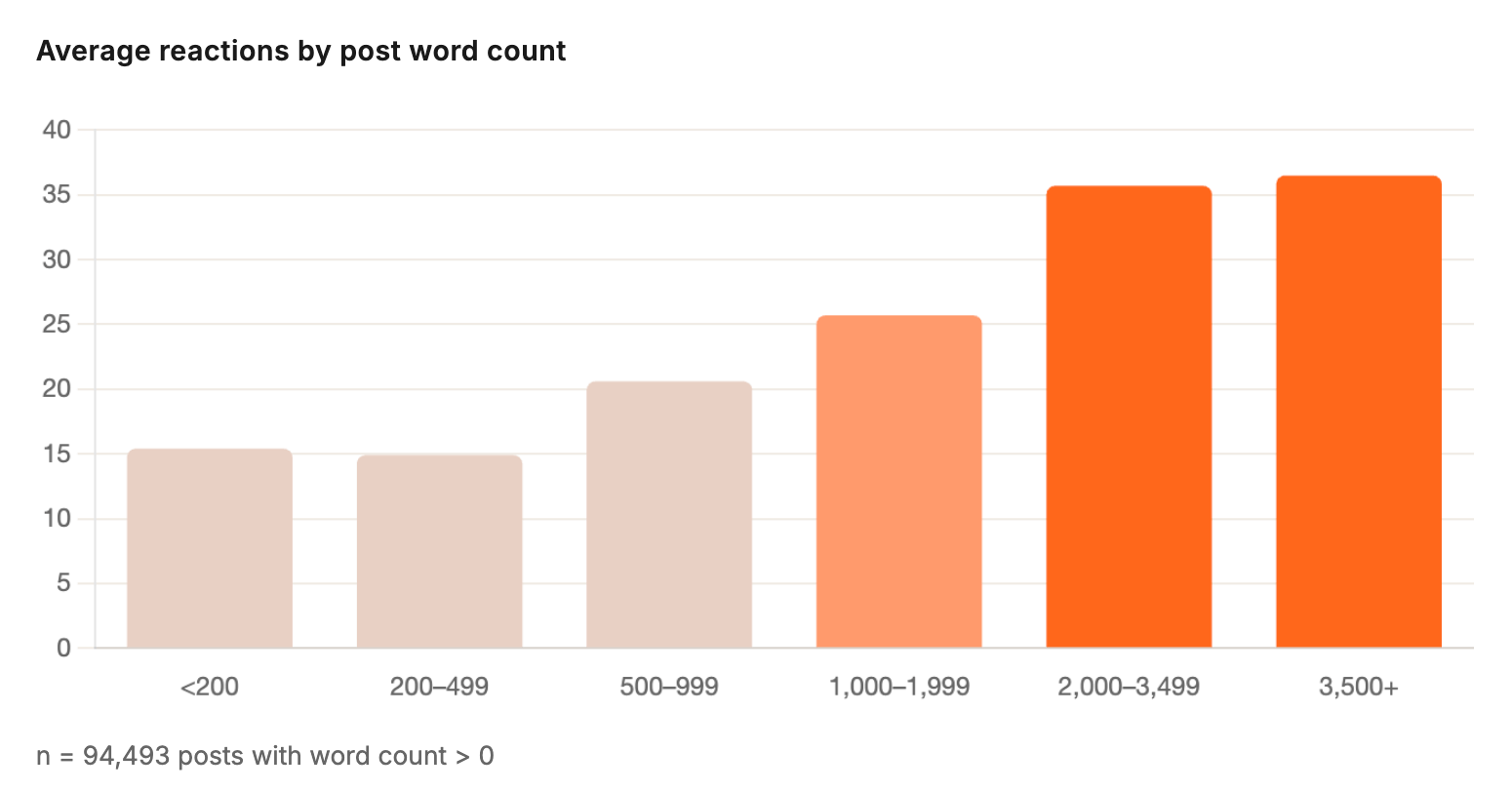
Posts over 2,000 words average 35–37 reactions.
Posts under 500 words average 14–16 reactions.
That’s more than a 2x performance gap at the extremes.
But reactions per 100 words tells a completely different story. Short posts (200–499 words) generate 4.8 reactions per 100 words.
Long posts (2,000–3,499 words) generate only 1.5 reactions per 100 words.
A 500-word post is about three times more efficient per word written.
The short-post anomaly: Several posts under 700 words hit over 3,000 reactions in April.
“Public money belongs in public schools” (427 words, 7,142 reactions) is the extreme example. Short posts that hit are not trying to be comprehensive — they are making a single, clear, emotionally charged claim and then stopping. The ceiling is lower but the floor disappears when the claim is sharp enough.
The 1,000–2,000 word range is the workhorse zone for most newsletter writers. It captures meaningful engagement (avg 25.7 reactions, median 8) without requiring the commitment of a long-form piece. If you’re not sure what length to write, 1,200–1,800 words remains defensible.
The simplest rule to follow: write as long as the idea actually needs. Don't pad to 2,000 words, but don't cut to 600 because shorter feels safer.
5. The Subtitle Is Worth More Than Most Writers Give It
Skip the subtitle and you’re leaving performance on the table. But the length matters as much as whether you have one.
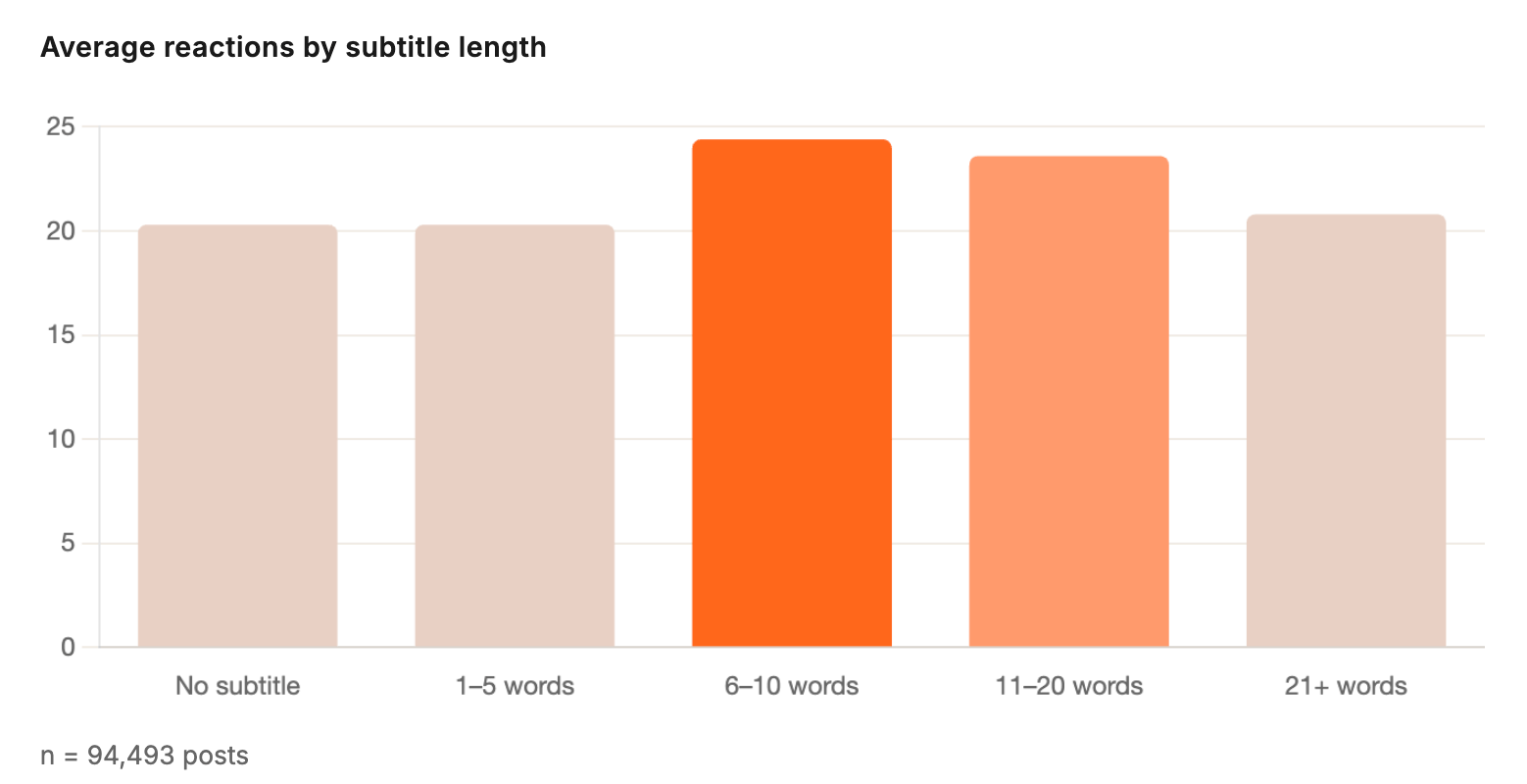
Subtitles of 6–10 words perform best (avg 24.4 reactions).
Subtitles of 11–20 words are close behind (23.6).
Both outperform no subtitle (20.3) and short subtitles of 1–5 words (20.3).
The 1–5 word subtitle performs the same as no subtitle at all. This suggests that placeholder-style subtitles — “A reflection.” “Part one.” “On letting go.” — contribute nothing. The subtitle needs to earn its place by adding a second layer of information the title didn’t include.
The subtitle performs best when it does something the title can’t. The title hooks. The subtitle either extends the promise (”And the story of a woman who didn’t like her brain and built a new one”), sharpens the stakes (”The currency of need has officially switched sides. But dating culture hasn’t caught up to reality.”), or names the payoff the reader will get.
Rephrasing the title in different words is the one move the data suggests doesn’t work.
The subtitle is where you close the deal. The title creates enough curiosity to stop the scroll. The subtitle converts that pause into an open. Six to ten words is enough to do that job without turning the subtitle into a second title.
6. Negative Framing in Titles Outperforms by 60%
Titles containing negative words (”never,” “nobody,” “no one,” “wrong,” “worst,” “hate,” “not”) outperform neutral/positive titles by a wide margin.
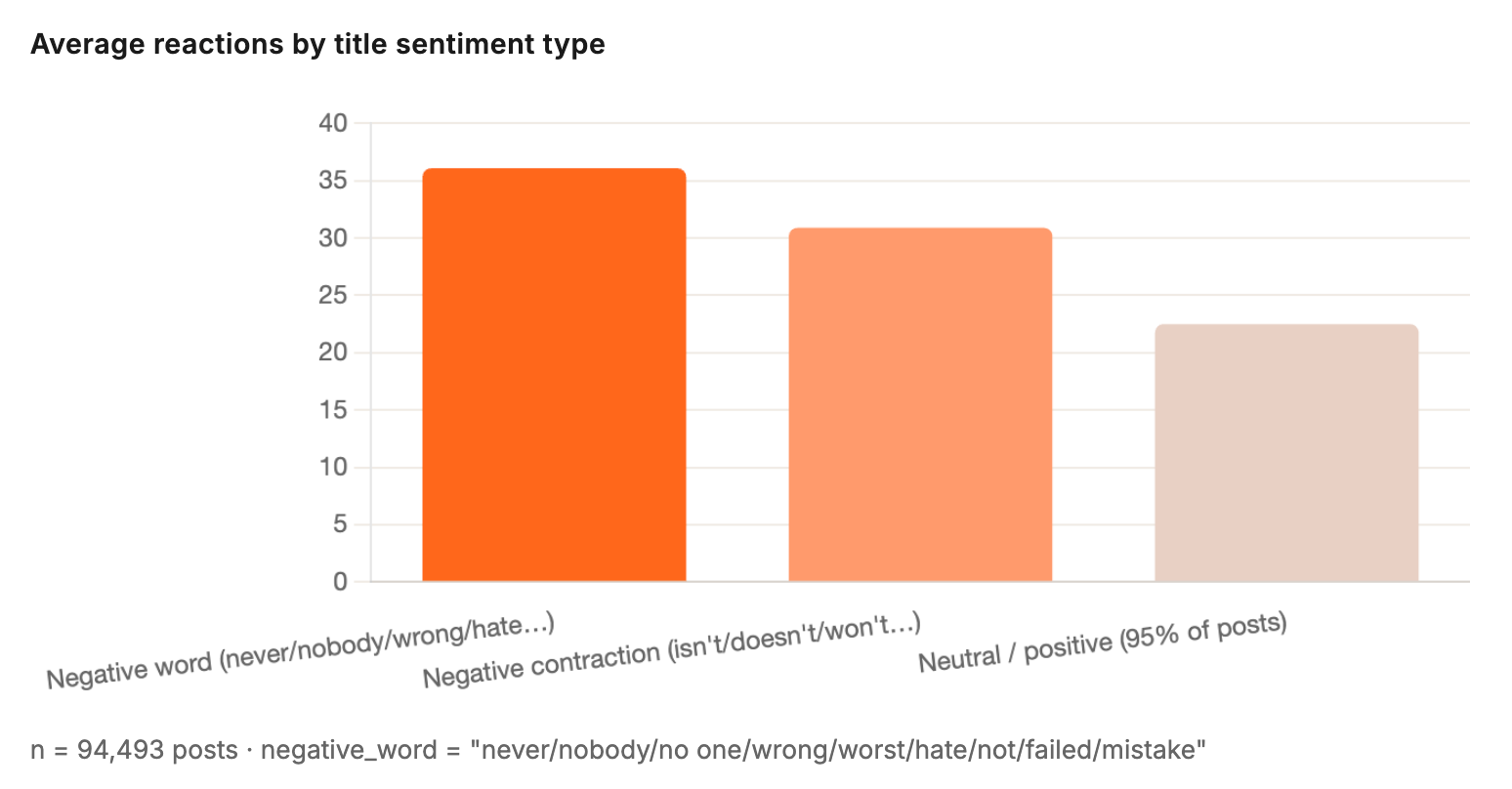
Negative-word titles average 36.1 reactions vs 22.5 for neutral/positive titles — a 60% premium. Negative contraction titles (”isn’t,” “doesn’t,” “won’t,” “can’t”) average 30.9 reactions, a 37% premium.
Combined: only 5% of posts use explicit negative framing, but they’re producing results 37–60% above average. That’s the most underused mechanical advantage in the dataset.
Why this happens: Negativity creates a problem the reader feels compelled to resolve. “Once you understand neuroplasticity your life will never be the same again” — the “never” transforms the title from information into a before/after promise.
“The 5 Most Important Skills to Learn in 2026” is fine. “5 Skills You’re Probably Ignoring That Will Define the Next Decade” operates differently in the brain. The negative word introduces a mild threat, and mild threats demand attention.
5 “Boring” Classics That Are Actually Unhinged (Once You Know What’s Really Happening) Pt. 1
Your English teacher lied to you about what these books are about
2,682 reactions · 2,164 words · “lied” + “Actually” negative reframe
The Real Reason Dating is So Hard Right Now (That No One is Naming)
The currency of need has officially switched sides. But dating culture hasn’t caught up to reality.
3,883 reactions · 3,648 words · “No One is Naming” = negative exclusion signal
7. The Number-Led Title Premium
Titles that open with a number (e.g., “5 skills,” “10 reasons,” “3 things”) outperform non-numbered titles by 47% on average reactions (34.3 vs 23.4). They also pull more comments per reaction — ratio of 0.335, tied with first-person for the highest in the data.
Only 1.6% of posts use number-led titles. Given the performance premium, that’s a significant underuse — though it’s probably self-limiting because most Substack writers deliberately resist “listicle” framing.
The comment-pull signal is important here. Number-led titles generate discussion at the same rate as first-person titles. The mechanism is probably expectation: readers who click a listicle have a clear sense of what they’re going to get, and when the reality diverges from or exceeds that expectation (either way), they comment.
8. Cover Image: A 2x Penalty for Skipping It
Posts without a cover image average 12.7 reactions. Posts with a cover image average 22.9 reactions. That’s an 81% performance gap — and 92.5% of posts already have one, which tells you that cover images have become table stakes rather than a differentiator. Not having one is now a penalty, not a neutral choice.
9. The Day-of-Week Myth: Kill It and Move On
Saturday and Sunday lead the clean dataset by a small margin, but the difference between the best day (Saturday, 25.2 avg reactions) and the worst day (Thursday, 22.3) is 2.9 reactions. All seven days have an identical median of 6 reactions.
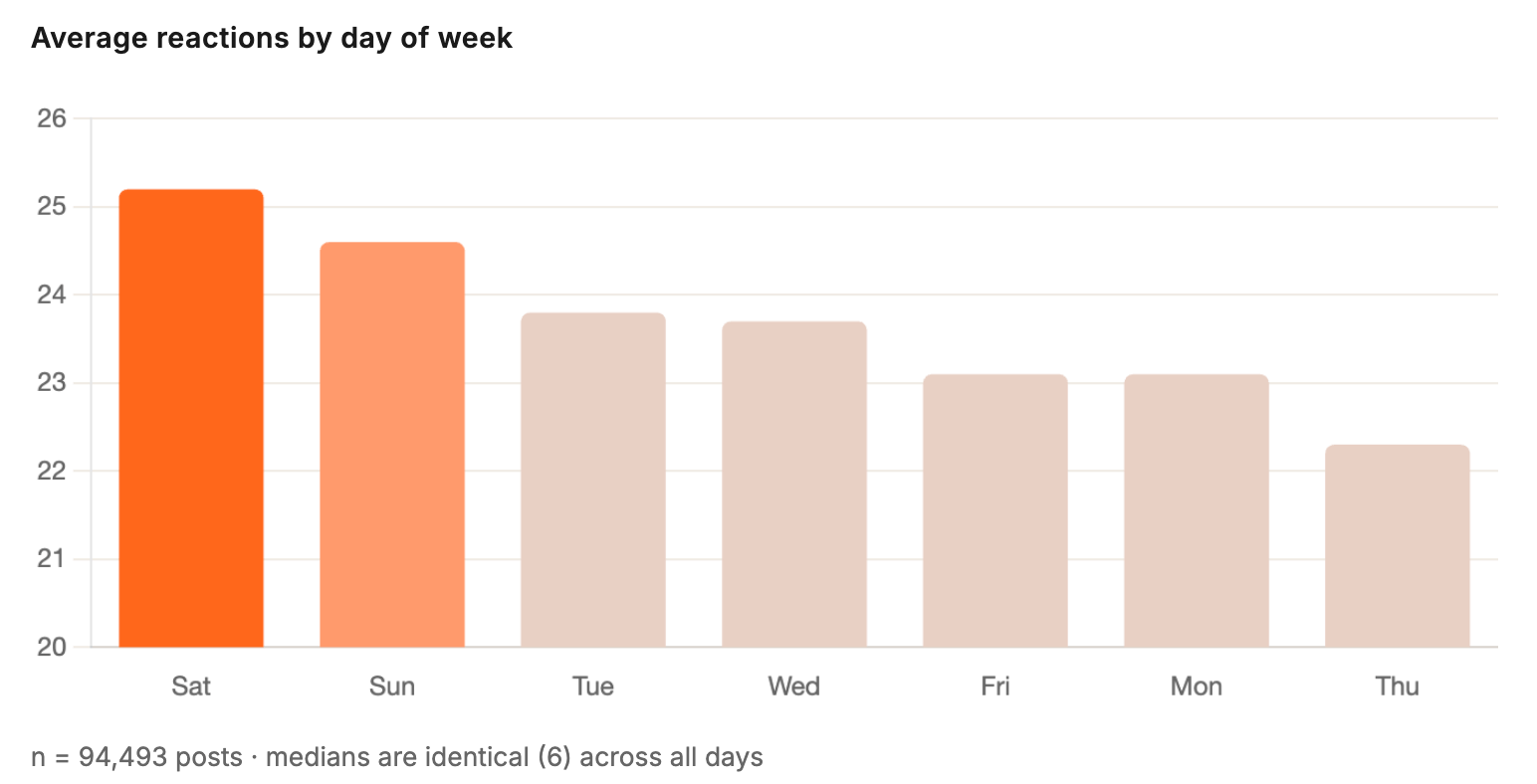
Publish when you’re ready. This signal is too small to plan around. The 2.9-reaction gap between Saturday and Thursday is within noise range for individual posts, especially given that post quality and publication size are uncontrolled variables in this dataset. The creators building large audiences are not coordinating on Tuesday morning. They’re writing better posts.
5 Patterns That Didn't Fit the Rules (But Still Performed)
The discussion-magnet structure nobody talks about
The posts with the highest comment-to-reaction ratios across the clean dataset are not the posts with the most reactions. The comment champions are “open thread” style posts and community-reply prompts. One newsletter running “Wednesday Open Reader Thread” posts is generating 500–600+ comments on posts with under 70 reactions. The mechanism: the title itself signals that commenting is the expected behavior.
For standard essay newsletters, the discussion-magnet title type is the first-person challenge or confession.
“I Got Good at Makeup and I’m Telling You Everything” pulls more proportional discussion than “How to Get Good at Makeup.” The “I” creates personal stakes that readers want to engage with.
The subtitle that matches the title performs worse
1–5 word subtitles perform the same as no subtitle (both average ~20.3 reactions). Short subtitles are almost always restatements: “A reflection.” “Some thoughts.” “Part two.” The data is consistent: if your subtitle is rephrasing the title, you’d be better off having no subtitle and letting the title carry the full weight.
Long titles on short posts work fine
The assumption is that a long title needs a long post to justify it. The data doesn’t support this.
“Your Virginity Is Not For Your Husband” (7 words, but a strong declarative with implied provocation) hit 6,464 reactions on a 1,764-word post.
“Public money belongs in public schools” — a 6-word declarative title — hit 7,142 reactions on a 427-word post. Title performance and post length are largely independent. The title sells the click; the post earns the reaction.
The lowercase title anomaly
Several high-performing posts use all-lowercase titles: “you need to be making monthly 10 lists” (2,644 reactions), “the thrill of living privately” (2,599 reactions).
This is not a systematic pattern with enough volume to quantify, but it appears consistently enough in the top quartile to be worth noting.
The lowercase title reads as a Note aesthetic applied to a post — intimate, not broadcast. Whether that creates a selective attention effect (it looks different from every other title in an inbox) or whether it simply attracts writers who have already built loyal audiences, the data can’t say. Worth watching.
The curiosity-gap title with a parenthetical outperforms both elements
Titles using the structure [statement] + [(what you didn’t know)] outperform plain declarative titles.
“The Real Reason Dating is So Hard Right Now (That No One is Naming)” and “5 ‘Boring’ Classics That Are Actually Unhinged (Once You Know What’s Really Happening)” both use the parenthetical to add a second layer of intrigue after the first hook. This is a title structure worth building deliberately into your drafts.
The Checklist: What the Data Actually Tells You to Do
These are the mechanical changes with the clearest support in the dataset. Each one is independent — you don’t have to do all of them to see improvement.
Title length: Aim for 9–17 words. The average writer is defaulting to 1–5 words (the lowest-performing bucket). Adding specificity and framing takes you into the sweet spot without sacrificing clarity.
❌ On Burnout
✅ What I Wish Someone Had Told Me Before I Burned Out Completely
First-person title: The single highest-performing pattern in the clean data, used by only 5.5% of posts. Put “I” or “My” in the title whenever the post is based on direct experience.
❌ The Problem With Hustle Culture
✅ I Quit the 12-Hour Days. Here's What Actually Changed.
Negative framing: 60% reaction premium, 5% of posts. Attach a loss-frame or exclusion signal to the title’s core claim.
❌ How to Write Better Emails
✅ The Email Habit Nobody Talks About That’s Killing Your Relationships
Subtitle: 6–10 words, adds a new layer. The subtitle that extends or stakes the title outperforms the one that rephrases it. Skip the subtitle entirely rather than write a 1–5 word placeholder.
Title: I Quit Social Media for 90 Days
❌ Subtitle: Some thoughts on the experience.
✅ Subtitle: And what it revealed about the gap between my real and performed self.
Post length: Long-form (2,000+ words) wins on raw reactions. Short-form (under 500) wins on reactions-per-word-written efficiency. The 1,000–2,000 word range is the most defensible for consistent output. Don’t write 600 words when 1,400 will serve the idea better.
Cover image: Not having one is an 81% reaction penalty. Non-negotiable.
Day of week: Does not matter. Publish when the post is ready.
If the scheduling gap is what's actually holding your posts back, WriteStack will save you.
Import your drafts, batch-schedule them, and keep a 2–4 week runway without the daily scramble.
The data on consistency is clear: showing up reliably matters more than any single title tweak.
We want to hear from YOU!
Each month Orel from WriteStack runs an exclusive data study for the Write • Build • Scale community.
Last month, we analyzed over 9,600 Substack Notes to find out what actually drives engagement when you post short-form content on Substack.

This is what we’re committed to at Write • Build • Scale: no-bullshit information for Substackers. No recycled advice dressed up in new packaging. No “trust your gut” disguised as strategy.
If we’re going to tell you something works, we want data behind it — not just a feeling.
And that means we need to know what YOU want to see next.
Drop a comment below: what would you most want us to analyze next? The best suggestion might just become next month’s study.
Methodology note.
Dataset: 94,391 public Substack posts from April 2026.
Excluded: political news, religion, sports, crypto, stocks, and niche-interest newsletters (see detailed exclusion list in the linked data note).
Metrics used: reactions (likes) and comments. Publication size is not available in this dataset, so all performance comparisons are raw rather than normalized.
Posts from the same publication may cluster; findings represent cross-Substack patterns, not single-account experiments.
 | A guest post by
|
The data exposes something most writers won’t admit: they’re optimizing for what feels bold and what looks minimal. Short titles feel punchy. No question mark feels confident. But the data says those instincts are backwards.
What’s actually happening is a trust gap. First-person titles, negative framing, longer specificity, they all do the same thing: they make a promise the reader can verify. “On Burnout” asks the reader to take a leap of faith. “What I Wish Someone Told Me Before I Burned Out” gives them something to grab before they decide to click.
35 years of communication taught me this: people don’t engage with ideas. They engage with people who seem to have lived them. The “I” in the title isn’t ego – it’s evidence. And evidence earns the open.
Good stuff.
Unlike most of these how I built a Substack with more subscribers than the population of Tokyo while you drank your morning coffee, this post was really helpful. Love the data driven approach!