
I Helped 1,000+ Creators Build Substack Businesses. Here's the Pattern That Keeps Most People Stuck
And why it has almost nothing to do with writing.

Most Substack advice is built for people who want to grow a newsletter. If you're a coach, a consultant, or an expert who actually wants this platform to make you money, that advice is quietly working against you.
This post is different. It’s for you if you want to build a publication that actually generates revenue, converts free subscribers into paying members, and positions you as an expert so Substack becomes a real lead generation machine for your business.
That’s a different goal from just building a newsletter. And it needs a different approach.
The Real Problem Isn’t the Platform
The creators who struggle the longest are almost never struggling because of a platform problem. They’re not missing a feature, and they’re not behind on trends.
What they’re missing is a strategy: A clear picture of why someone should subscribe, what happens after they do, and where the revenue actually comes from.
And here’s the part most people skip past too quickly. Substack will give you a beautiful publication. It will let you publish, set up a paid tier, and help you show up in people’s inboxes. But it won’t tell you that the paid tier will sit empty if there’s no clear upgrade path. It won’t tell you that publishing alone, without a visibility strategy, is mostly just writing into the void.
This is the pattern I see constantly: Creators who are talented, who have real expertise, who’ve been publishing for months, and who are stuck at a few hundred subscribers, wondering what they’re doing wrong.
And the answer usually isn’t the quality of their ideas or writing. It’s everything around the writing.
One of our coaching clients, Mandeep Kaur, is a perfect example.
Mandeep is a transformational coach who spent 30 years in Fortune 500 companies before making a full career change at 51. She came to us without even having a publication up and running yet. When we asked her why she joined our private coaching program instead of figuring it out alone first, she said something that stuck with me.
“I was looking for something that was just easy and simple. I didn’t want to sit there and overthink the writing and the logo and the name. Just begin. Just write.”
A few weeks later, Mandeep crossed 100 subscribers from a standing start, and frankly, going from 0 to 100 is harder than most people realize. The early stages are the hardest part of building anything: You’re doing all the groundwork with none of the credibility, none of the existing audience, and none of the momentum. Once you have those things, growth compounds. But getting there from 0 takes real commitment.
From 30 Years in Fortune 500 Companies to Building a Coaching Business on Substack

In this episode, I’m joined by Mandeep Kaur, who spent 30 years in Fortune 500 companies before reinventing herself as a transformational coach and founder of Awaken • Align • Ascend on Substack.
Why Subscriber Count Is the Wrong Number to Chase
One of the most common questions we get is some version of: “What’s the fastest way to grow my subscriber count?”
And I understand why people ask it. The subscriber count is visible. It’s the number on your profile, the number that feels like proof you’re building something valuable.
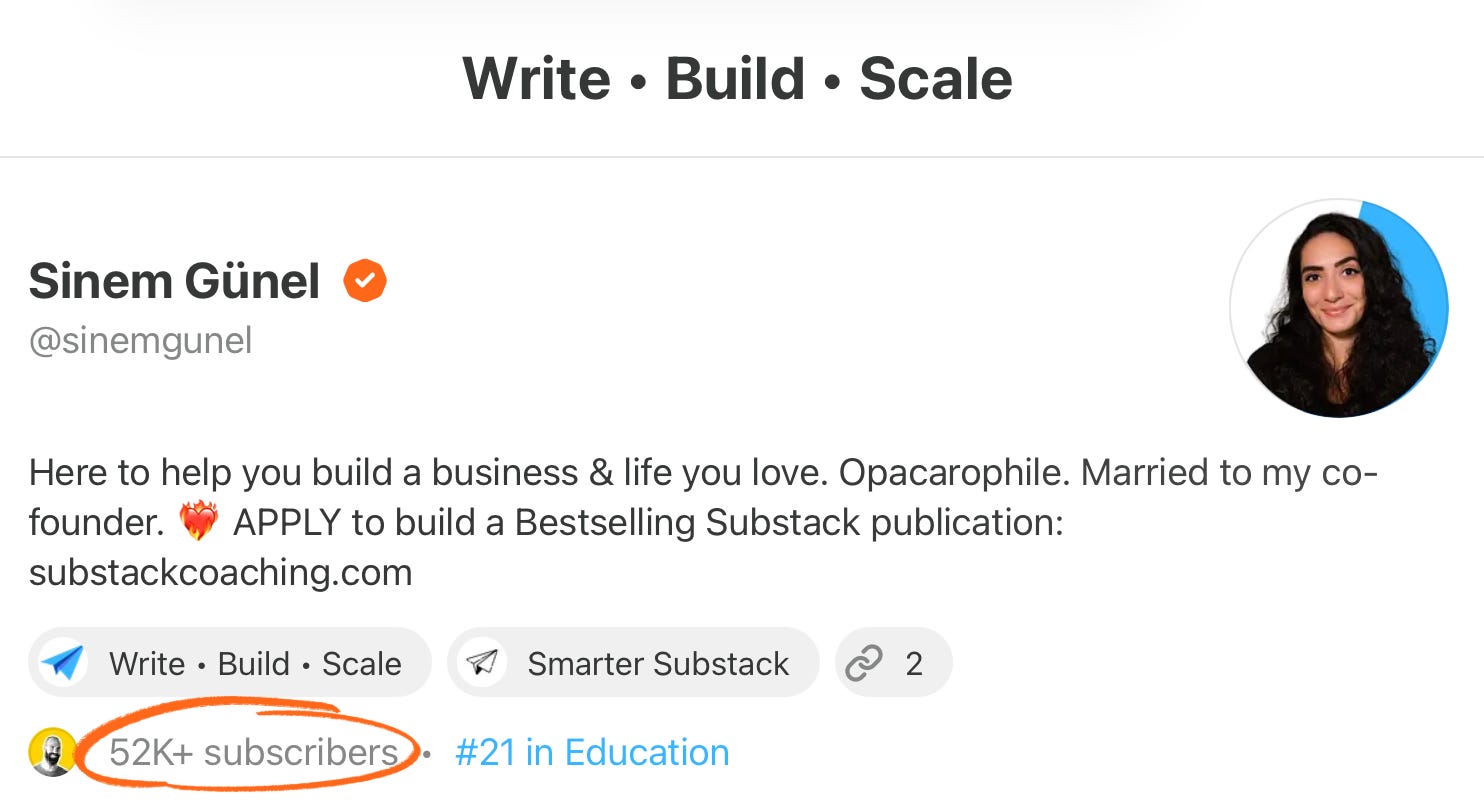
But the creators who focus on growing the number often grow more slowly than the ones who focus on building a real connection with a real audience.
A great example of this is our client Raquel Devillé.
Raquel is a somatic therapist who writes about trauma, stress, and the nervous system. And she writes in French. When she started taking Substack seriously at the end of last year, she didn’t have a massive head start. She wasn’t coming from a huge social following. She was writing in a language that puts you in a smaller pool on the platform by default.
Today, she’s at over 3,000 subscribers and on the edge of becoming a Substack Bestseller with over 100 paid members.
And that’s not because she gamed the algorithm, but because the people who come across her work genuinely enjoy it and want to hear from her.
Raquel does livestreams, uses photos of herself, and writes personal Notes.
She isn’t hiding behind a logo or a brand, she’s showing up as a real person, talking about things she actually cares about, with real warmth and expertise. When you do that consistently, people don’t just subscribe. They stay. They tell their friends. They upgrade to paid because they trust you, not because you ran a strong marketing promotion.

You can’t automate trust, but you can build it faster than you think, if you’re willing to let people see you.
One practical lever that compounds quickly is Notes. Our own Notes generated over 10,000 subscribers without massive viral hits.
Leveraging Substack Notes isn’t just about more value but about having a system you can repeat without burning out. If you want the shortcut, we packaged ours into 365 Substack Notes Templates — a year of plug-and-play prompts so you never stare at a blinking cursor again.
The Paywall Mistake That Quietly Kills Revenue
Here’s a mistake I see constantly that is killing your growth on Substack, even if you do a lot of things right: Most creators hide their paid tier.
They don’t do it on purpose. They just don’t know how to build the infrastructure that makes it easy and obvious for readers to upgrade. They have a paid tier. They’ve got good content behind it. But if you land on their publication as a free subscriber and want to upgrade, you’d have to scroll through the archive, hunt for a button, and hope you can figure out what you’re actually paying for.
That’s a navigation problem, and frankly, if people have to work to give you money, most of them won’t bother to take the next step.
What we teach our clients, and what we do ourselves, is to treat the paid tier like a product, with its own dedicated page.
A “Become a Member” page is essentially a landing page for your paid tier. It clearly explains what paid subscribers unlock, lays out the pricing, and features testimonials from existing paid members. That kind of social proof pushes someone from curious to committed.
Two of our clients, Yordan and Susan, have both built this beautifully.
Yordan’s page lays out exactly what you get when you upgrade: The specific resources, the perks, the testimonials. There’s no guesswork. You land on it, and within a few seconds, you know whether this is right for you.
Susan’s page does the same thing from a slightly different angle: Clear breakdown of benefits, real quotes from paid subscribers, and a frictionless path to upgrade.
Both pages do the selling for the creator.
Compare that to Substack’s default subscription page, which gives you 3 or 4 bullet points and not much else:
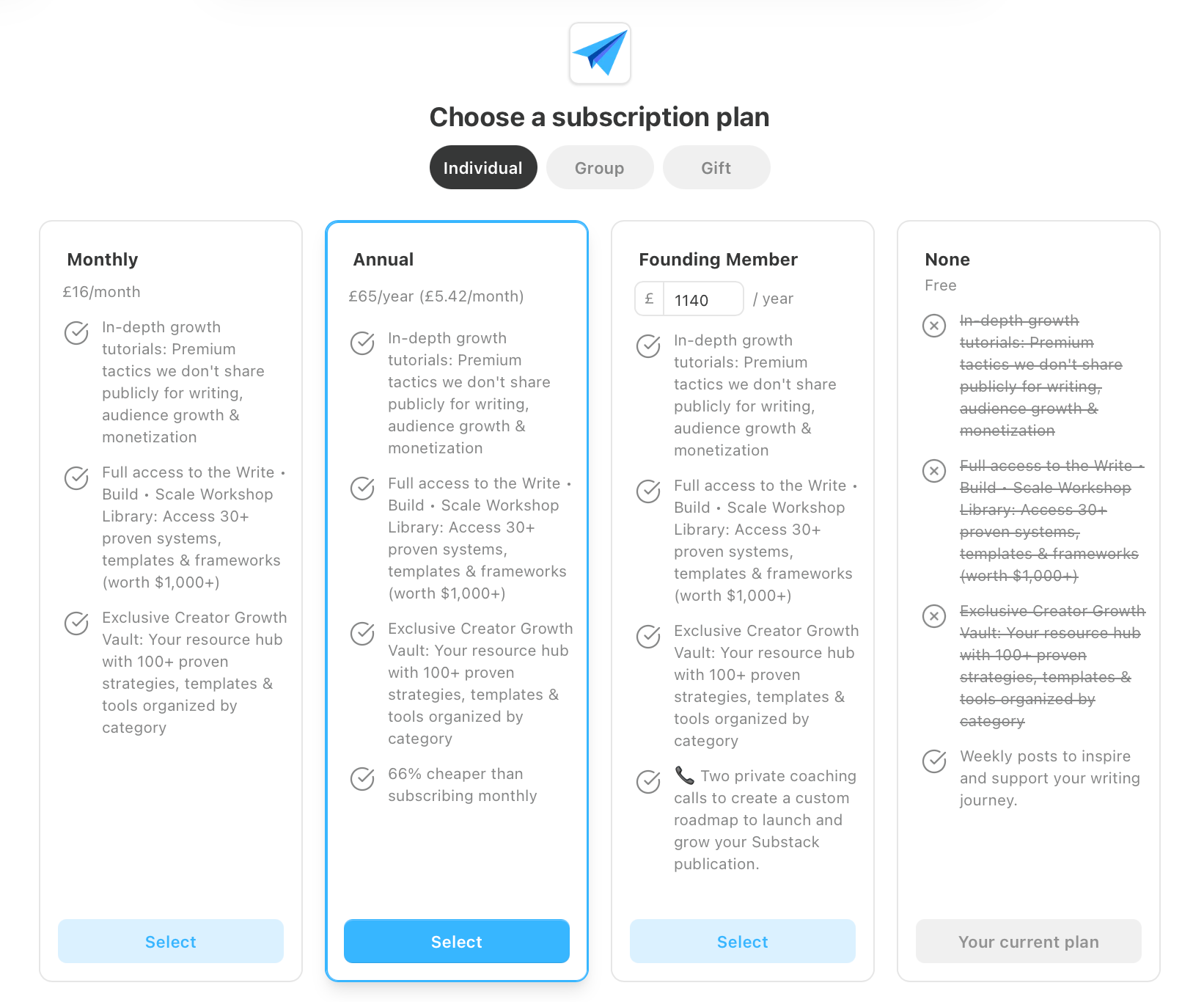
Technically, this page is functional, but it’s not a strong marketing asset working in your favor.
The other piece of this is how you structure the content itself.
For example, we never lock a full article completely behind the paywall. Instead, our free subscribers get a real taste of the value we provide right away, and then the paywall arrives at the point where they want more.
On Substack, your revenue won’t just come from working harder, it’ll come from removing friction.
If you’re already publishing consistently but your paid tier isn’t growing, our Substack Accelerator could be your next right step.
You’ve done the hard part of showing up, and now you need the conversion infrastructure underneath it. Inside the program, we audit your Become a Member page, your paywall placement, your upgrade path, and everything else that is influencing your growth.
→ Apply for the Substack Accelerator
Why Most Publications Stay Small
I want to be honest with you here, because this post is supposed to be a real breakdown, not a showcase.
Working with 1,000+ creators teaches you the patterns of success as much as it teaches you the patterns of failure.
And the most common one is overthinking, which shows up in different forms:
Waiting until the publication looks perfect before publishing.
Spending 3 months on a content strategy document instead of writing articles.
Deciding you need more clarity on your positioning before you can talk about your paid tier.
All of these feel like responsible moves. They feel like you’re doing the work.
But what they actually do is protect you from the thing that would actually move the needle: Showing up, being visible, and letting real people tell you what they think.
In our interview with Mandeep, she put it better than I could:
“In my previous life, I worked with the CEOs of huge pharmaceutical companies. And I know what it’s like when everything has to look polished. But what people are truly seeking is your authenticity.”
That shift, from “I need to look professional” to “I need to be real,” unlocks growth for the next level.
The second pattern is people building in isolation.
They watch videos. They read articles. They collect information. But they never get feedback on their specific publication, their specific niche, their specific monetization setup.
But Substack is a team sport.
The platform is built for collaboration: Recommendations, guest posts, co-authored content, and livestreams with other creators.
The people who treat it like a solo game, heads down, just publishing and hoping, are fighting against the grain of how the platform actually works.
And the same is true when it comes to building your business on Substack. The fastest version of this is almost always working with someone who can look at your specific situation and tell you what to do next.
What works for a business coach is different from what works for a somatic therapist writing in French, which is different from what works for a former Fortune 500 executive starting over at 51.
Substack strategy is not one-size-fits-all. The people who treat it that way stay stuck for a long time.
What the Trajectory Actually Looks Like
I want to close with a real look at what this takes, because a lot of people come to Substack with either too much optimism or too much pessimism, and both are expensive.
Too much optimism means expecting viral growth in week one and quitting in month 3 when it hasn’t happened.
Too much pessimism means never starting at all, because it feels like the space is too crowded, too established, too hard to break into.
The reality is somewhere in the middle, and it’s more encouraging than most people expect.
We started our publication 2 years ago.
Today we’re serving 50,000 subscribers and almost 2,000 paying members, but that didn’t happen overnight. There were months with slow growth. There were experiments that didn’t work. There were posts we put a lot of effort into that flopped.
But the compounding is real.
The Notes we published consistently generated more than 10,000 subscribers without big viral moments.
The recommendation partnerships we built generated 9,000+ subscribers almost on autopilot.
And the creators we’ve worked with prove what happens when you combine the right strategy with genuine consistency and a willingness to actually show up.
Remember: The platform doesn’t reward the people with the biggest existing audience. It rewards the people who treat their publication like a business, build the right infrastructure under it, and stay in the game long enough to compound.
Where to Go From Here
If what I’ve shared here lands for you, and you’re a coach, consultant, or expert who wants Substack to actually move the needle in your business, we’d love to chat about how we could support you.
The Substack Accelerator is our coaching program for creators who want the strategy, the templates, and the feedback loops to stop guessing and start compounding.
Apply for the Substack Accelerator →
What’s the single biggest thing keeping you stuck on Substack right now? Drop it in the comments and let’s chat. 💬
Thank you so much! The work we've been doing together has given me so much clarity for Substack. I love it here and it's thanks to you!
Hi Sinem! I’ve just started my Substack, and I wanted to thank you for your videos—they’ve been incredibly helpful as I’m getting started. I really appreciate you sharing your knowledge. Wishing all of us a growing community around our pages, where people can come to learn, share ideas, and inspire one another. All the best!