


For the past 365 days straight, I’ve done one thing without exception:
I published a Substack Note.
On most days, I’d publish three. But always at least one.
After publishing so many Notes, I learned a lot about what actually works when it comes to publishing Notes that get good engagement and bring in new subscribers to your publication.
In today’s post, I want to share the three biggest lessons I've taken away from a full year of posting Notes - and how you can apply them to your own Substack right now.
Let's dive in.
Lesson 1: Notes = Discovery Engine
Between my co-founders (Sinem Günel & Philip Hofmacher) and me, we’ve generated 10,000+ subscribers directly through writing Substack Notes.
That’s a significant chunk of our overall audience.
It wasn’t because a handful of Notes went viral and blew everything up overnight. The growth was gradual. It compounded.
It was the direct result of showing up consistently, day after day, not of chasing or waiting for a viral moment.
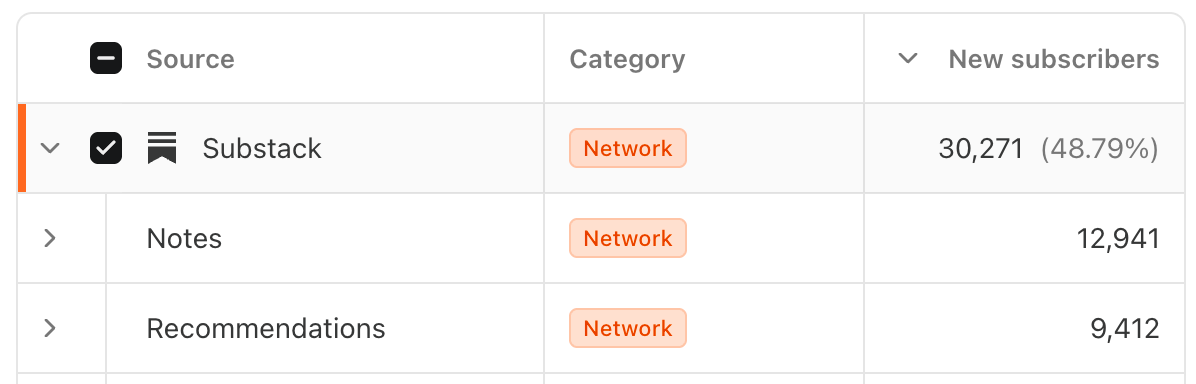
When you publish a Note and it gets good early engagement (likes, comments, restacks), the Substack algorithm picks up on those signals and starts distributing it to more and more people who could be interested in the topic.
People who don’t follow you yet. People who’ve never heard of your publication.
That’s when Notes become a discovery mechanism: someone sees your Note in their feed, finds it interesting, clicks through to your profile, checks out your publication, and subscribes.
Your long-form newsletter, by contrast, mostly reaches people who are already on your list. Notes are how you reach the people who aren’t yet.
But the algorithm rewards consistency and punishes the opposite.
Publishing ten Notes in one day and then going quiet for a few days doesn’t work.
What works is showing up every day. At a minimum, one Note per day. If you can do two or three, even better, as more touchpoints mean more opportunities to be discovered.
For me, three Notes per day has become the sweet spot. It sounds like a lot, but the way I make it sustainable is by batch-producing.
Every Monday afternoon, I block one hour and write all 21 Notes for the week. I then schedule them using WriteStack, so it’s completely hands-off for the rest of the week.
(Substack now also has a native scheduling feature built in, which is a real game-changer that wasn’t available until recently.)
Batching means I only have to get into “Note-writing mode” once a week instead of every single day.
And it means that even on days when I’m busy, travelling, or just not feeling inspired, Note are still going out.
Consistency doesn’t require much willpower if you build the right system around it.
Lesson 2: Notes Bring You Loyal Readers & Paying Customers
Most people think of Notes primarily as a way to attract new subscribers. And they absolutely are that.
But after a year of doing this, one of my biggest realisations is that Notes are equally powerful — maybe even more powerful — for deepening the relationship with your existing audience.
When we look at our Notes analytics, we generate tens of thousands of impressions every single month.
More than half of those impressions come from people who are already on our list.
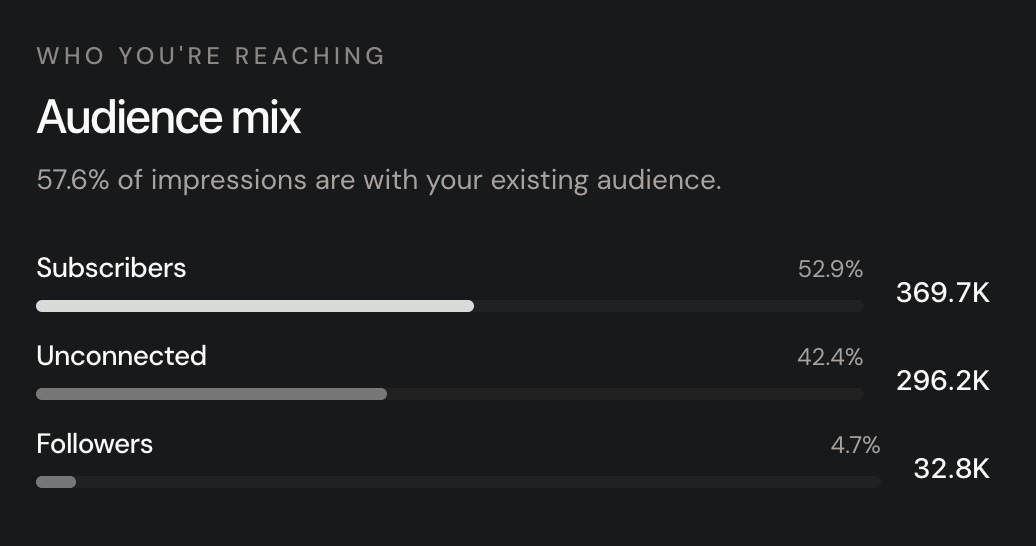
All these additional touchpoints our existing audience has with us turn casual readers into loyal subscribers and paying customers.
There’s a concept in psychology called the mere exposure effect:
The more often you’re exposed to a person or a message, the more connected you feel to them.
That’s exactly what’s happening when someone sees your name in their Notes feed every day.
You become more top of mind. They feel like they know you better. They start liking and trusting you more — simply because you show up more often.
And that trust is what converts readers into paying subscribers and customers.
Out of the 21 Notes I publish every week, I mix between three different types of Notes that I’ve found perform the best.
These three types are:
Educational Notes: Quick tips, actionable insights, practical how-tos. Content that people can immediately apply. These consistently perform well because people love to learn something useful.
Inspirational Notes: Content that shifts someone’s mindset, builds their self-belief, or gets them ready to take action. These often have the highest emotional impact and tend to be the most viral, because an emotional response drives shares and restacks.
Personal Notes: A glimpse of who you are beyond your topic of expertise. What you believe. What you love. A bit of behind-the-scenes from your life. You don’t have to treat this like Instagram (I’m actually a pretty private person, and I’m selective about what I share), but letting your audience see you as a real human, not just a content creator, builds a level of personal connection that nothing else can replicate.
All in all, think of Notes not as a broadcast channel, but as a daily conversation.
One that keeps you relevant, keeps you top of mind, and keeps building the relationship that makes everything else — paid subscriptions, product sales, collaborations — possible.
Unlock 365 Substack Notes Templates
If you are serious about growing on Substack, you really can’t miss out on Notes.
But we know that showing up every single day can feel like a massive burden. That’s why we have created 365 Notes templates for you.
You can get full access for only $47 right now.

Lesson 3: Use the 10-5-1 Rule for More Engagement
Many new creators treat Notes like a broadcast channel: publish a Note, close the app, move on. Rinse and repeat.
Publishing consistently is the foundation — I can’t stress that enough.
But if you’re only publishing and never engaging with other people’s content, you’re leaving a lot on the table.
Notes is a social feed, not just a publishing tool. And the creators who grow fastest are the ones who combine consistent publishing with consistent engagement.
My business partner Philip developed a simple framework for this that we now recommend to everyone we work with: the 10-5-1 rule.
For every Note you publish, you also:
Like 10 Notes from other creators in your niche or an adjacent one
Leave 5 thoughtful comments on other people’s Notes or posts
Send 1 DM to another creator
If you publish multiple Notes per day, you don’t necessarily have to run through the full 10-5-1 for each one — do it at least once daily, and adjust based on how much time you have. But make it a habit.
Every time you leave a genuinely insightful comment on someone else’s Note, you’re putting your name in front of their entire audience. People read comments.
If your comment adds something real to the conversation — builds on the idea, offers an additional insight, shares a relevant experience — some of those readers are going to click your profile out of curiosity. That’s free visibility.
The likes and the DM serve a different purpose: they build relationships.
When you like someone’s content or leave a comment, they get a notification. They see your name. They check out your profile.
Over time, those small repeated signals accumulate into a real relationship.
And that one daily DM is one of the most powerful relationship-building habits you can build on this platform.
Those relationships are what lead to the collaborations that drive serious growth: guest posts, joint Substack Lives, podcast appearances, and newsletter recommendation exchanges.
All in all, the 10-5-1 rule isn’t engagement for engagement’s sake; it’s a systematic way to build visibility and the kinds of relationships that open real doors.


