
Why Smart Creators Are Moving to Substack Right Now
You don't need expensive tools. You need the right method.

Most creators spend years building audiences on platforms they don’t own.
And then they wonder why they’re still broke.
Here’s what nobody tells you about making money online: the tools don’t matter nearly as much as the model.
I’ve watched creators spend $500 a month on email software, course platforms, and fancy websites—and earn $0 in return.
And I’ve watched creators build $10,000-a-month businesses using entirely free tools.
The difference isn’t budget. It’s the method.
Over the past 18 months, we’ve grown the Write • Build • Scale publication on Substack to over 1,000 paid subscribers.
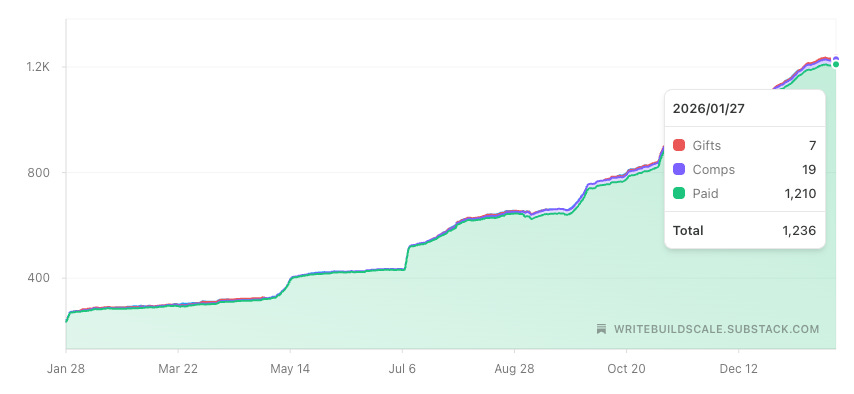
In this piece, I’m breaking down the exact method—step by step—so you can do the same.
Why Substack Is Built for Business
Let me start by showing you what most creators get wrong: They treat platforms as places to post content. They build followers on social media, maybe start a blog, perhaps launch a podcast. They create content everywhere but own nothing.
Here’s the issue: followers aren’t customers.
Likes aren’t relationships.
And views aren’t revenue.
I’ve seen creators with 100,000 followers who can’t pay their rent. And I’ve seen creators with 5,000 subscribers who’ve built six-figure businesses.
The difference is that the second group built on a platform designed for business, not just content.
Substack is not just a social network, and it’s not a blogging platform. It’s business infrastructure disguised as a writing tool.
Let me explain what I mean.
You own every relationship from day one. When someone subscribes to your Substack, you get their actual email address. Not algorithmic access. Not “reach.”
This matters because email is still the highest-converting channel for selling anything online. And on Substack, building an email list happens automatically every time someone hits the subscribe button.
The platform actively helps you grow. Most platforms make you fight for attention. Substack does something different—it has a built-in recommendation network where other publications can recommend yours. When their readers subscribe to them, those readers see your publication as a suggested follow.
A huge portion of our subscribers at Write • Build • Scale came through recommendations from other creators. We didn’t pay for that growth. We didn’t hack an algorithm. The platform’s infrastructure made it happen.
There’s also Substack Notes—essentially a social feed where your ideas can reach people who’ve never heard of you. We recommend showing up on Notes at least once per day. And to make it easy, we’ve created 365 Substack Notes Templates for you.
And every long-form post you publish is searchable forever, which means content you write today can bring in subscribers months or years from now.
Community is built into the architecture. Substack Chat lets you build a direct community with your subscribers. You can have conversations, answer questions, and create relationships that go far beyond a one-way newsletter.
This is where the magic happens. When readers feel connected to you and to each other, they stick around. They engage. They eventually buy.
Connection with other creators is effortless. This is something nobody talks about enough. Substack makes it incredibly easy to collaborate with other creators in your space.
You can cross-post, do recommendation swaps, appear in each other’s publications, and build genuine relationships with people on similar journeys. Many of our best opportunities—partnerships, collaborations, even friendships—came from connections we made through Substack.
When you’re building alone on a social platform, you’re competing with everyone. On Substack, you’re part of an ecosystem where collaboration benefits everyone.
Substack as Your Business Hub
Here’s how to think about Substack: it’s not your entire business. But it can be the foundation everything else gets built on, or it can be a strong pillar in your ecosystem.
Your Substack builds your email list automatically. Every subscriber is someone who raised their hand and said, “I want to hear from you.”
That’s your core audience of people who already trust you enough to give you access to their inbox.
This audience becomes the foundation for everything else you do:
Courses
Coaching
Consulting
Digital products
Sponsorships
Speaking
Whatever direction you want to take your business, it starts with an audience that knows, likes, and trusts you.
Your content compounds. Unlike social media posts that disappear in 48 hours, your Substack content builds over time. We have posts from months ago that still bring in new subscribers every week. That’s an asset, not just content.
Your paid tier is an entry point, not an end goal. Substack gives you a built-in way to monetize through paid subscriptions. But here’s how we think about it: the paid tier is not the destination. It’s where the deeper relationship begins.
At Write • Build • Scale, our paid subscription is one piece of a larger business. Some paid subscribers go on to join our courses. Some book coaching. Some become long-term community members. The paid tier is where the deeper relationship begins—not where it ends.
How This Becomes a $10K/Month Income Stream
Most creators think they need a massive audience to make real money, which isn’t true.
Here’s a realistic scenario:
You have 5,000 free subscribers. That’s a modest, achievable list.
Of those, 200 become paid subscribers at $10/month. That’s $2,000/month in recurring revenue.
You launch a course or workshop twice a year. Each launch brings in 30-40 sales at $200. That’s another $6,000-8,000 per launch, or roughly $1,000-1,500/month averaged out.
You take on 2-3 coaching clients at $500-1,000/month. That’s another $1,000-3,000/month.
You land one sponsorship deal per month at $500-2,000.
Total: $5,000-10,000/month from a 5,000-person email list.
This works because you’re not relying on any single revenue stream. Your Substack audience feeds multiple offers, and each offer serves people at different levels of commitment and investment.
This is exactly how we structured Write • Build • Scale.
We’re serving 1,000 paid subscribers, but paid subscriptions are only a small piece of how the business generates revenue.
The Three-Pillar Method
So how do you actually build this? Let me walk you through our exact method.
#1. Audience Attraction
Before you can monetize, you need people. And this is where most creators waste enormous amounts of time doing the wrong things.
Here’s what doesn’t work: posting randomly, hoping something goes viral, waiting for the algorithm to bless you.
Here’s what does work: strategic visibility through Notes, collaborations, and search-optimized content.
The Notes Strategy
Substack Notes is the single most underused growth feature on the platform. It’s essentially Substack’s social feed, and it can drive massive visibility if you use it correctly.
We post one to three Notes per day. Not random thoughts—strategic content designed to test ideas, build relationships, and drive people back to our publication.
Here’s our approach: take the best insights from your long-form posts and turn them into standalone Notes. A framework that took you 2,000 words to explain in a post can become a punchy 100-word Note that reaches people who’ve never seen your publication.
We’ve had single Notes bring in hundreds of new subscribers.
If you want an unfair advantage at growing your audience through Notes, we’ve put together 365 ready-to-use Notes templates — one for every day of the year.

The Recommendation Network
A huge portion of our subscribers came through Substack’s recommendation feature. This is when another publication recommends yours, and their new subscribers see a one-click option to subscribe to you too.
The key is building real relationships with other creators in your space. Engage with their work genuinely. Comment thoughtfully. Share their posts. Over time, these relationships naturally lead to recommendation swaps and collaboration opportunities.
Your Content Compounds
Unlike social media posts that disappear after 48 hours, your Substack posts live in a permanent archive that grows over time.
Every article you publish becomes part of a searchable library. When new subscribers find you, they can binge your back catalog. A post you wrote six months ago can convince someone to subscribe today—and eventually become a paying member.
Think about it like a photographer building a portfolio, or a chef developing a menu. Each piece adds to the whole. New readers don’t just see your latest post—they see a body of work that demonstrates your expertise and builds trust.
We regularly see new subscribers go through our archives and upgrade to paid after reading posts we published months ago. That depth of content creates a compounding effect that you simply don’t get on platforms where yesterday’s post is already forgotten.
#2: Audience Trust
Getting subscribers is step one. Converting them to paid is step two. And conversion doesn’t happen without trust.
Here’s where most creators go wrong: they lock their best content behind the paywall immediately and wonder why nobody’s upgrading.
Think about it from the reader’s perspective. If they’ve never heard of you, and all your best work is hidden, why would they pay? They have no evidence that you’re worth paying for.
The Trust-Building Approach
When we launched Write • Build • Scale, we gave away some of our best content for free: posts that had performed well, frameworks we knew were valuable, resources that genuinely helped people.
This seems counterintuitive. But here’s what happened: people read that free content, got real value from it, and thought, “If this is what they give away for free, what’s behind the paywall must be incredible.”
That’s the trust equation. Overdeliver on free content, and the paid tier sells itself.
Your free content should prove your expertise. Your paid content should deliver transformation.
Free posts teach the “what” and the “why.” Paid content delivers the “how”—the templates, the frameworks, the step-by-step systems, the direct access to you.
At Write Build Scale, our free newsletter gives strategic insights about growing on Substack. Our paid tier includes workshops, templates, and hands-on resources—things that actually help people implement what they’re learning.
That distinction is crucial. If your paid content is just “more articles,” you’re going to struggle to convert. If your paid content delivers tangible outcomes, people will pay for it gladly.
#3: Audience Monetization
Now for the part everyone wants to know about: how do you actually get people to pay?
Most creators quietly add a “subscribe” button somewhere and hope people find it. Then they’re disappointed when nobody upgrades.
We take a completely different approach. We treat our paid tier like a product and launch it like one.
The Sprint Promotion Method
Instead of constantly promoting our paid tier—which feels exhausting and annoys your audience—we run what I call sprint promotions.
A few times a year, we create dedicated campaigns with clear start dates, clear end dates, and compelling reasons to upgrade now instead of later.
For example, our Substack September Bootcamp. Everyone who upgraded during that period got access to live workshops, expert interviews, and recordings. There was a specific offer, a specific deadline, and a specific transformation promised.
That single campaign brought in over 100 paid subscribers.
Compare that to vaguely saying “upgrade to paid for exclusive content”—which is what most creators do and which almost never works.
The Product Stack
But here’s the real unlock: your paid tier doesn’t have to be your only offer.
Once someone becomes a paid subscriber, they’ve raised their hand. They’ve said, “I trust you enough to give you money.” That’s a much smaller group than your free audience, but it’s a much more valuable group.
Some of those people want to go deeper. They want courses. They want coaching. They want community. They want direct access.
So you create those offers and make them available to the people who are already paying you. Not everyone will upgrade further—but some will. And at higher price points, you don’t need many.
This is how you build a real content business, not just a newsletter.
The 90-Day Roadmap
Let me give you a concrete timeline. If you’re starting from zero, here’s exactly what to focus on in your first 90 days.
Month #1: Foundation
Week 1 & 2 Setup and positioning.
Before you write a single post, get clear on your niche. Complete this sentence: “My publication helps [specific person] achieve [specific outcome].”
If you can’t complete that sentence clearly, you’re not ready to launch. You’ll end up writing scattered content for nobody in particular, and you’ll wonder why you’re not growing.
Once you’re clear on positioning, set up your Substack. Write a compelling bio that tells people exactly what they’ll get. Create an About page that sells the value of subscribing. Design a simple header—it doesn’t need to be fancy, just professional.
Week 3 & 4: Build your content foundation.
Publish your first five posts before you start promoting anything.
Why five? Because when someone discovers you, they need enough content to binge. One lonely “welcome to my newsletter” post doesn’t cut it. Five strong posts signal that you’re serious and give new readers a reason to subscribe.
Here’s what to write:
Your origin story—why you started this and what qualifies you
Your big insight—the core idea that drives your publication
A tactical how-to—something immediately useful
A framework or system—something people can implement
A contrarian take—something that challenges conventional wisdom
Month #2: Growth
Now that you have a foundation, focus on visibility.
Your daily habits: Write for at least one hour. Post one to three Notes. Engage genuinely with other creators in your space. Reply to every comment on your own posts.
Your weekly goals: Publish one substantial post. Reach out to one creator for potential collaboration. Review your analytics to see what’s resonating.
By the end of month two, you should have around 500 to 1,000 free subscribers if you’re executing consistently. If you’re well below that, something about your positioning or content isn’t working—and you need to adjust before moving forward.
Month #3: Monetization
This is where most people stall. They think they need more subscribers, more credibility, more something before they can ask for money.
Wrong. If you’ve been providing value for two months, you’ve earned the right to offer a paid tier.
Week 9 & 10: Prepare your paid offer.
Decide what paid subscribers will get that free subscribers don’t. You could offer premium posts with deeper tactical content, templates, and tools, community access through Substack Chat, live calls or Q&A sessions, or access to your content archive.
The key is making the paid tier feel like a different product, not just “more of the same.”
Week 11 & 12: Launch your paid tier.
Don’t just flip the switch. Create an event around it.
Give it a name—something more compelling than “I’m launching paid subscriptions.” Create urgency—maybe early subscribers get a discount or a bonus. Promote it heavily for a defined period—then ease off and focus on delivering value.
We got to 100 paid subscribers in less than 60 days using this approach. From there, we scaled to over 1,000 paid within 18 months.
It’s not about tricking people into paying. It’s about creating a compelling enough offer that the right people want to upgrade.
What Most Creators Get Wrong
Before we wrap up, I want to talk about why most people fail at this—because it’s probably not what you think.
It’s not the writing. It’s not the tech. It’s not even the strategy.
It’s the timeline.
Most creators expect results in weeks. They publish ten posts, get 200 subscribers, and decide it’s not working.
Meanwhile, the creators who succeed? They’re thinking in seasons, not sprints.
They know that month one is about learning. Month two is about refining. Month three is about finding what resonates. And months four through twelve are about doubling down on what works.
The second mistake is trying to do everything at once. They’re on Substack, but also posting on five social platforms, starting a podcast, and thinking about YouTube. Their energy is scattered.
The creators who grow fastest go deep on Substack first. They master one platform before adding another. They build a real foundation instead of a shallow presence everywhere.
The third mistake is waiting to monetize. They think they need 10,000 subscribers before they can offer a paid tier. They think they need permission. They think they need to be “ready.”
You’re ready when you’ve delivered value. That’s it. If people are reading your work and telling you it’s helpful, you’ve earned the right to offer something paid.
Don’t let perfectionism disguise itself as patience.
The Decision
So here’s where we are: I’ve shown you why Substack works as a business foundation. I’ve shown you how the math breaks down. I’ve shown you exactly what to focus on in your first 90 days.
Now it comes down to you.
Six months from now, you could have a growing publication, an audience that trusts you, and real revenue coming in from your expertise.
Or six months from now, you could still be thinking about starting.
The difference isn’t talent. It’s not luck. It’s not some advantage other people have that you don’t.
The difference is deciding to begin.
I started writing online as a broke college student. I didn’t have a network. I didn’t have fancy tools. I didn’t have anyone telling me it would work.
I just started.
And everything I have today—the business, the audience, the freedom to live life on my terms—came from that decision.
🤝 Want to Build Faster?
If you’re serious about using Substack to grow your audience, brand, and income, we can help you get there in a fraction of the time.
Our Substack System VIP Experience is a 1-on-1 coaching program where we work directly with you over 8 calls to:
Build your foundation — positioning, paid tier structure, and content strategy that actually converts
Grow your audience — proven systems for Notes, recommendations, and collaborations that bring in 100+ new subscribers per month
Monetize strategically — from your first paid subscribers to building a product stack that generates real revenue
You’ll also get ongoing email support between calls, plus 30 Done-For-You Substack Notes to accelerate your visibility from day one.
It’s hands-on guidance from people who’ve built exactly what you’re trying to build.

Thanks for the enlightening direction.
Much insight and perspective packed into a nicely written article, especially for writing beginners like me! Thanks and much appreciated!
I'm only confused about the timeline you mentioned, as it seems very optimistic compared to what other writers are saying. Everywhere I read, it says not to expect fast growth. They suggest it takes a good year to reach 1,000 subscribers. Am I missing something?!