If you’ve heard about Substack Notes but aren’t sure what they are, how to use them, or why they even matter for your growth, this piece is for you.
I’ll walk you through everything:
what Notes actually are
how to post your first one
what to post so people actually engage
and how to use Notes strategically to grow your audience faster.
By the end, you’ll understand exactly how to leverage Substack Notes to get discovered by new readers, build trust with your existing audience, and turn casual followers into paying subscribers.
At Write • Build • Scale, we’ve grown to over 40,000 subscribers with more than 1,000 paid members over the last year and a half, and Notes have played a crucial role.
They help us reach thousands of new readers, build true relationships with other creators, and convert our casual readers into paying members.
What Is Substack Notes?
Think of Substack Notes as Substack’s social layer.
It’s a feed of short-form posts where you can share quick thoughts, images, videos, or links with the Substack community.
When you post a Note, it doesn’t go to your subscribers’ email inboxes. Instead, it shows up in the Notes feed, where people can discover it, engage with it, and find their way to your publication.
Now here’s why this distinction matters.
On Substack, you have three things:
Your Publication — this is where your long-form writing lives. Your blog, your archive, your home base.
Your Profile — this is like your author bio. It tells people who you are and what you write about.
And Notes — this is the social media side of Substack.
Here’s something important to understand: Notes are not tied to your publication. They always get published under YOUR name, your profile.
They can be visible on your publication page, but you are publishing your Notes with your profile, not with your publication.
Your publication is where you go deep.
Notes is where you stay visible.
I like to think of it this way: a long-form post is like a big, hefty meal. Notes are tiny snacks or breadcrumbs. They keep people fed between the big meals.
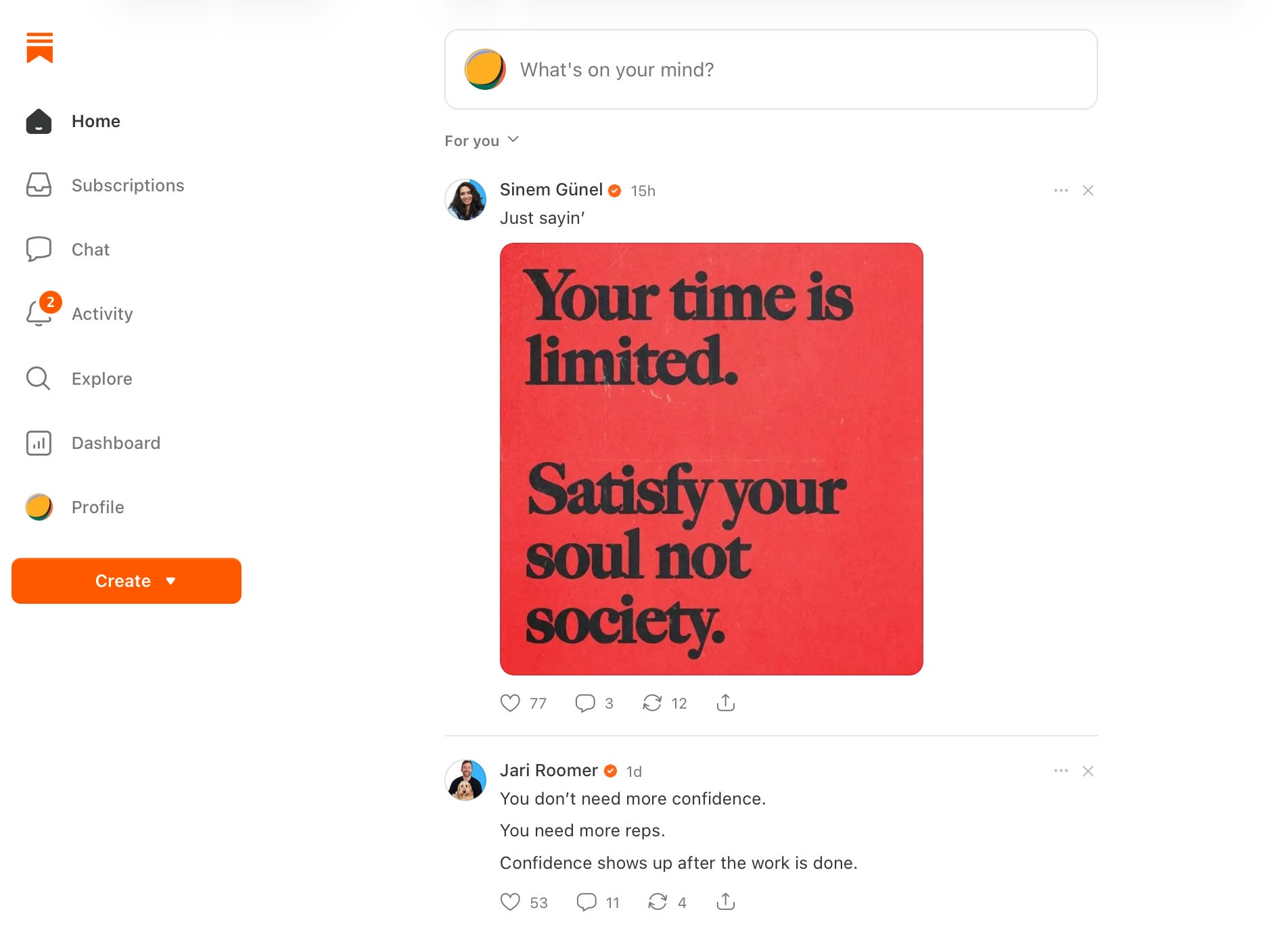
When you’re on Substack and click on “Home,” you’re already seeing the Notes feed:
Most creators don’t even realize this IS the Notes feed because you don’t see the word “Notes” anywhere.
This is basically an infinite social media feed where you see Notes from creators you might already be connected with, or whom the Substack algorithm thinks you might like.
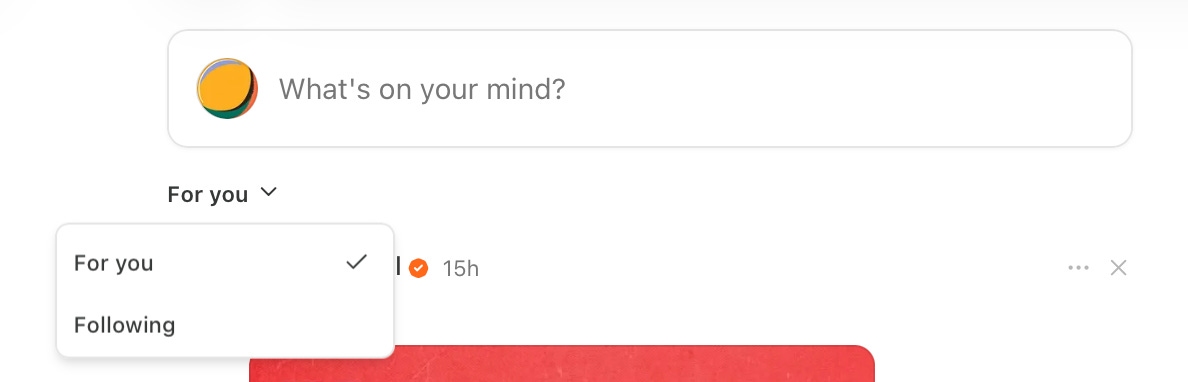
The default option is the “For You” setting. This means you could see content from people you are NOT following yet or subscribed to:
This is also YOUR chance to get discovered by readers who don’t know you yet.
If you switch to the “Following” tab, now you would only see Notes from people you’re already following. But the default is “For You.” That’s the discovery opportunity.
When someone visits your publication, they can see a feed of just your Notes, and many publications even have this pinned to their navigation bars. This way, your Notes become part of your overall Substack presence.
Now, let’s talk about why Substack has even built this feature.
In the early days, Substack publications were pretty siloed. If you wanted new subscribers, you had to go OUT to other platforms like LinkedIn or X and try to funnel people back to your Substack.
Notes changed that.
It created a discovery engine INSIDE Substack. Now readers can find new writers without ever leaving the app. And writers can grow their audience without constantly hustling on external platforms.
Why Notes Matter for Your Growth
You understand what Notes are. But why should you actually care? Why spend time posting short-form content when you could just focus on your newsletter?
There are two main reasons.
Reason 1: Discoverability.
When you publish a newsletter, it goes to your existing subscribers. That’s great, but it doesn’t help you reach NEW people.
Notes changes that.
When you post a Note, it can be seen by people who have never heard of you before. Maybe they follow someone who engaged with your Note. Maybe they’re browsing a topic category you posted in. Maybe the algorithm just served it up because it matched their interests.
Either way, Notes puts you in front of readers who would have never found you otherwise.
Reason 2: Brand recognition and trust.
Here’s something most writers don’t think about: it takes multiple touchpoints for someone to actually become familiar with your voice. They need to see your name, read your thoughts, and experience your perspective several times before they feel like they know you.
And this isn’t just intuition. There’s actual research behind this. The classic “Marketing Rule of 7” suggests that a prospect needs to encounter your brand at least seven times before they take action.
But in today’s digital world, that number has actually increased. Research found that modern consumers engage with brands anywhere from 6 to 20 times before making a decision.
So think about what this means for you as a creator: if you’re only sending one newsletter per week, it takes you ten weeks to have ten touchpoints with a reader.
But if you’re posting Notes regularly — maybe a few times a week or even daily — and they see at least some of them, you build that connection so much faster.
Notes lets you stay top of mind between your longer posts.
It keeps you visible. It builds trust. And trust is what turns a casual reader into a subscriber, and a subscriber into a paying member.
Now let me quickly explain something that confuses a lot of people:
On Substack, there’s a difference between FOLLOWERS and SUBSCRIBERS.
Subscribers have given you their email address. They get your newsletter in their inbox, and you own that relationship.
Followers are people who clicked “follow,” so they see your Notes in their feed, but they haven’t necessarily subscribed yet:
Think of followers as the top of your funnel. They’re interested, but they’re not committed yet. Your job is to use Notes to nurture that interest and eventually convert them into subscribers.
The good news is that Substack’s system is designed to help you do exactly that. When someone sees your Notes repeatedly, engages with your content, and starts to trust you, the natural next step is to subscribe. And once they subscribe, they might eventually become a paid member.
That’s the funnel. Notes feeds into it at the very top.
💡 If you want to master Substack Notes fast,Substack Notes Simplifiedis perfect for you — get instant access to the frameworks, templates, and systems we use at Write • Build • Scale.
When you’re on the Substack homepage, click on “Home” from the dropdown menu.
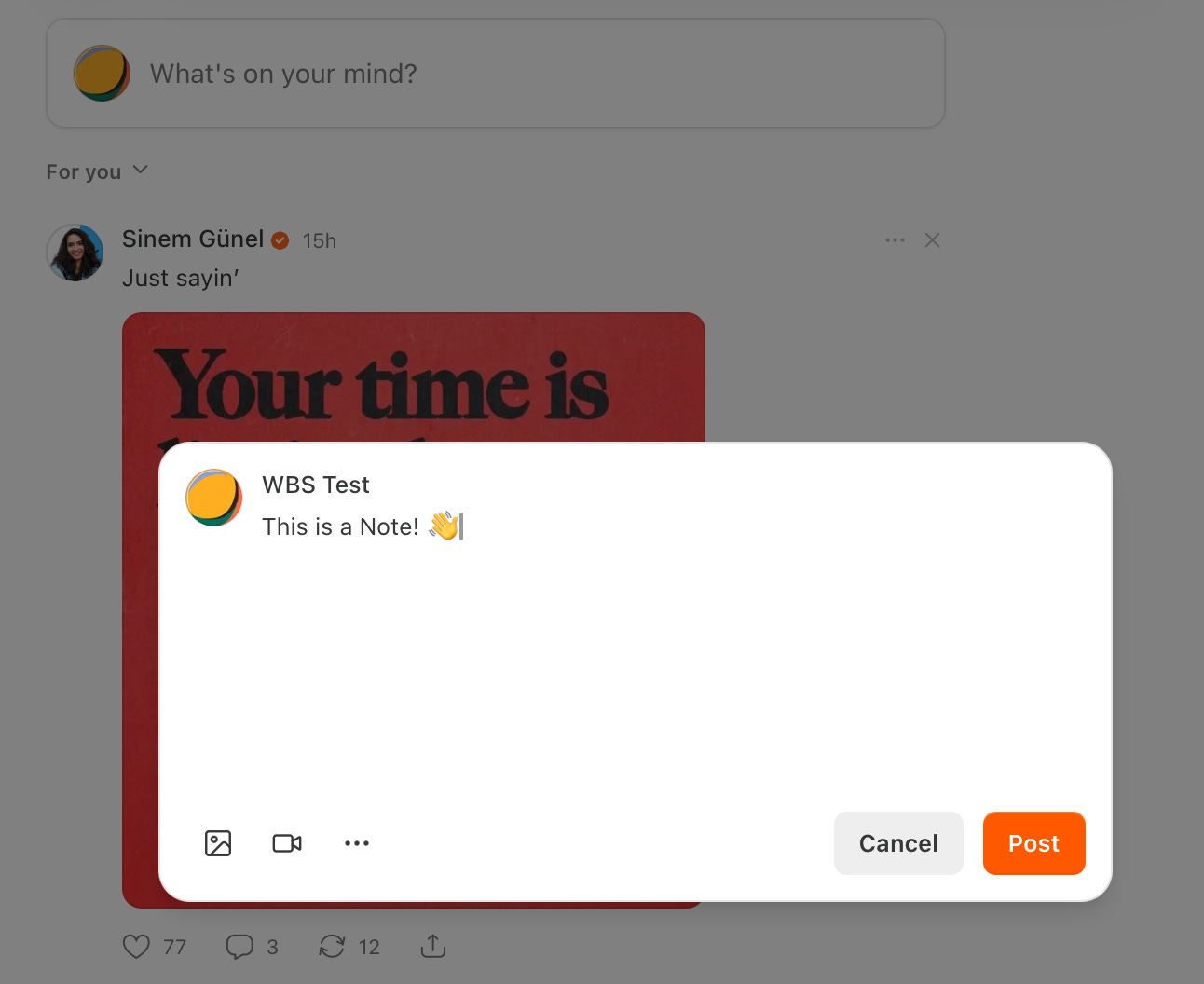
At the top, you’ll see a box that says “What’s on your mind?”
This is where you write your Note.
Click into it, and you can start typing:
A Note can include:
Plain text (the most common)
Images or photos
Videos, including short-form vertical videos
Links to articles, both your own and others’
Quote cards (more on this in a second — they’re one of my favorite features)
So let’s say you want to share a quick thought: You just type it out, keep it conversational, and when you’re ready, you click “Post.” That’s it. It’s live.
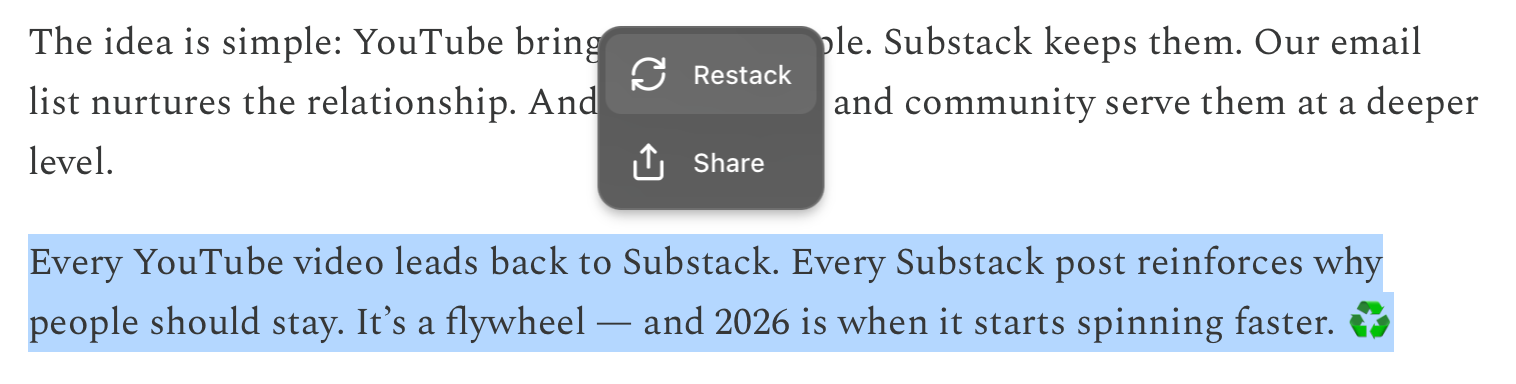
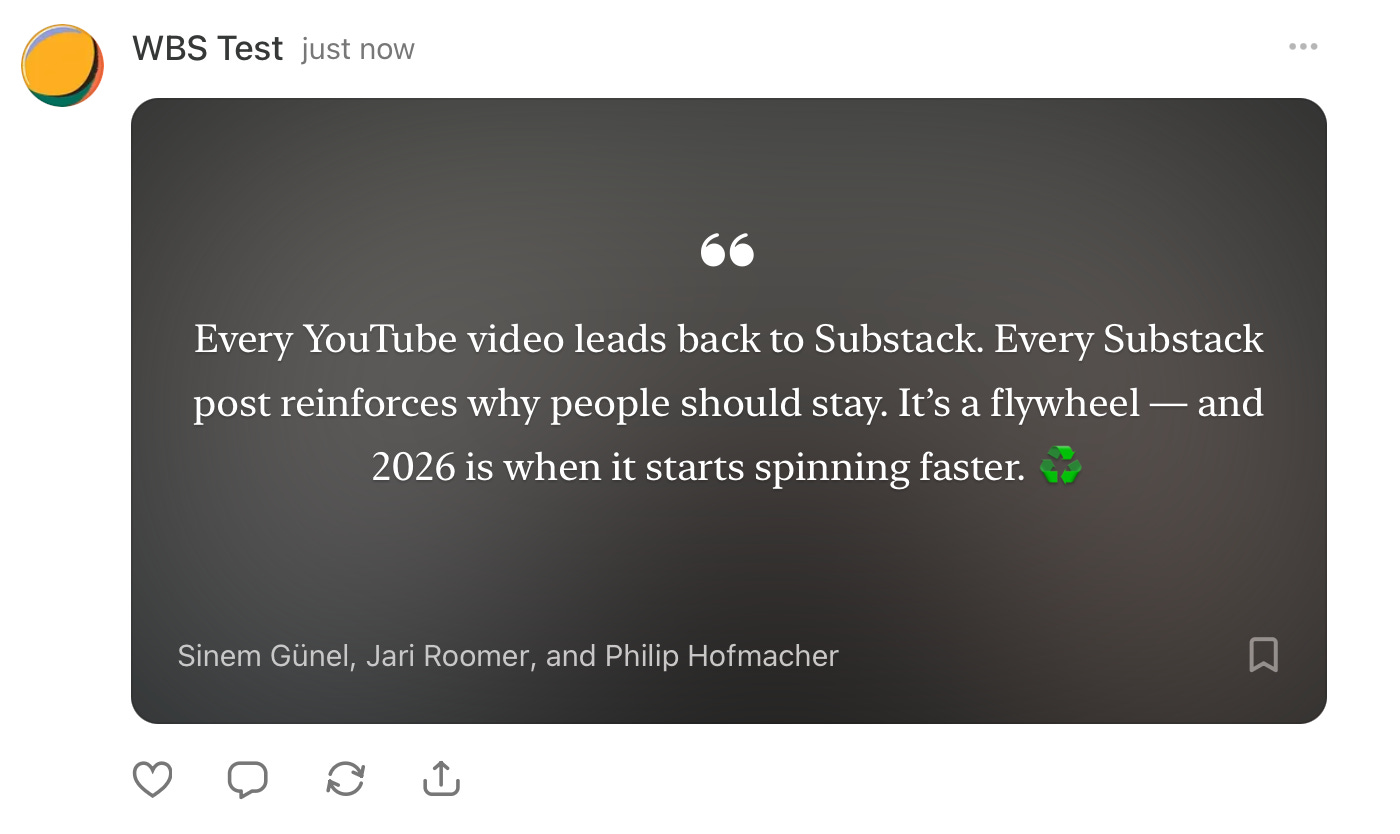
Now let me show you something really useful: If you have an existing post on your publication and you want to share a quote from it as a Note, go to that post, highlight the text you want to share, and you’ll see an option to “Restack.”
This creates a beautiful quote card with that text, and it automatically links back to your original article. It’s an incredibly easy way to repurpose your long-form content into bite-sized Notes that drive traffic back to your publication:
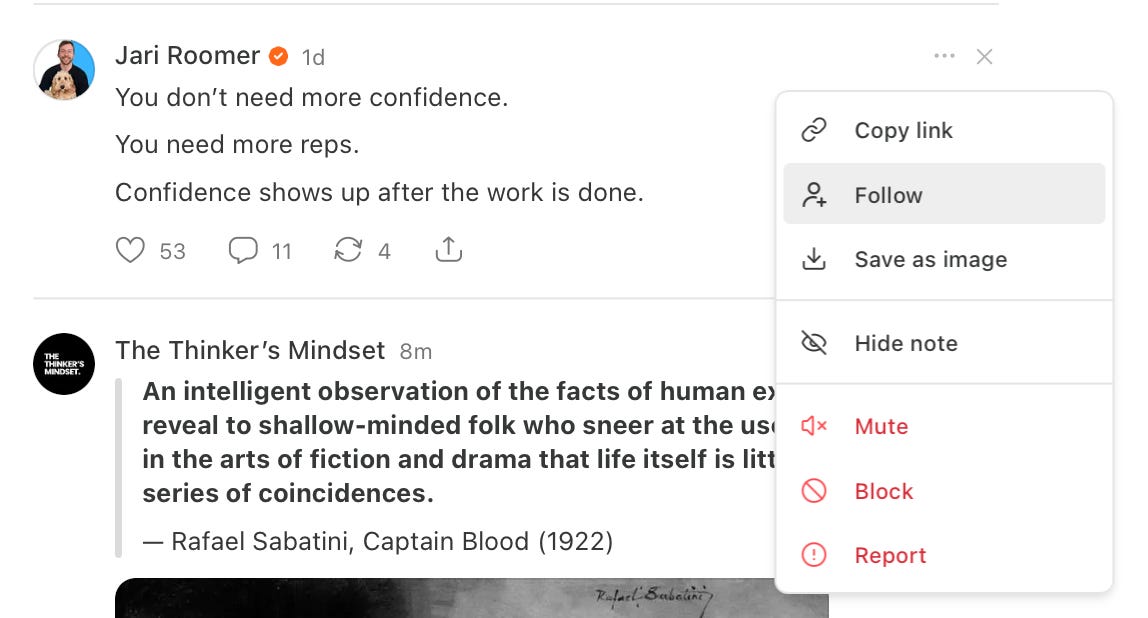
But that’s not all. When you see a Note from someone else that you want to share with your own audience, you can also “restack” it. This is like a retweet. It shares their Note to your feed. You can restack it as-is, or you can add your own commentary on top.
One of the core online writing principles I’ve been following for almost a decade is to make your content quotable. This means whenever you’re done writing a piece, you want to think about which parts of it a potential reader might want to share with their friends on their own profile.
You want to intentionally create these snippets to make your work more shareable.
This is something I’ve always kept in mind when writing my articles, but now on Substack it’s not just a vague idea anymore.
It’s something you can practically apply by restacking those quotable lines from your own work to give your long-form articles more visibility.
And in the best case, others will do the same.
One more thing: video Notes.
You can upload short-form videos directly to Notes. These could be quick tips, behind-the-scenes clips, or even repurposed content from other platforms. For example, I take snippets from my YouTube videos and post them as Notes. It’s an easy way to show up more frequently without creating entirely new content:
You can also go Live on Substack, and the platform will auto-generate clips from your livestream that you can then share as Notes. So if you’re doing any kind of video content, Notes gives you multiple ways to repurpose it.
These are all very easy ways to show up more frequently and build trust with active users.
One quick setting to know about: when you post a Note, you can choose who can reply. You can set it to “Everyone,” limit replies to just your subscribers, or even only your paid subscribers.
However, in practice, it’s not used very frequently since Notes is supposed to be a discovery tool. It usually doesn’t make a lot of sense to limit responses because you DO want to spark conversations with people who aren’t familiar with your work yet.
What to Actually Post on Notes
Knowing HOW to post is one thing. Knowing WHAT to post is where most people get stuck, so here’s a brief overview of the six most common types of Notes we use:
1 — Educational Notes
These teach your audience something specific. A quick tip. A micro-lesson. A piece of advice they can use immediately. These work because they provide instant value and position you as someone worth following.
2 — Inspirational Notes
These shift people’s mindset or help them see a new possibility. Maybe it’s a reframe. A perspective shift. A reminder they needed to hear.
3 — Personal Notes
These show a snapshot of your life, your work, or your creative process. Your workspace. A draft in progress. A small win you’re celebrating. Something from your day that connects to what you write about.
These work because they let people see the human behind the publication. And in the age of AI, that human connection matters more than ever.
4 — Promotional Notes
These highlight something you’re offering. A new post. A product. A service. Use these sparingly, but don’t be afraid to let people know what you’re working on.
5 — Feedback Notes
These ask your audience a clear question. What are you working on? What’s your biggest challenge with X? What do you want me to write about next?
These spark engagement and give you insight into what your readers actually care about.
6 — Collaborative Notes
These invite people to share their own work or ideas. You might spotlight other creators. Ask people to drop links to their publications. Or invite them to share their wins.
These build community and goodwill.
Now, here’s an important principle:
Each Note should focus on ONE idea. If it’s a tip, share one tip. If it’s a story, tell one story. Clarity makes your Note easier to read, easier to remember, and easier to share. The only exception is when your Note is literally a list.
One more thing about writing Notes: your first line matters A LOT. It’s the hook that determines whether someone stops scrolling or keeps going.
A weak hook might sound like: “I’ve been thinking about writing lately.”
There’s nothing wrong with it, but it doesn’t grab attention.
A stronger hook might be: “The best writing advice I ever got was also the hardest to follow.”
Open with something that sparks curiosity or promises a clear benefit.
One last idea on what to post: look at your comments. Your readers are already telling you what they’re curious about by engaging with your content. Turn their questions, their reactions, their points of confusion into new Notes. This keeps your content audience-driven and relevant to the people who actually matter.
💡 Not sure what to post today? Inside Substack Notes Simplified, you’ll get a 30-Day Notes Challenge with 90 ready-to-use templates covering all six Note types — educational, inspirational, personal, promotional, feedback, collaborative, and much more.
Just pick one, customize it, and post. It’s the fastest way to build a consistent Notes habit.
The Growth Strategy: The 10-5-1 Rule
You know what Notes are, how to post them, and what to post. Now let’s talk about using them strategically to actually grow.
Here’s a simple system we call the 10-5-1 Rule.
Every time you publish a Note:
Like 10 Notes from other creators.
Write 5 meaningful comments — not just “great note,” but something that adds to the conversation.
And send 1 direct message to a creator in your niche to start a relationship.
This takes less than 20-30 minutes a day, but it compounds. You build visibility. You build relationships. And you become a known presence in your corner of Substack.
Now, here’s something that makes showing up consistently a whole lot easier:
Batch create your Notes.
Once a week, sit down and write 15-20 Notes in one session.
And on those days when you can only do the bare minimum? Restacking is your best friend. Two clicks and you’ve shown up in your audience’s feed. It’s the perfect option when you’re short on time but still want to stay visible.
Track what works.
Go to your profile, look at your past Notes, and check the stats. You’ll see how many clicks, likes, and restacks each Note got. More importantly, you’ll see if any Notes brought in new subscribers.
Once a week, scroll through your last 10-20 Notes. Identify which ones performed best. And use those as templates for future content. If something worked once, it’ll probably work again with a fresh angle.
Don’t chase perfection.
Some of our best-performing Notes were quick, unpolished thoughts we almost didn’t post. Done is better than perfect. The algorithm rewards consistency, so focus on showing up regularly, learning from what works, and improving over time.
Mistakes to Avoid
Before we wrap up, let me quickly share some mistakes to avoid.
Mistake 1: Being spammy. If you’re constantly self-promoting without providing value, people will tune you out. Lead with value. Promotion should be a small percentage of your Notes.
Mistake 2: Follow-for-follow tactics. Some people try to game the system with coordinated engagement groups. This doesn’t work on Substack the way it might on other platforms. The algorithm is designed to surface content that readers actually enjoy. Authentic engagement beats manufactured engagement every time.
Mistake 3: Waiting until you have the perfect thing to say. You don’t need to be brilliant with every Note. Just show up, share a thought, and be human. Consistency beats perfection.
Mistake 4: Ignoring the human element. In a world full of AI-generated content, genuine human connection stands out. Write like yourself. Show your personality. Let people see who you really are. That’s what builds real loyalty.
Let’s Bring It All Together
You now know what Substack Notes are and how they fit into the platform. You know why they matter — discoverability and building trust faster through those multiple touchpoints. You know how to post, what to post, and how to use the 10-5-1 rule to grow strategically. And you know the mistakes to avoid.
But here’s the thing.
Knowing what to do is one thing. Actually doing it consistently? That’s where most people get stuck.
You just read an extensive guide. You understand the mechanics. But what about tomorrow? Will you actually show up and post Notes?
We want to make it easy for you. That’s why we created Substack Notes Simplified — a crash course for creators who want to show up consistently and publish Notes their readers will truly engage with.
Inside, you’ll get the exact frameworks, templates, and systems we use at Write • Build • Scale.
Plus, you’ll get access to a 30-Day Notes Challenge with 90 ready-to-use Note templates so you can implement what you’ve learned immediately.
The course takes you less than 3 hours to complete, and the 30-day challenge gives you the structure to actually build the habit.




Going to try more of the 10-5-1 going forward in hopes that Substack starts to love me again!
Thanks for your consistency and commitment to helping people Sinem!
I am really amazed by how much value you offer