
I Analyzed 9,641 Substack Notes. Here's What 99% of Writers Are Doing Wrong.
1 month of Notes data, 3 rounds of analysis, and 1 clear lesson.


You wrote a Substack Note last week. It got 80 likes, a few restacks, maybe a couple clicks to your publication, and zero new subscribers.
This is the common experience with Notes of most creators. Even if engagement metrics climb, the subscriber line stays flat.
And frankly, the common advice (like: be consistent, find your voice,…) does not explain why one Note converts 80 strangers into subscribers while another with the same click count converts nobody.
I wanted to know what actually separated the Notes that converted from the Notes that didn’t. So I pulled every Substack Note posted in April 2026 from WriteStack’s database, threw out the topical noise, and analyzed what remained.
And here’s the number that proved the analysis is worth paying attention to:
Out of 9,641 Notes from 689 writers, the top Note drove 111 free subscribers. The median Note that converted anyone at all drove exactly 1.
That is a 111x gap between the best Note and the typical winning Note. Not the gap between winners and losers. The gap inside the winners’ club itself.
Most writers who manage to convert anyone at all are stuck at the bottom of that distribution.
A handful are doing something specific and repeatable that delivers a hundred times the conversion off the same feed, the same algorithm, the same readers.
This article is about what that handful are doing differently.
Surprisingly, the biggest pattern had nothing to do with hook type or post timing. It was about a single sentence many writers refuse to put in their Notes because it feels arrogant.
But writers who used it converted at 20 times the rate of writers who did not.
And sadly, most creators are doing the exact opposite of what works.
What “Viral” Actually Means Here
Likes and restacks are vanity metrics. They feel good, but they tell you nothing about whether anyone walked across the bridge to your publication.
Everything below is sorted by one metric: free subscribers gained per Note.
The 9,641 Notes I analyzed exclude news commentary, sports, crypto, and breaking-news takes. Those categories ride external events for their engagement, so the conversion patterns inside them are noise.

Of the 9,641 Notes, only 956 drove at least one subscriber. The other 8,685 racked up likes and clicks that converted nothing. The top Note got 0.84 percent of its clicks to convert. Plenty of Notes with similar click counts converted zero.
Five patterns separated the winners from the noise. Here they are, in order of lift.
Lesson #1: The Credentialing Hook Beat Everything Else By 20x
I tagged 45 Notes whose opening sentence stated a specific, verifiable credential before saying anything else.
Things like “I trained for 6 years at medical school,” or “At 55, I finally understand what my mother meant.”
Those 45 Notes averaged 3.13 subscribers each.
The other 9,596 Notes averaged 0.15. That is a 20.7x multiplier.
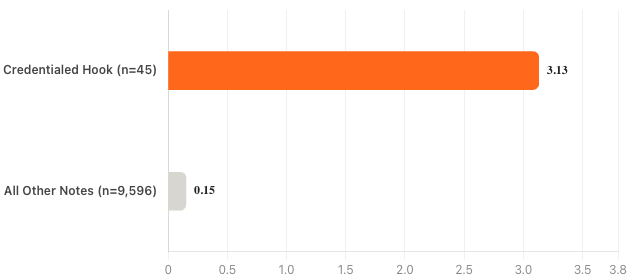
I checked whether one writer was carrying the finding and one author accounted for 26 of the 45 credentialed Notes in the dataset.
So I pulled their Notes out and reran the analysis on the remaining 19. The lift held: a 2.1x average over the non-credentialed baseline, even with the heavy contributor removed.
The pattern survives without the heavy user. It just gets less dramatic.
Why This Works
A credential, stated in the first sentence, does the work of trust before the reader has to decide whether you are worth listening to.
Substack Notes is a feed of strangers. Most of the people who scroll past your Note will never click your profile, never check your bio, never see your About page. They have one moment to decide if you have authority on the topic, and that moment is the first sentence.
“I think you should sleep more” is a stranger talking.
“I trained for 6 years at medical school. Here is what most people get wrong about sleep” is a doctor giving you advice.
It’s the same sentence about sleep with a significantly different conversion rate.
The Template
Open with a verifiable specific. “After [N] years of [thing], I learned…” or “At [age], I finally [result]…” Numbers and named roles make the credential land. Vague ones do not. “I have been thinking about this a lot” is not a credential.
Lesson #2: Anaphora Tripled Average Subscribers
Anaphora is the writing trick where you repeat the first word of consecutive lines. “Nobody told me X. Nobody warned me Y. Nobody covered Z.” Or “Your liver does X. Your kidneys do Y. Your gut does Z.”
I tagged every Note where three or more consecutive lines started with the same word. There were 408 of them.
They averaged 0.48 subscribers per Note, against a non-anaphora baseline of 0.15. A clean 3.16x lift.
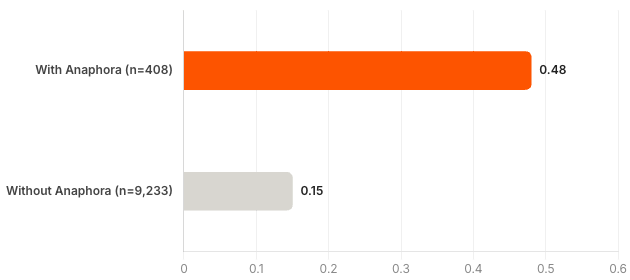
The viral rate (Notes with at least one subscriber gained) was 13.7 percent for anaphora Notes versus 9.7 percent without. The lift compounds, since anaphora also pulls more clicks per impression. Visually, repeating openings make the eye stop scrolling.
Why This Works
The Substack feed is a wall of left-aligned paragraphs. Most Notes look identical to each other from a reader’s peripheral vision.
Anaphora gives you a vertical spine.
Three lines starting with the same word create a visual ladder that pulls the eye down.
Once the reader is reading, the repetition does a second job. It builds rhythm and primes anticipation. The reader’s brain is now running ahead of the prose, expecting the fourth line in the pattern.
Even when the pattern stops at three, the brain has already engaged and is committed to finishing.
The Template
Pick a 1- or 2-word opener (Nobody, Your, I, She, This, No). Use it to start three consecutive lines. Each line should land on a different specific. Then break the pattern with a longer fourth line that pays off the rhythm.
Lesson #3: The 31-to-60 Word Body Was The Sweet Spot
I bucketed every Note’s body length and computed the average subscribers gained per bucket. The result is a clean curve with a clear peak.
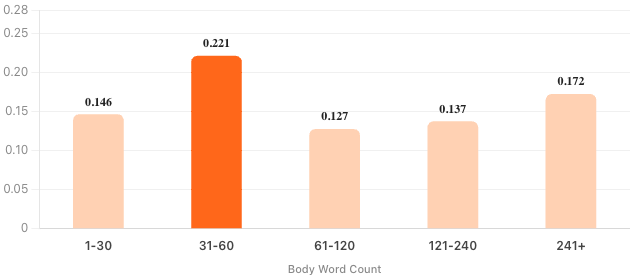
Notes between 31 and 60 words averaged 0.22 subscribers each, with an 11.3 percent viral rate.
Every other bucket was lower.
The 1-to-30 word ultra-short cohort underperformed slightly (0.15), and the 61-to-120 word cohort dropped to 0.13. Long Notes (241+) recovered a little, probably because long Notes are usually serious essays from established writers who already command attention.
The sweet spot was 31 to 60 words. That is enough room to set up a thought, deliver a payoff, and stop. It is not enough room to wander.
Inside scene-hook Notes (Notes that open with a specific moment or setting), the sweet spot was even more pronounced: 31-to-60 word scene-hook Notes averaged 0.55 subs each, more than triple the next nearest bucket.
Why This Works
Substack Notes is a scrolling feed competing with Twitter and LinkedIn for the same reader attention.
A reader’s commitment is measured in seconds, not paragraphs. At 31 to 60 words, a reader can read your whole Note in 8 to 12 seconds without opting in to “reading mode.” They finish. Then they decide whether to click your name.
At 61 words and up, the Note hits the “more” cutoff in the feed. The reader has to tap to expand. Most of them do not. So the 61-to-120 word band catches Notes that are too long to hook in-feed and too short to feel like an essay worth committing to.
The Rule
Aim for 31 to 60 words total. One short hook line. Two to four lines of body. One closing line that lands. If you cannot make your point in that range, the point is not sharp enough yet.
Lesson #4: One Restack Is Worth 12 Likes
Likes feel like the engagement signal, but they are not. Restacks are.
Across the 9,641 Notes, the dataset generated 0.0035 subscribers per like and 0.0429 subscribers per restack. A restack is 12.1 times more potent than a like, on average, at delivering an actual subscriber.
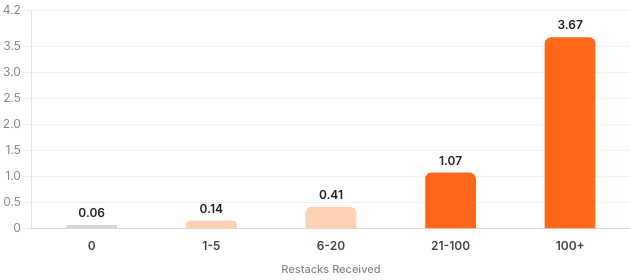
The restack curve is exponential. A Note with 100+ restacks averages 3.67 subscribers, the 21-to-100 band averages 1.07, and the 6-to-20 band averages 0.41. Each step up roughly triples the conversion.
Crossing 100 restacks gives you a 75 percent chance of going viral by our definition (1+ subscribers).
Likes, by comparison, scale much more slowly. The 0-to-10 likes bucket averages 0.07 subs. The 51-to-200 bucket averages 0.25. The 1000+ bucket averages 6.28, but that band only contains 40 Notes and most of them are riding restacks too.
Why This Works
A like is a passive signal seen by almost no one.
A restack puts your Note inside someone else’s feed, in front of their followers, with their implicit endorsement attached. Each restack is a free distribution event. A heart tap is a private nod that nobody else sees.
The mechanism explains why credentialing and anaphora both win, by the way. They both increase the probability that someone will restack.
A reader does not restack because the writing is nice. They restack when the Note makes them look smarter or more interesting in front of their own audience. Authority and pattern-rhythm both do that.
The Rule
If you are optimizing your Notes for likes, you are optimizing the wrong thing. Write for the restack. That means writing Notes that make a specific reader want to be the one who shared it with their audience first.
Lesson #5: Question Marks Cut Subscribers By 35 Percent
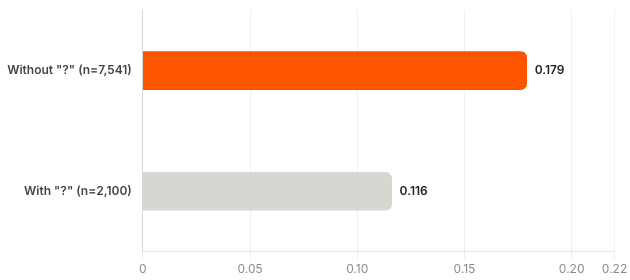
Of the 9,641 Notes analyzed, 2,100 contained at least one question mark anywhere in the body. Those Notes averaged 0.116 subscribers each. The 7,541 question-mark-free Notes averaged 0.179.
That is a 35 percent drop in average conversion when you put a question mark in your Note. The viral rate also drops, from 10.4 percent down to 8.2 percent.
The effect is sharpest inside scene-hook Notes (Notes that open with a moment or setting).
Scene-hook Notes without a question mark averaged 0.34 subs each. Add a question mark anywhere in the body and the average crashes to 0.14, a 59 percent drop.
The pattern shows up at the dataset-wide level too: question-mark Notes are 4.3 percent of the top 100 viral Notes by subscriber count, but 21.8 percent of the broader dataset. They are massively underrepresented at the top.
Why This Works
A question hands the reader work. “Have you noticed how X always Y?” forces them to stop, decide whether the question applies to them, decide whether they have an answer, and then decide whether to keep reading.
Each of those decisions is a chance to scroll past.
A statement does the opposite. It hands the reader a finished thought.
They consume it for free, agree or disagree, and continue. On a fast feed, free wins. The reader does not want a quiz. The reader wants a small jolt of insight delivered without effort.
The Rule
Find every question mark in your draft and convert each one to a statement, even if the statement feels less elegant. “Why do most writers fail?” becomes “Most writers fail for one reason.”
You lose nothing in meaning but you gain conversion.
Bonus Finding: Sunday Beat Wednesday By 78%
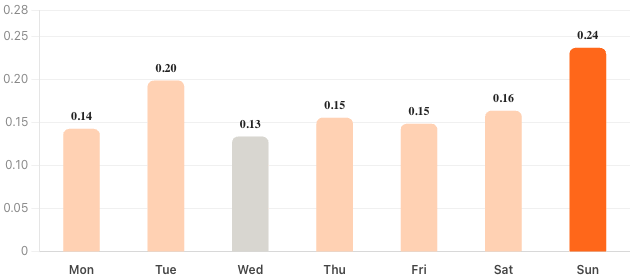
The day-of-week effect is real but smaller than the writing effects above. Sunday Notes averaged 0.236 subscribers each. Wednesday Notes averaged 0.133. Sunday is the best day to post. Wednesday is the worst.
The likely mechanism is reader attention budget.
On Sunday, readers are casually scrolling with no inbox to clear. They have time to consider a click.
On Wednesday, they are rushing through their feed between meetings. Engagement holds, but conversion drops.
Tuesday is the surprise runner-up at 0.20 subs per Note, possibly because Tuesday is when many newsletters publish and readers are already in “Substack mode.”
Your Learnings to Grow Your Audience With Notes
Open with a credential, stated as a specific. Years, roles, ages, named institutions. If you do not have a credential, open with a specific moment or number.
Use anaphora. Three consecutive lines that start with the same word. Pick the word before you write the lines.
Cut your Notes to 31 to 60 words total. If your Note is longer, the second half is probably the better half. Move it up and trim the rest.
Stop optimizing for likes. Track restacks per Note. Write Notes that make the reader look good when they share you. Restacks scale your distribution exponentially. Likes do not.
Find your question marks. Convert them to statements. A statement does the work for the reader. A question makes the reader do the work.
One More Thing
Most advice about Notes comes from people who looked at a few hundred Notes and made up a theory.
This analysis is based on 9,641 Notes, three rounds of analysis, and a dataset that filtered out the news-cycle noise other writers count as wins.
Five patterns. One month. Five lessons for you.
That is the whole game.
You just saw what 9,641 Notes can tell us. WriteStack tells you what your Notes are telling you.
Which ones drove subscribers (not just impressions), when your audience is most active, and what’s working across millions of Substack Notes right now, as templates.
Try it today, for free.
Try WriteStack For Free ➔
 | A guest post by
|
So…I’m curious whether writestack.io will use these findings to generate top notes ideas for you based on on the analytics you’ve done here. It’s such a great tool!
I don't know how many words this post of yours is (it clearly doesn't matter, we're unconditional when the research and presentation is tops!) The reader also feels cared for by you as you look out for our best interest too. Some hoarders would keep it all for themselves. 😮 It is all fascinating to me and eye-opening too! I'm just getting started here on Substack and am very glad I found you! Thank you. 💐