
I Analyzed 2.7 Million Substack Notes From Bestsellers. Here's What Actually Works.
They get 4-6 times the engagement everyone else does on their Notes.


You write a Note. It gets a dozen likes, maybe a couple of restacks, and one comment (if you’re lucky).
Then you look at a Bestseller’s Note in the same feed, same format, same length, and it has 300 likes and 40+ replies.
The obvious conclusion is that they know something you don’t: a better hook, a sharper opener, some formula you haven’t cracked yet.
I wanted to know if that’s actually true, so I pulled 2.46 million Notes written by the 9,081 accounts Substack has tagged with a Bestseller badge, and compared them against a 254,000-Note random sample of everyone else.
I checked hook style, length, and the ratio between likes, restacks, and comments at every level of reach. Two of the three explanations you’d guess don’t hold up. The third one does, but it points in a direction that’s actually useful if you don’t have the following yet.
Methodology
A Bestseller here means Substack’s own badge, pulled from bylines and profile data rather than anything I inferred.
All metrics (likes, restacks, comments) are public numbers visible on Substack itself, so nothing below is a private subscriber or revenue figure. Restacks of other people’s content were excluded; every Note counted here is original. Where a comparison could be skewed by Bestsellers simply reaching more people, I controlled for it by comparing Notes in the same reach bracket rather than group averages.
The gap, before you control for anything
Averaged across the whole dataset, a Bestseller’s Note pulls 49.9 likes, 6.4 restacks, and 2.9 comments. A non-Bestseller’s Note pulls 10.9 likes, 1.1 restacks, and 0.9 comments. That’s a real gap, and it’s not small.
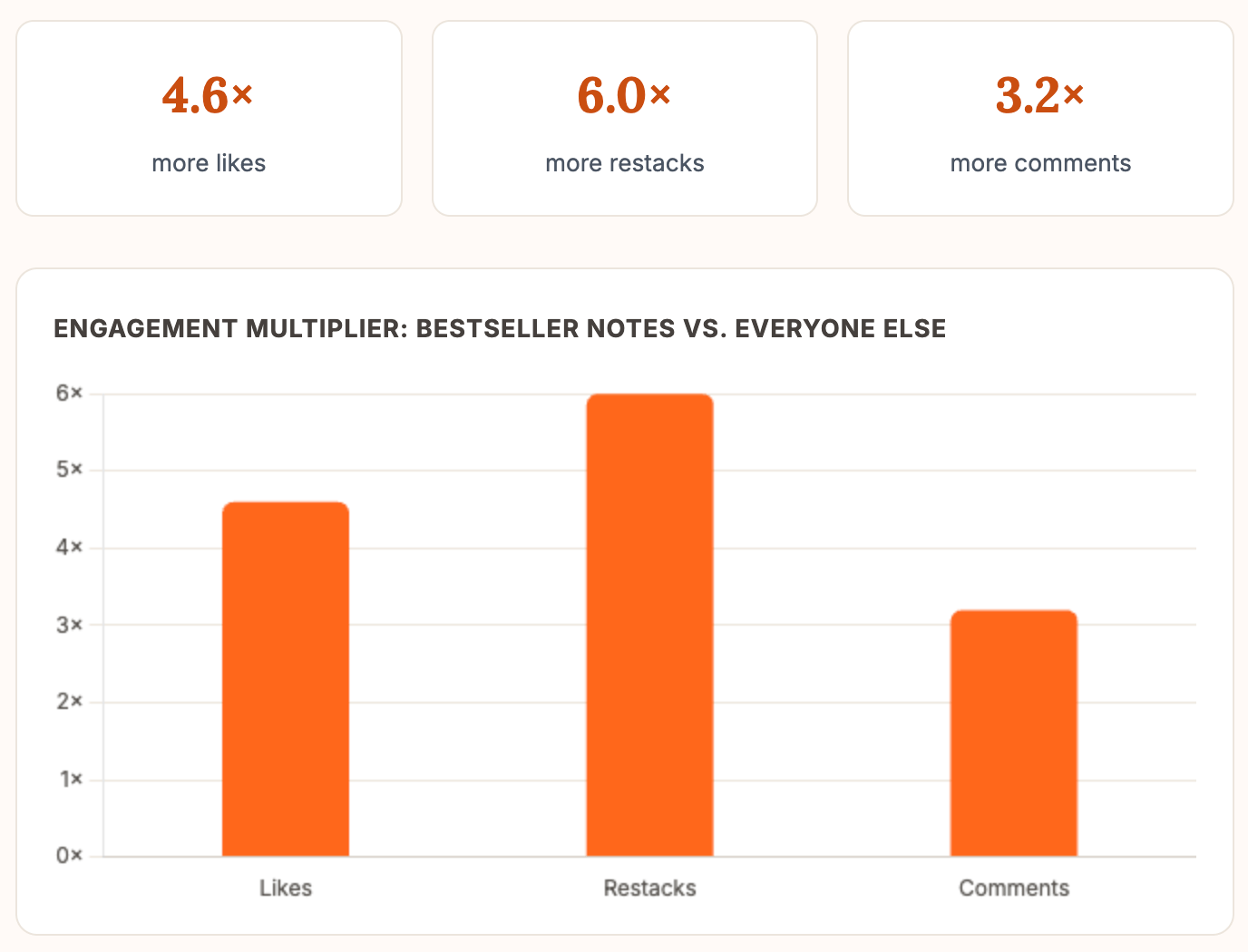
If you only look at this table, the Bestseller badge looks like a cheat code. The rest of this piece is about what happens when you try to find the mechanism behind it.
It isn’t the hook
The obvious next question is whether Bestsellers open their Notes differently. I checked two common opener types across the full dataset: a question in the first sentence, and a first-person “I” opener. I also checked whether the Note led with a number.
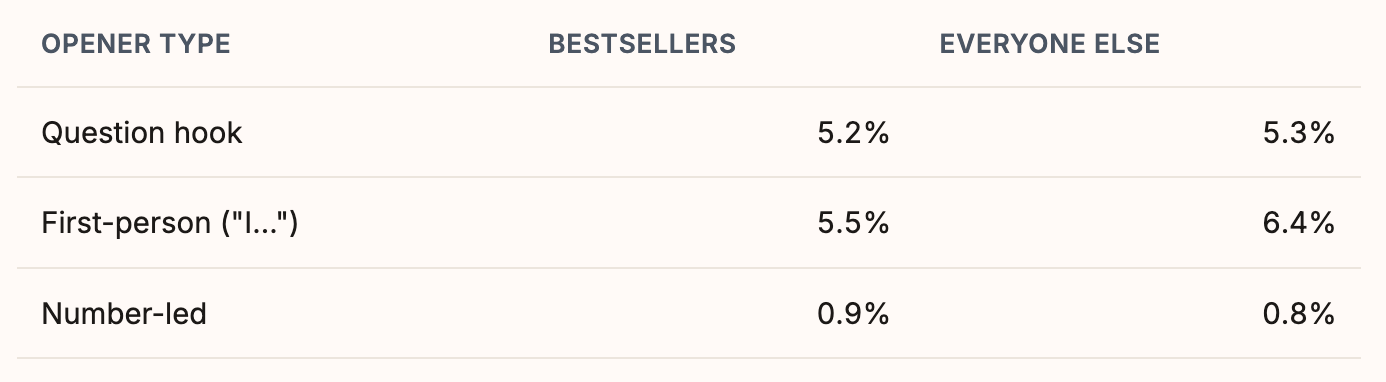
None of these move enough to matter. Question hooks are used at nearly identical rates in both groups. Non-Bestsellers actually open with “I” slightly more often than Bestsellers do. If hook formula explained a 4 to 6x gap, you’d expect Bestsellers to cluster around one winning pattern. They don’t cluster at all.
Length barely moves either
Length is a little more honest than hooks, but it still isn’t the story. Across the whole dataset, Bestseller Notes run 280 characters on average against 260 for everyone else, an 8% gap. When I controlled for reach and compared only Notes with similar like counts, the median length was 172 characters for Bestsellers and 147 for everyone else. Bestsellers write a bit more, about 25 extra characters at the median, but that’s a short clause, not a different length category. It isn’t the “write three times as much” or “keep it under twenty words” gap a hook-and-length formula would need to explain a 4 to 6x engagement multiple.
What actually splits, once you control for reach
Here’s the part that surprised me. I sorted every Note into three reach bands (0-15 likes, 16-60 likes, and 60+ likes) so I could compare bestsellers and non-bestsellers landing in roughly the same place, instead of comparing a bestseller’s typical Note to a small account’s typical Note. In the middle band, the match is close: bestsellers average 30.4 likes and non-bestsellers average 28.7, essentially the same audience reaction. That’s the cleanest apples-to-apples comparison in the dataset, and it’s where the real pattern shows up.
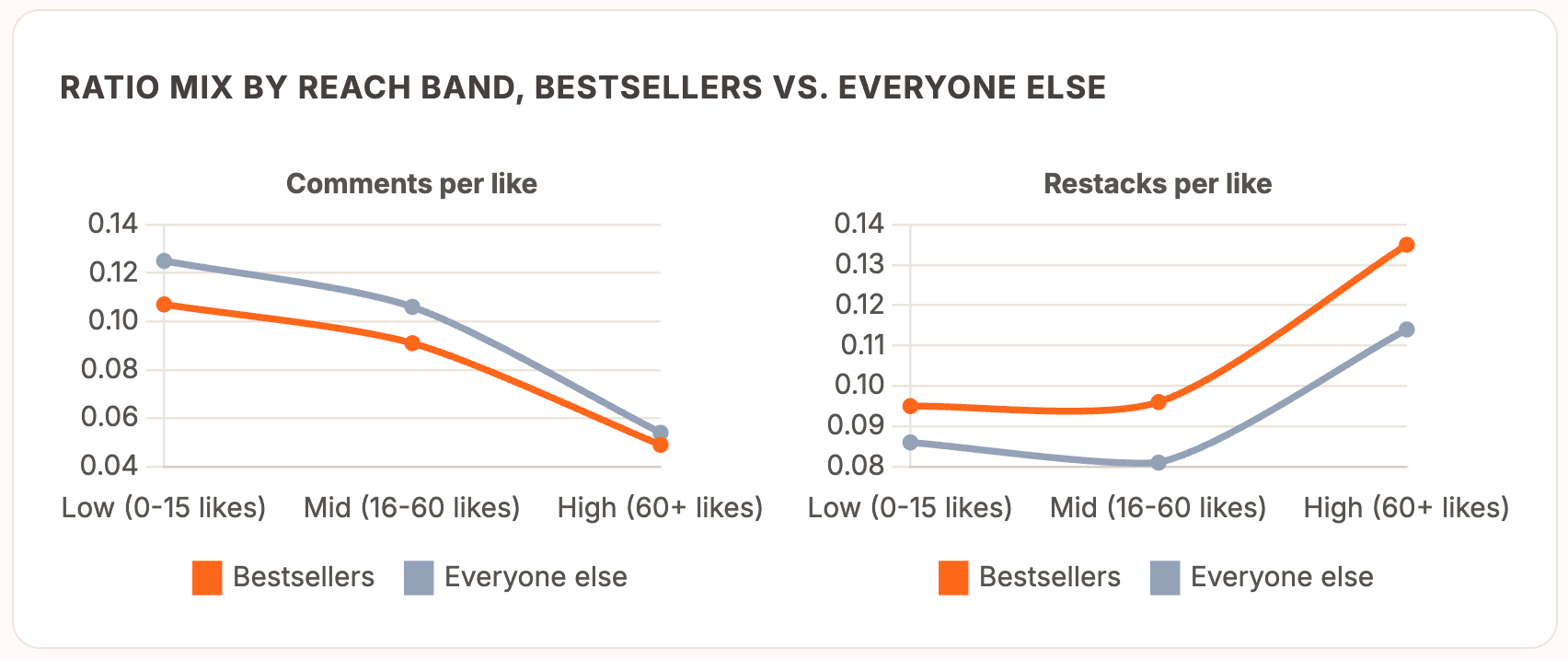
At matched reach in the middle band, non-Bestsellers pull 0.106 comments per like against 0.091 for Bestsellers, a 16% gap in the smaller creator’s favor. Restacks run the other way: Bestsellers get 0.096 restacks per like against 0.081 for everyone else, a 19% gap favoring the Bestseller. The same split holds up in the low band (0-15 likes) and the high band (60+ likes) too, smaller at the extremes but never reversing.
Why this splits the way it does
Restacking is partly a statement about the author, not just the Note.
Restacking someone with a recognizable name carries a small social signal (”I read this person”), which nudges the ratio toward established accounts even when the Note itself lands with the same number of likes as a smaller creator’s.
Commenting doesn’t carry that same signal. A reply to a stranger’s Note costs the same attention whether that stranger has nine subscribers or ninety thousand, so when a smaller account’s Note lands, readers convert their reaction into a reply more often, because there’s no reputational math involved in typing a response.
What actually drives comments (it isn’t reach at all)
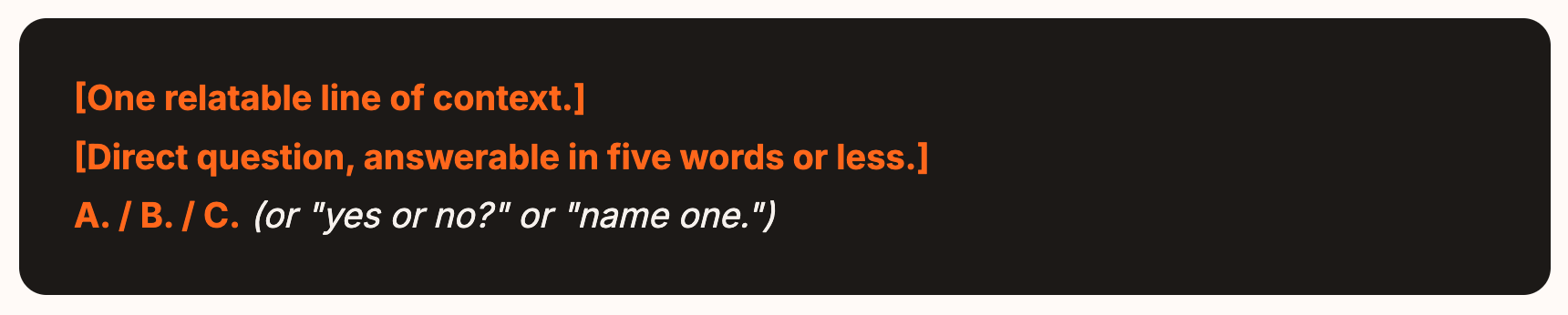
I pulled the highest comment-per-like Notes from both groups to see what they had in common, and the pattern was almost too consistent. It wasn’t topic. It wasn’t tone. It was a direct, low-effort question, usually with an explicit format for answering.
Look at what these three have in common. None of them are clever. None of them use a number or a bold claim.
Each one hands the reader a question they can answer in five words without thinking hard, and each one landed a comment count that dwarfs its like count.
Geoff Talbot’s Note pulled 318 comments on only 29 likes, a ratio over ten times higher than the dataset average.
Rebecca Day’s pulled 414 comments on 50 likes. Neither account needs a Bestseller badge to make that work, because the mechanism has nothing to do with reach.
The payoff: what to actually copy
Given all of the above, the two things worth optimizing are not what most Note advice tells you to optimize. Hook cleverness and note length are close to parity between Bestsellers and everyone else, so there’s little to gain by obsessing over either one. The two real levers are structural, and both are available to you regardless of subscriber count.
If you want comments
Ask a direct question with a low-effort answer format. Not a rhetorical question, and not an abstract one. Give the reader something they can answer in one line without having to think.
If you want restacks
Restacks reward the account more than the individual Note, which means the compounding advantage Bestsellers hold is really a function of accumulated reach and reputation, not a trick available to you today. The way you get there is the least exciting answer in this whole piece: show up often enough, for long enough, that restacking your work starts to carry the same signal restacking an established name already does.
P.S. The one place this data does point to something you can act on today: the restack advantage bestsellers hold barely narrows even at matched reach, which means it’s built on volume and consistency over time, not any single Note’s craft.
If you’re trying to build that same compounding reach before you have it, the boring, unglamorous lever is posting on a schedule you actually keep. That’s the entire premise behind WriteStack’s scheduling queue, and it’s the one thing in this whole analysis that isn’t a matter of taste.
Sample: 2,459,728 original Notes from 9,081 Substack-tagged bestseller authors, compared against a 254,056-Note random sample of non-bestseller accounts (roughly a 2% sample of that population). Restacks of other authors’ content were excluded from both groups. All figures are public engagement metrics as of July 2026.
 | A guest post by
|
Thank you for the tips
Controlling for reach made this much more interesting. The result I take from it is not simply “ask an easy question,” but that comments and restacks measure different kinds of behavior.
A low-effort prompt can generate hundreds of replies, but reply volume is not necessarily the same as relationship or engaged readership. For those of us trying to find a smaller number of serious readers, perhaps the better question has a low barrier to entry but enough substance to reveal something real.
I would be fascinated to see one more metric: repeat commenters. How many people return to the same writer over weeks or months? That might tell us more about community than comments per like.