
How I Built a $50K/Mo Substack Business (Full Breakdown)
The revenue breakdown, subscriber journey, and full system behind our Substack publication.

Most people think the only way to make money on Substack is through paid subscriptions.
And honestly, that’s what I thought too when we launched the Write • Build • Scale publication.
But after two years, the truth is that paid subscriptions are only a small piece of the puzzle.
In this post, I’m pulling back the curtain on exactly how we designed our Substack publication to generate $50,000+ per month.
I’ll walk you through our full business model, our income streams and what percentage each one contributes, the products we sell, how our funnel works from a single free subscriber all the way to a VIP client, and the specific strategies that got us here.
The Trap Most Substack Creators Fall Into
Here’s what the typical Substack creator does: They start writing. They turn on paid subscriptions. They set the price to $5 or $10 a month. And then they wait.
They wait for subscribers to trickle in. And most of them never get past a few hundred paid members.
They assume Substack is a subscription platform, so the subscription must be where the money is, right?
Well, no.
The creators who are making real money on Substack treat it as business infrastructure, not a subscription platform. They’ve designed entire ecosystems around their publication, with multiple products, multiple price points, and systems that turn a single subscriber into a long-term customer.
That shift in thinking changed everything for us.
A Quick Note on How We Got Here
Before I show you the numbers, let me give you some context. Because none of this happened overnight.
I’ve been writing online since 2018.
I started on Medium, where I built an audience of over 80,000 followers. Over the years, I became a Boost nominator and an editor of one of the largest publications on the platform. And I built the go-to educational program for Medium writers.
I built the entire business together with my husband, Philip Hofmacher. He’s been my co-founder and partner from the very beginning. Philip actually built his first online courses back in 2015. So between the two of us, we spent years learning how to create courses, how to build communities, how to run launches, and how to turn an audience into a real business.
In 2024, we teamed up with Jari Roomer, who had already been a friend and collaboration partner for years. Together we launched the Write • Build • Scale publication on Substack.
I’m telling you all of this is so you’re aware this didn’t happen in a few months. There’s a decade of building, learning, and iterating behind what we have today. We were able to make smart decisions on Substack because we’d already made the expensive mistakes on other platforms.
Now let’s get into the numbers!
The Revenue Breakdown: What $50K+ Per Month Actually Looks Like
When people hear we have over 1,200 paid subscribers, they always assume that’s where most of the money comes from, but it’s not.
Here’s the actual breakdown:
1. Courses (~55% of revenue)
Our courses are our biggest revenue driver. These are what we call our “mid-ticket offers,” priced around $500.
They include programs like Substack System, where we teach you exactly how to build and grow a profitable Substack publication:

And Mini-Course Accelerator, where we teach you how to build and sell your first mini-course in less than 14 days:

Now, here’s something important to understand about why courses became our biggest revenue driver: When we launched Write • Build • Scale on Substack, we already had a list of over 30,000 email subscribers on Kit. That means we had a huge audience of people who were excited to follow along our journey and learn how they could start on Substack themselves.
We were able to share what we were learning in real time, build an entire brand around Substack education, and create products that our audience was already asking for. That existing audience gave us a massive head start.
2. VIP Programs (~20% of revenue)
These are our one-on-one high-ticket coaching and consulting offers. We work directly with creators who want personalized strategy and support. Per client, this is our highest-value income stream.
And here’s what’s interesting: some of our VIP clients told us they didn’t come to us because of what we teach. They came because they wanted to understand how we designed this business.
Our VIP coaching program is for you if you want to grow your Substack publication without wasting any time. You can apply for it here.
3. Continuity Offers (~15% of revenue)
This includes two things: our private community, The Link, and our Substack paid subscriptions.
Now here’s the part that surprises people: Our paid Substack subscription, the thing most people assume is our main income source, makes up only about 8% of our total revenue.
We have over 1,200 paid subscribers. Our subscription is set to $20 per month. And it’s still only 8% of what we generate.
If we only relied on paid subscriptions, we’d be leaving over 90% of our income on the table.
4. Low-Ticket Offers (~10% of revenue)
These are digital products we sell through Gumroad and Teachable: templates, resource packs, workbooks, and smaller tools. Price points range from $27 to $97.
We actually just launched our Gumroad store at the end of 2025, so we’re expecting this category to grow significantly across 2026.

This bucket also includes what I call silent winners: order bumps and upsells.
When someone is buying one of our products, they see a relevant add-on at checkout:
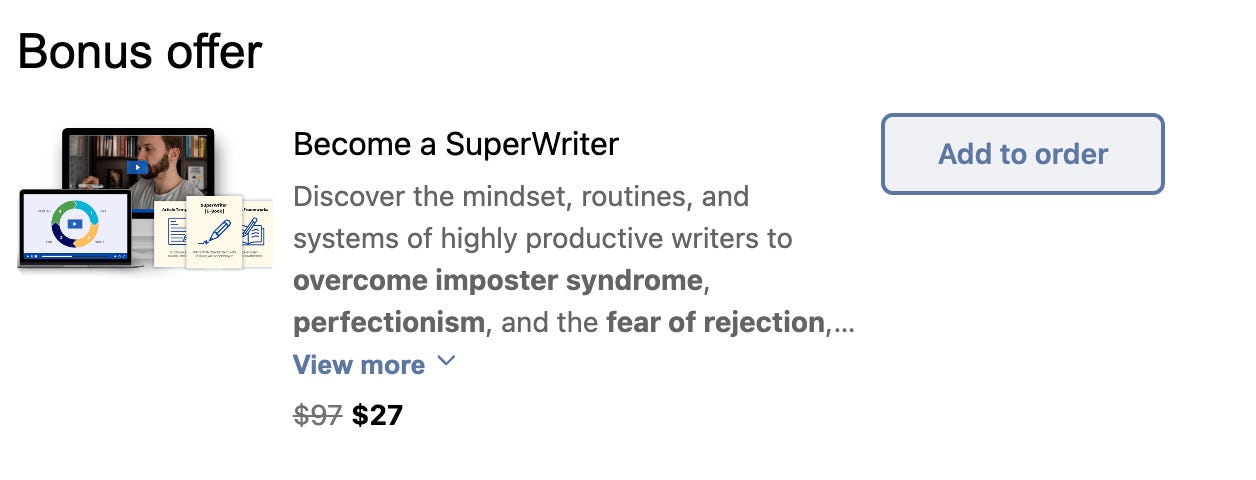
A large percentage of our buyers add these to their cart because it makes sense with their purchase. It doesn’t sound like much per transaction, but over the course of a month, especially during launch periods, it adds up to a meaningful amount of revenue.
The Takeaway
Paid subscriptions are the foundation. They create recurring revenue, they bring people into our ecosystem, and they build trust over time.
But they are not the ceiling. They are just the foundation that everything else is built on.
If you’re a Substack creator and you’re only thinking about paid subscriptions, you’re looking at a fraction of the opportunity.
Starting your Substack journey? I put together a free Substack Starter Kit with the exact starting framework we used to build Write • Build • Scale. It’s the fastest way to set up your foundation the right way.
How We Got to 1,200+ Paid Subscribers
Getting to 1,200 paid subscribers wasn’t by publishing great content and hoping people would convert.
We charge $20 per month, which is intentionally higher than the average. And the vast majority of our subscribers are annual members.
That’s because we don’t rely on passive conversions. Instead, we run sprint launches for our paid tier.
A sprint launch is a focused promotional campaign, typically lasting three to seven days, with urgency, bonuses, and social proof, all designed to convert free readers into paid subscribers. We run these multiple times per year.
When you look at our paid subscriber growth chart, it tells the whole story. You can see very clear spikes that align exactly with our sprint launch campaigns. It’s not a slow, steady drip. It’s intentional, focused promotion:

If you’re looking for reliable ways to launch and grow your paid tier, you’ll love our Free-to-Paid Playbook with over 100 conversion strategies.
How to “Launch” Your Paid Tier
For our one-year anniversary in July, we published a massive article called 365 Lessons We Learned in Our First Year on Substack:

This was a genuine gift to our community. Enormous value. Completely free.
And we backed it up with our biggest promotion ever: a tiered discount on our paid tier.
The first tier offered up to 99% off for fast action takers. Once that tier sold out, the next tier kicked in, still a great deal but less of a discount. And then the next tier after that:

This created real urgency. People could see the best discounts selling out in real time. And it drove a significant spike in paid conversions. This single campaign added over 100 new paid subscribers to our publication.
The key insight here is to treat your paid tier like a product launch, not a feature you hope people notice.
The Full Subscriber Journey: From Discovery to VIP Client
This is the part that makes the whole system click.
Let me trace the journey of a single subscriber, from the moment they discover us all the way to becoming a long-term customer. Because this is how every piece of the business connects.
Step 1: Discovery. Someone finds us. Maybe through a YouTube video. Maybe through Substack’s recommendation network. Maybe through Notes, our podcast, or a collaboration with another creator. They read a free post or watch a video and think, “OK, this is useful.”
Step 2: Subscription. They might subscribe to our Substack directly, or they might download one of our freebies, like our Substack Starter Kit. Either way, whether they’re on our Substack list or our Kit list, we now have the opportunity to continue this relationship. And that’s the key moment. Once someone is on one of our lists, we can nurture that relationship over time through automated email sequences, regular content, and launches.
Step 3: Paid subscription. They’ve been reading our content for a while. They trust us. Then one of our sprint launches happens. They see the tiered pricing, the social proof, and they decide to go annual. Now they’re a paid subscriber getting our premium content every week.
Step 4: First product purchase. Inside our emails and content, they learn about Substack System, our flagship course. The trust is already built. They’ve been in our world for weeks or months. They buy. And maybe at checkout, they see an order bump: a template pack or resource bundle that’s directly relevant. Many of our buyers add it. That’s two revenue events from a single purchase.
Step 5: Community access. When someone buys one of our mid-tier courses, they get three months of access to The Link, our private community where we provide direct support, multiple weekly live coaching sessions, and workshops. This is where we support our members on a personal level. They get feedback, accountability, and direct access to us.
Step 6: Continued membership. After those three months, if they love what they’re getting, and most do, they continue on a quarterly plan. Or they upgrade to one of our annual plans that include private coaching. This is where community becomes continuity revenue.
Step 7: VIP. Some members realize they want even more. They want fully personalized support. They want us to sit down with them, look at their specific situation, and design a strategy together. These creators apply for our VIP coaching. And this is where we work one-on-one with people who are serious about building on Substack and don’t want to waste any time.
One person. Seven touchpoints. Multiple revenue events. And at every single step, they’re getting more value.
This is what I mean when I say Substack is business infrastructure. The publication is the entry point. The ecosystem is the business.
The Full System: How Every Piece Connects
Here’s how the entire system works together:
At the top: free content. YouTube videos, Substack posts, our podcast, and collaborations with other creators. This is how people find us.
Next, and this is the critical step: subscription. Because only when someone is subscribed to one of our lists, either on Substack or on Kit, can we actually control the relationship. This is where we can move them into automated sales sequences, invite them to participate in launches, get them to join live webinars, and present offers in a way that feels natural because they’ve already been getting value from us.
Without this subscription step, you’re just putting content out into the world and hoping for the best. With it, you have a direct line to your audience that no algorithm can take away.
From there: sprint launches that convert free readers into paid subscribers during focused campaigns.
Below that: our product ladder. Low-ticket offers, courses, VIP programs. Each level serves people at a different point in their journey and at a different price point.
And feeding into all of it: The LINK community, which retains customers, creates deeper relationships, and opens the door to upgrades and VIP coaching.
Every piece feeds the next. And once this system is in place, most of it runs automatically. The email sequences run on their own. The order bumps trigger on their own. The community creates value on its own.
Our job is to keep creating great content at the top and to show up for our VIP clients and community members.
The Honest Truth Behind This
I don’t want this to feel like a highlight reel.
We didn’t build this in a few months. And we didn’t figure it all out on Substack.
I’ve been creating content and building online education programs since 2018. My husband and co-founder Philip Hofmacher built his first online courses back in 2015. Between the two of us, we spent years learning on other platforms first. How to create courses. How to build a community. How to run launches. How to price offers. How to structure funnels.
We made expensive mistakes on other platforms so we didn’t have to make them on Substack.
And honestly, that’s one of the biggest reasons our VIP clients come to us. It’s not just that we teach Substack. It’s that we’ve been through the entire journey of building an online education business. The trial and error. The failed launches. The pricing mistakes. The audience-building grind. All of that is baked into what you’re seeing today.
So if you’re reading this and thinking, “I could never build that,” I want you to hear this:
You don’t need to build all of this on day #1. You don’t even need to build most of it in year #1.
You need to start with one piece. The Substack publication. The free content. The trust. And then you layer on one product at a time. One income stream at a time.
Your Next Step
If you’re past the starting phase and already know that you want to go all-in on Substack this year, our VIP coaching program might be the perfect fit for you.
This is where we sit down together, look at where you are, and map out your path to building a thriving Substack publication that grows well beyond just a paid tier.
Thanks! This was obviously an incredible and profitable journey! "I’ve been writing online since 2018." Has this only been about helping to improve other writers? I'm finding the niches for using the various writing platforms work extremely well and are popular.
The 8% paid subs figure is properly eye-opening. Everyone assumes the subscription is the business, but you've shown it's just the front door. I ran the numbers on what 1,000 subscribers at $8/month actually nets after fees. Roughly $83K a year. Wrote up the full economics here: https://sulat.com/p/substack-millions