
How I'd Fix Any Substack in 30 Minutes
The 3 tweaks that decide whether visitors subscribe or leave.

Right now, while you’re reading this, you’re missing out on subscribers who would love to see, read, and pay for your work.
People are arriving on your Substack publication.
They’re looking around.
And they’re leaving.
Not because your writing isn’t good enough.
Not because your topic isn’t interesting.
But because your storefront isn’t ready yet.
In this article, I’m going to walk you through 3 Substack tweaks that we use at Write • Build • Scale to turn first-time visitors into loyal subscribers and paying customers.
These three tweaks have helped us grow our publication to over 45,000 subscribers and more than 1,600 paid members.
This isn’t about strategy, mindset, or building a system over several months.
It’s 3 specific tweaks you can make in less than 30 minutes.
🎯 Want the exact templates from this article?
Our free Substack Starter Kit walks you through everything from creating your profile to writing your About page to designing your homepage.
Your About Page Is a Sales Page (Treat It Like One)
Most Substack creators don’t even rewrite their About page.
They just leave the default page that Substack auto-generates when you sign up. It’s generic, it’s impersonal, and it reads like every other publication on the platform:
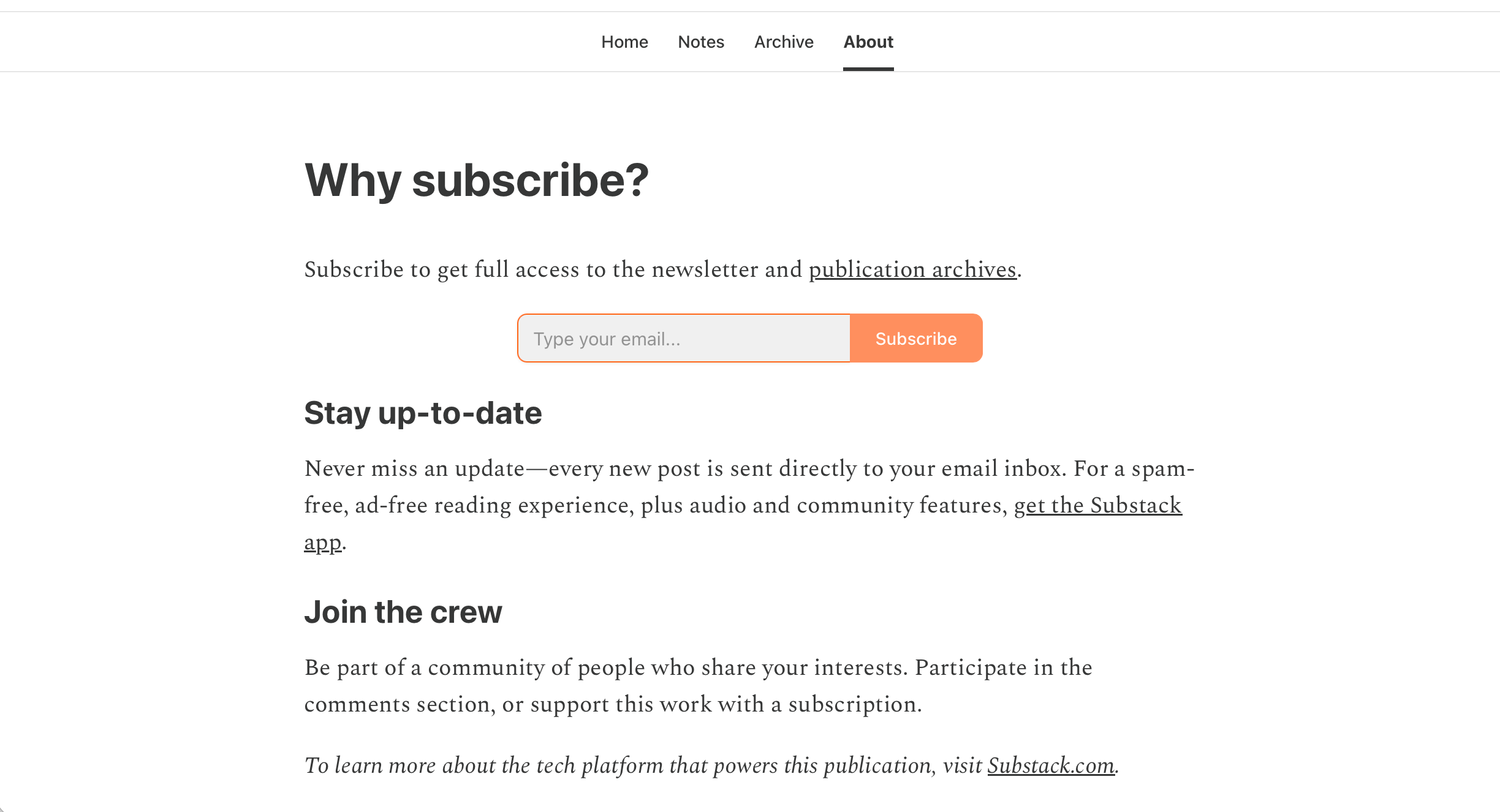
That’s the worst possible first impression you can give a new visitor.
The writers who do rewrite their About page usually make a different mistake: They treat it like a CV. They walk in with their life story, their credentials, the year they started writing, and the long list of things they’ve done.
But the visitor landing on your About page isn’t asking “who is this person?”
They’re asking one question, and one question only:
Is this worth subscribing to?
If your About page doesn’t answer that question quickly, the visitor closes the tab and goes back to whatever they were doing before.
The About page is one of the most-visited pages on any Substack publication. People click through to it when they browse through your page for the first time, and they expect to find a clear answer to their question.
So your About page isn’t a vanity page. It’s more like a sales page for your entire publication.
And the structure that actually converts is the opposite of what most writers do.
The Structure That Actually Converts
Here’s the exact About page structure that works:
Share what the publication is and who it’s for.
What will the reader get out of subscribing?
Add your subscribe button to make it easy for someone to quickly sign up.
Share who you are and why you run your publication.
Share what the free and the paid tiers include.
Another call to action to subscribe and be part of your community.
Now, I want to show you what this looks like in real life, because examples make this so much easier to understand than any template ever could.
These examples are all from our own students and coaching clients at Write • Build • Scale.
Ilham’s Reader-First Masterclass
Our member Ilham ✨ runs a publication called 1% Wiser, which is for deep feelers and overthinkers who want clarity and calm:

The first thing she does is open with “Hey there!” It’s warm, it’s personal, and it immediately feels like she’s talking to one specific person, not broadcasting to a crowd.
Then look at the second line: “If you’ve landed here, there’s a good chance you’re the kind of person who thinks constantly, feels deeply, and sometimes wonders, ‘why is adulting so hard?’”
That’s her reader’s exact internal voice. She’s not telling them what her publication is about. She’s telling them who they are.
And the moment a reader sees themselves described that precisely, they’re already half-subscribed.
Then she has a section called “This space is for you if.” And underneath it, five hyper-specific points:
“You overthink everything.”
“You second-guess yourself.”
“You feel like an impostor, even when you’ve done your best.”
“Your inner critic is loud.”
“You feel so deeply that it sometimes becomes hard to swim back to the surface.”
Every single one of those lines is written in the reader’s voice, not in Ilham’s voice. She’s not listing topics she covers. She’s listing things the reader already thinks about themselves.
That’s the difference between a generic About page and one that actually converts.
Jeanie’s Simple Template (Copy This in 20 Minutes)
If Ilham’s page feels like a lot of work, here’s a simpler version that still converts incredibly well: Jeanie Hosken runs Restoration Center Encouragement, and her About page is actually the exact template we give our students inside Substack System, because it’s the easiest version to start with.

You can always make it fancier later, but this gets you 80% of the way there in 20 minutes:
Hi, my name is [your name], and I’m the creator of [publication name].
[Publication name] is for [target audience] who want to:
— [benefit one]
— [benefit two]
— [benefit three]
[Subscribe button]
Who am I? [Brief background, expertise, and a photo]
Subscribe and you’ll get: Every [frequency], I’ll send you [free value]. Premium members also get [premium perks].
That’s it. That’s the entire template.
Two More About Pages Worth Studying
Melissa Scala runs the Grow Healthier + Happier publication and her opening header is literally the question her visitor is asking: “What is the Grow Healthier and Happier newsletter all about?”

She’s not making the visitor work to figure out what the page is for. And then her personality leaks into every paragraph. She even writes a soft permission line at the end saying: “If you decide the newsletter is not for you, simply unsubscribe.” That sounds counterintuitive, but it actually lowers the pressure and makes people more likely to subscribe.
Yordan Ivanov runs Data Gibberish and uses a more advanced version of the About page with a lot more nuance and detail:

Yordan’s About page is structured like a full sales page. He opens by describing his reader’s pain in second person: “You keep the data flowing across pipelines, models, and dashboards. When something breaks, you’re the first ping. When everything works, nobody notices.”
He also includes testimonials, an FAQ section, clear pricing, and even a refund policy. This is what an About page looks like when your paid tier is a serious revenue stream.
You now have four very different versions to draw from.
Pick whichever one is closest to where you are right now and start from there.
🎯 Don’t want to write your About page from scratch?
Our free Substack Starter Kit includes the fill-in-the-blank About page template, plus lessons on creating your profile, positioning your publication, writing attractive headlines, and a lot more.
The Hidden Homepage Feature 90% of Creators Don’t Know Exists
Your homepage is the front door of your Substack publication. It’s the very first thing most non-subscribers see when they discover you.
And inside the homepage, there’s a feature called the Subscribe Block that almost nobody is using properly. Most creators don’t even know this option exists and then they’re surprised when they see it on someone else’s publication.
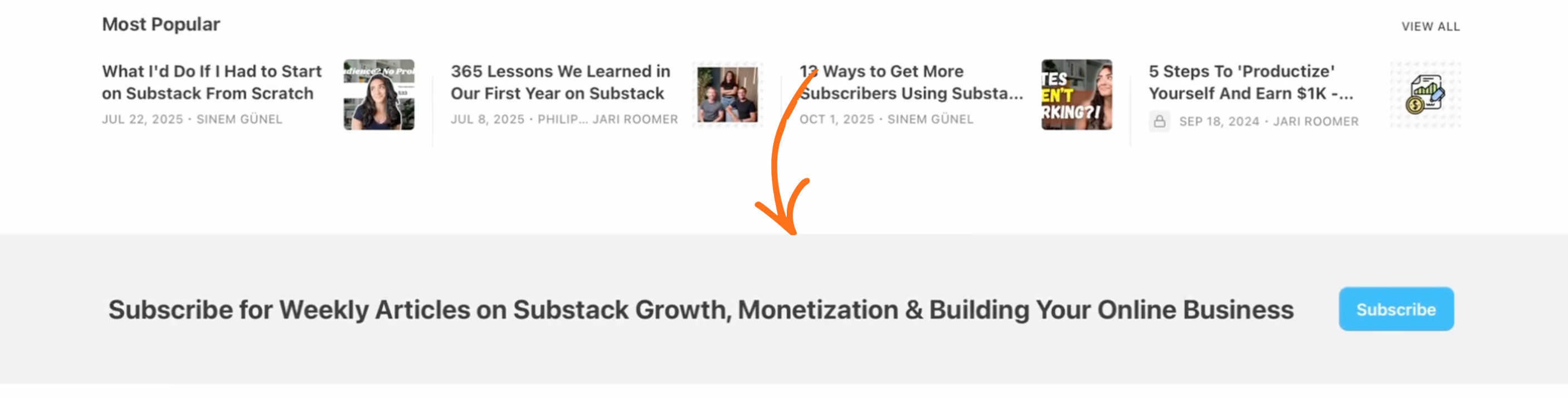
The real value of this feature is that the block is dynamic. You can write four different messages — one for each type of reader — and Substack will automatically show the right message to the right person.
Depending on where the reader is on their journey, your Subscribe Block should answer their specific question:
A non-subscriber is asking “should I sign up at all?”
A free subscriber is asking “is the paid tier actually worth it?”
A paid subscriber is asking “is there an even higher level I can join?”
Each one of those questions deserves a different answer.
How to Set It Up
Go to your dashboard, then to “website editor.”
Once you’re in the theme editor, look for the option called “Use custom body layout” and toggle it on.
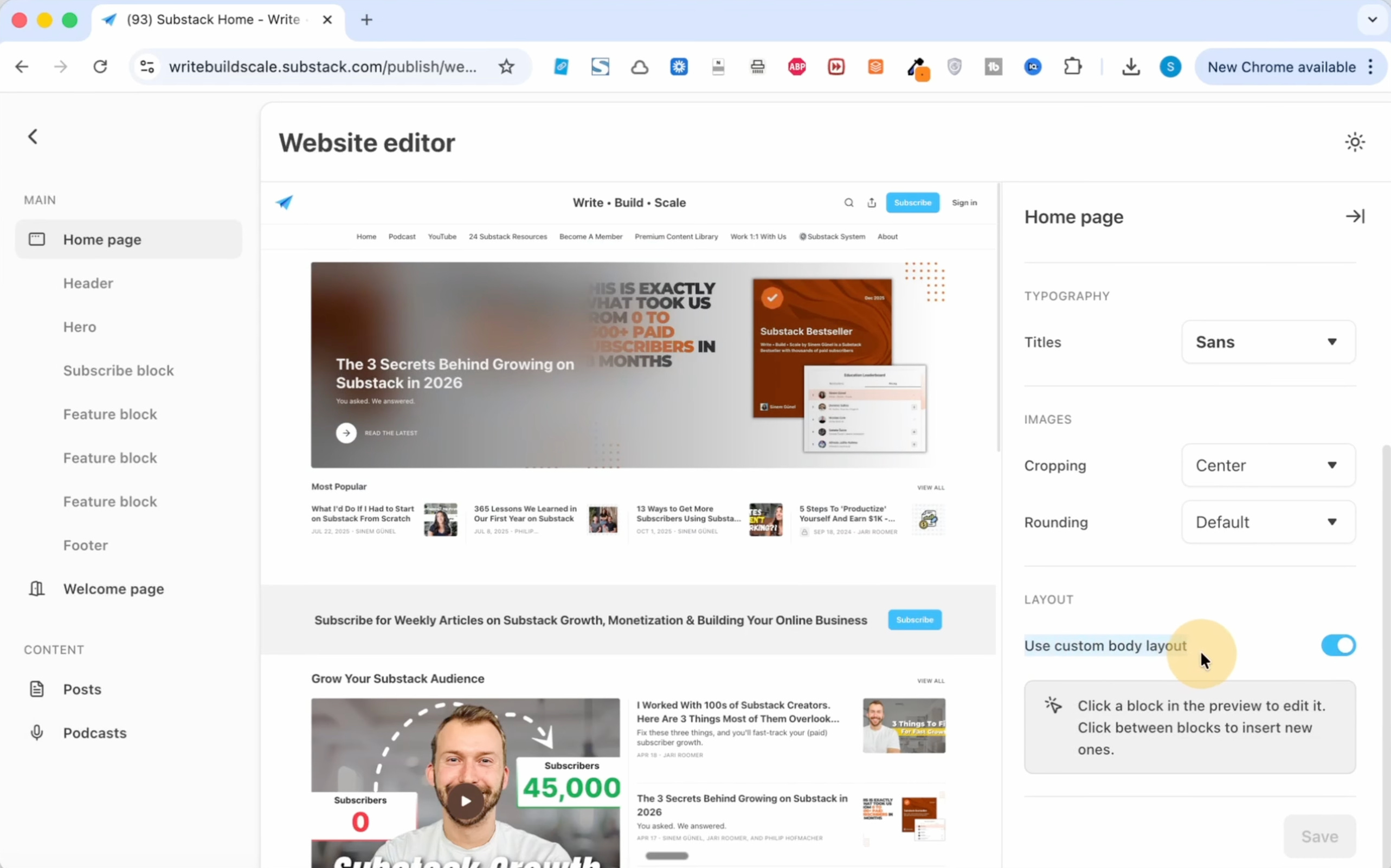
Click to add a new block, and from the left-hand side of the editor, select “Subscribe Block.”
Place it wherever it makes the most sense, depending on your publication layout. Usually, you want to place it as high on the page as possible because the goal is for new visitors to see it.
Then write the four versions, one for each type of reader.
What We Do at Write • Build • Scale
For non-subscribers, we show this message: “Subscribe for Weekly Articles on Substack Growth, Digital Writing, and Building Your Online Business.”
It tells the visitor exactly what they’re going to get and exactly when.
For our existing free subscribers, we show a completely different message: “Member Perks: Exclusive Guides, Templates, and Workshops to Build Your Substack Business.”
For our existing paid subscribers and founding members, we show a thank-you message: “Thank you for being a paid subscriber, we appreciate you.”
Same homepage. Different messages. And it’s all set up in just a few minutes.
Copy-Paste Templates for Every Reader Type
For non-subscribers:
“Subscribe for [weekly/monthly] articles on [topic one], [topic two], and [topic three].”
“Subscribe for [frequency] resources to help you [outcome] without [common pain point].”
“Join [number] readers getting [frequency] [content type] on [topic].”
For existing free subscribers:
“Member perks: [Premium content type one], [premium content type two], and [premium content type three].”
“Upgrade to premium and unlock [premium offering] to help you [desired transformation].”
“Become a paid subscriber and get full access to [exclusive perk one], [exclusive perk two], and [exclusive perk three].”
For existing paid subscribers:
“Thank you for being a paid subscriber, we appreciate you.”
“Become a founding member to unlock [perk one], [perk two], and [perk three].”
For existing founding members:
“Thank you for being a founding member, we appreciate you.”
“You’re one of our founding members. Thank you for making this work possible.”
The principle behind all of this is simple: Specificity converts.
“Subscribe to my newsletter” is generic.
“Subscribe for weekly articles on Substack growth, digital writing, and building your online business” tells the reader exactly what they’re getting and exactly when.
The Growth Feature That Runs in the Background While You Sleep
The third tweak is about a massively underrated feature on Substack: The newsletter recommendation feature.
You set it up once, and then it runs in the background, sending you new subscribers from other people’s publications, every single time those publications get discovered.
It’s the closest thing Substack has to a set-it-and-forget-it growth feature.
Most Substack creators either don’t use this feature at all, or they use it the lazy way. They recommend a few newsletters they already like, sit back, and hope the favor gets returned, and it usually doesn’t.
What actually works is proactive outreach.
At Write • Build • Scale, more than 9,000 of our subscribers found us through recommendations from other publications. And right now, we have over 700 Substack publications recommending us:

The recommendation feature isn’t just about recommending newsletters you love. It’s about building a network of creators who become your supporters, your collaborators, and eventually your friends. The recommendation is just the starting point, not the end goal.
Start With 3-7 Partners
Don’t try to find 50 recommendation partners this week. Instead, find your first 3 to 7.
Three to seven publications you genuinely feel good about. Three to seven creators with audience overlap, whose work you’d be proud to send your readers to.
Start there. Once those first ones are set up and running, you can keep adding new partners over time as you discover new good fits. This is an ongoing practice, not a one-time push.
Finding the Right Partners
Audience overlap doesn’t mean the same niche. It means the same reader.
A health newsletter and a productivity newsletter can have the exact same reader. A marketing newsletter and a creator-business newsletter can have the exact same reader. A parenting newsletter and a personal growth newsletter can have the exact same reader.
When you’re looking for partners, ask yourself this one question for every publication you find:
Does this publication already attract the type of reader I’d love to have?
If the answer is yes, add it to your list.
The Outreach Process
Spend a few days warming up before you reach out. Don’t slide into someone’s DMs cold. Follow them, like their Notes, leave thoughtful comments on their posts, and restack their best work that truly resonates with you.
The point of this is that when your DM finally lands in their inbox, your name and your face are already familiar to them. You’re not a stranger anymore.
Then send the first DM. Don’t lead with the ask. Lead with appreciation and an open door.
Here’s the exact script we use:
“Hey [Name], I recently came across your work on [Publication Name] and really love what you’re doing — especially [specific thing you genuinely appreciated]. I run [Your Publication], which is for [audience] who want to [outcome]. I think there’s real audience overlap between our readers, and I wondered if you’d be open to a potential collaboration — maybe a recommendation swap to start, and we could explore other ideas from there. No pressure either way — just wanted to reach out because I really enjoy your work.”
Three things to notice about this script: It opens with a real, specific compliment. It frames the ask as a collaboration, not a favor. And it ends with no-pressure language.
Don’t Be Afraid to Follow Up
Substack DMs get buried fast. Most creators are getting dozens of messages a day, and your perfectly good message can disappear under three new ones in the same hour.
If you don’t hear back within a few days, just follow up:
“Hey [Name], just bumping this up in case it got buried. No pressure at all — if it’s not the right fit, I totally understand. Wanted to make sure you saw it.”
Following up isn’t pushy. It’s respectful of the other person’s attention.
🎯 Want more DM scripts and outreach templates?
The Substack DM Playbook gives you ready-to-use scripts for every type of outreach — recommendation swaps, guest post pitches, collaboration proposals, and follow-ups. Never overthink a DM again.
Don’t Stop at the Recommendation
Once a recommendation is live, you’ve already built a connection. Now suggest the bigger collaborations:
A guest post on each other’s publications.
An interview on each other’s podcasts.
A joint workshop for both of your audiences.
That’s where the recommendation feature stops being a quiet little growth lever and starts becoming the foundation of your entire creator network.
The compounding effect is powerful: Five DMs this week is twenty DMs this month. Even if half the people say no, you’ve added ten new recommendation partners in a single month. And every single time any of those ten publications grow, they’re sending you subscribers — automatically, in the background, without you doing anything else.
Three Tweaks, One Hour, Compounding Growth
Rewrite your About page so it speaks to your reader.
Set up your dynamic CTA on your homepage with a different message for every type of visitor.
Reach out to your first 3-7 recommendation partners this week.
Each one takes less than an hour to set up. But together, they completely change how new visitors experience your Substack — and how new subscribers find you.
If you want hands-on support implementing these changes, our private coaching programs might be a perfect fit for you.
We work with a small group of creators, coaches, consultants, and entrepreneurs to help them grow their Substack publications directly — from optimizing their About page and homepage to building their recommendation network, their paid tier, and their entire revenue strategy.
If that sounds like what you need right now, you can apply here:
The % of posts I've read on Substack in my first 2 weeks that have been genuinely helpful is remarkably high.
Thank you for the feature, Sinem. Wouldn't have come even close to creating a Substack About Page without the guidance from WBS 🫶🏻 Appreciate you guys!