
100 Lessons We Learned From Building & Selling Online Courses (We Wish We Learned Sooner)
Avoid the mistakes we made, and build your course with confidence and clarity.


We’ve been creating online courses for nearly a decade now.
It started with selling $10 courses on Udemy (something we definitely don’t recommend anymore), but it evolved into running online courses that generate multiple 6-figures per year.
Over these years, we learned many lessons (often, the hard way) about what it takes to build and sell a successful online course.
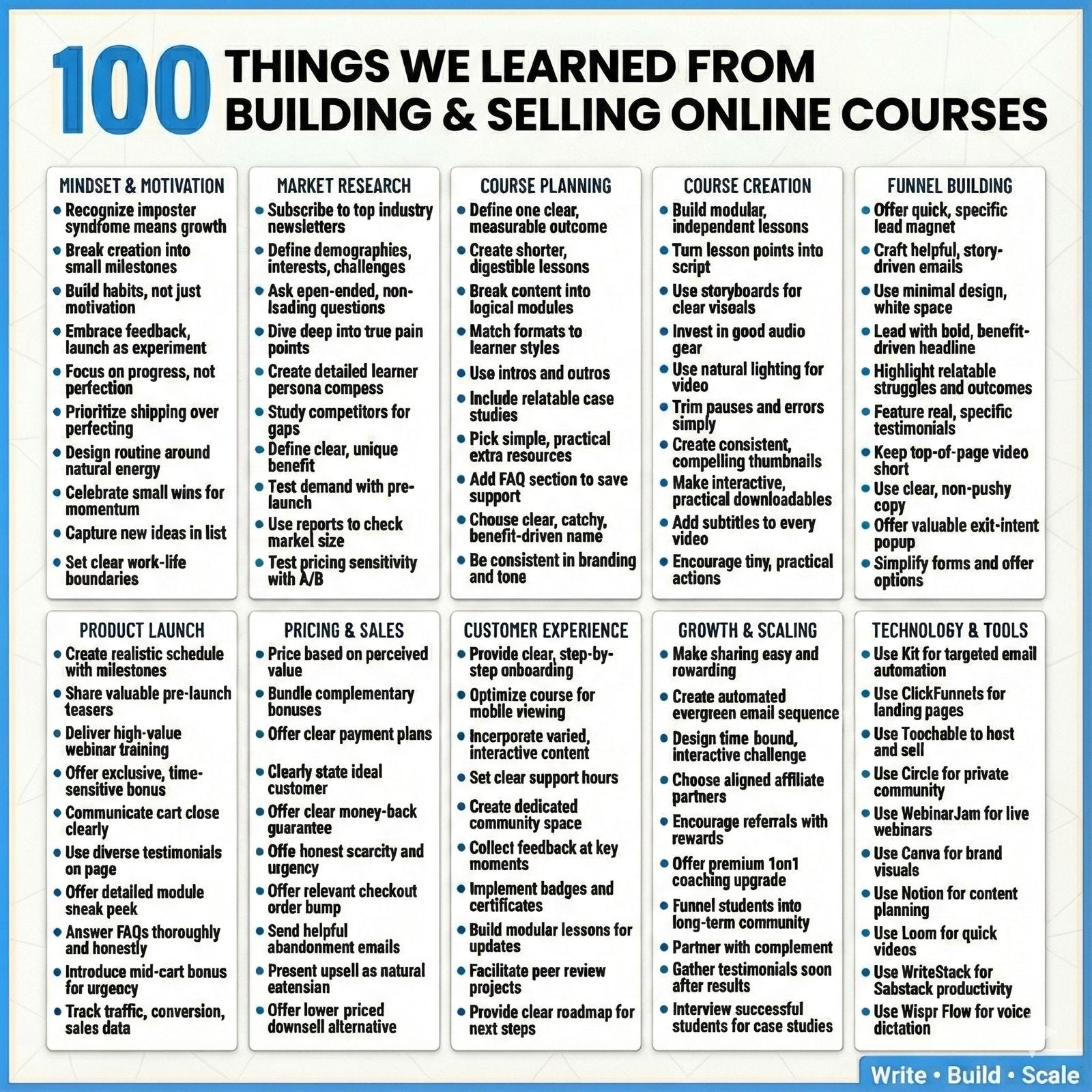
To save you the time and effort, we pulled together 100 of the most important lessons we’ve learned along the way.
Use these insights to skip the most common mistakes, speed up your course creation progress, and sell your course with confidence.
If you want our exact system to build and launch your own online course in just two weeks (so you have a profitable digital product in 2026 and beyond), check out Mini-Course Accelerator.
It’s open for enrollment - at a special Black Friday discount - until Tuesday, December 2nd.
Mindset & Motivation
1. How do I overcome imposter syndrome when I’m creating my course?
First off, imposter syndrome is normal. If you feel it, it usually means you’re leveling up.
Focus on what you bring to the table - your story, your process, your perspective.
And don’t pretend to be perfect. Share your true journey. People connect with that, and it’ll boost your confidence too.
2. How do I set expectations that are realistic instead of hopeful or rushed?
Break your course down into small, clear milestones, so you’re not staring at one massive project.
And give yourself buffer time because life happens.
3. How do I stay disciplined and consistent when motivation fades?
Make tiny daily actions non-negotiable (even 15 minutes of work counts).
Use an accountability buddy to keep you on track. And keep reconnecting with why you care about this topic in the first place. Passion outlasts motivation.
4. How do I deal with the fear of failing before or after I launch?
Think of your launch as an experiment, not a final exam.
Even if something doesn’t work, you learn and improve. That’s progress.
Every creator you admire has “failed” a hundred times.
It’s part of the process.
5. How do I stay motivated when progress is slower than I hoped?
Slow progress is still progress.
Track the small wins, because they add up fast.
And keep coming back to your bigger “why” - the reason you wanted to create this course in the first place.
6. How do I balance my perfectionism with actually moving forward?
Decide what “good enough” looks like for each task… and stick to it.
Ship first, polish later.
Perfectionism feels productive, but it’s usually just a fancy form of procrastination.
7. How do I build a creator routine that keeps me on track?
Work with your natural energy, not against it.
Block focused time in your calendar, create little rituals that get you into “work mode,” and schedule breaks so you don’t burn out.
8. How do I remember to celebrate the small wins along the way?
Start a wins journal or share your progress publicly.
The more you celebrate the tiny steps, the more momentum you build.
It turns the whole journey into something fun instead of one long grind.
9. How do I avoid shiny object syndrome when new ideas keep distracting me?
Don’t chase every new idea.
Write them all in a “future ideas” list and keep your focus on the course you’re building right now.
Your next idea will still be there in two months - but this course won’t build itself.
10. How do I manage my work-life balance while building a course?
Set actual boundaries. Tell the people around you when you’re working and when you’re not.
Schedule rest and downtime the same way you schedule meetings. Good balance isn’t “nice to have.” It’s what keeps you creative and consistent.
Market Research
11. How do I keep track of industry trends and shifts that might shape my course?
Subscribe to a few solid newsletters in your niche and follow the people who actually know what they’re talking about.
Every now and then, skim an industry report or hop into a webinar.
You don’t need to obsess over every little shift. Just stay aware enough to adjust your course when the market changes.
12. How do I identify exactly who my target audience is?
Look at your current audience. Who are they? What do they care about? What problems are they constantly dealing with?
Then back it up with data.
Check your social media insights, keyword research, and past customer info.
You’ll quickly see patterns around who benefits most from your course.
13. How do I run surveys and interviews that give me real insights?
Keep surveys short and ask open-ended questions about their struggles, goals, and frustrations.
No leading questions. No steering them into a direction.
14. How do I uncover the true pain points and goals of my audience?
Dive beyond surface answers by probing why challenges exist and what outcomes they truly want.
Validate by observing discussions in communities, reviews, and social media where your audience shares frustrations and dreams.
15. How do I build a customer avatar that actually helps me make better decisions?
Create a super clear picture of your ideal buyer: their background, habits, motivations, frustrations, buying triggers… all of it.
Then use that avatar as your filter for everything: content, messaging, pricing, and course delivery.
Decision-making gets way easier when you’re building for one specific person.
16. How do I analyze my competitors to see their strengths and gaps?
Look at their content, pricing, reviews, marketing - everything.
See what students love, and more importantly, what students wish was better.
Those gaps are your opportunities to differentiate yourself.
17. How do I define a clear USP that sets my course apart?
Your USP should be one clear thing your course offers that others don’t.
A unique benefit, angle, or approach that solves a real pain point in a way only you can.
18. How do I validate that there’s real demand for my course topic?
Don’t assume there’s demand for your course - test if there’s demand for it.
Run a pre-launch campaign, tease the course idea, survey your audience, create a waitlist and see who signs up.
If people show interest before you’ve even built the course, you’re onto something.
If no one bites, great - you just saved yourself weeks of wasted work.
19. How do I evaluate the market size and whether it’s growing or shrinking?
Check search trends, market reports, and what’s popping off in communities around your topic.
If people are talking, searching, and buying… you’re in a healthy market. If everything looks stagnant, maybe rethink your angle.
20. How do I figure out what people are willing to pay?
Run simple pricing experiments.
Try different prices, different packages, different bonuses. Watch what converts and listen to what people say about value vs. price.
Somewhere in there is your sweet spot. Profitable for you, fair for them.
Planning Your Course
21. How do I define a clear learning outcome that guides the entire course?
Pick one specific skill or transformation your students will walk away with.
Make it concrete and measurable so you always know whether your content supports that goal.
If the outcome is clear, the rest of the course becomes way easier to build.
22. How do I decide how long my course should be without overwhelming students?
Think about how much time your audience actually has.
Short, snackable courses (1-2 hours) always beat giant courses nobody finishes.
It’s better to keep things clear and effective rather than overwhelming people with a monster course.
23. How do I outline a course structure that feels simple and logical?
Break everything into clean modules that build on each other. Every module should teach one clear step in the right direction.
Your students should feel like they’re leveling up every module instead of jumping all over the place.
24. How do I choose the right lesson format for my content and my students?
Most of the time, a mix of video lessons, text summaries, and practical exercises works best to keep your students engaged.
25. How do I decide whether I need intros and outros for every module?
If an intro helps set expectations or gets students excited for what’s next, use it.
If an outro helps wrap things up and point to the next step, add it.
But don’t force them into every module if they start feeling repetitive.
26. How do I know when to include case studies, and how do I pick the right ones?
Use case studies whenever a real example will make the lesson click faster.
Pick stories that feel relatable and reflect the actual challenges your audience faces.
If students can see themselves in the example, it’s the right one.
27. How do I choose the extra resources that will help students get better results?
Add resources that make implementation easier (like worksheets, templates, checklists, or swipe files).
But don’t overwhelm people with a giant folder of “stuff.” Give them the tools that actually move the needle.
28. How do I decide whether an FAQ section makes sense for my course?
If the same questions keep popping up during your pre-launch, surveys, or pilot… add an FAQ.
It saves you time on support and removes doubts that your students didn’t want to ask out loud.
29. How do I choose a course name that feels clear, catchy, and aligned with my promise?
Make the benefit obvious, then add a hook that grabs attention.
Test a couple of names with real people in your target audience. They’ll tell you which one resonated most with them.
30. How do I create a strong brand for my course that students instantly trust?
Keep your visuals, tone, and messaging consistent everywhere.
Show your experience, share your wins, and sprinkle in some social proof.
Trust comes from clarity and consistency. Nail those, and your course feels legit from day one.
Course Creation Process
31. How do I keep the option open to update my course without rebuilding everything from scratch?
Keep each lesson short and self-contained. Don’t make videos depend (too much) on each other to make sense.
That way, if something changes, you only update one lesson instead of redoing the entire course. Future you will thank you.
32. How do I script my content so lessons flow well?
Start by deciding exactly what the student should learn in that lesson. Then outline the key points you want to hit.
Put those two together and boom - that’s your script.
33. How do I design slides and visuals that make my teaching clearer?
Figure out the lesson objectives, list your key points, and arrange them in a logical order. Use a storyboard to visualize how the lesson will flow.
34. How do I make sure my audio quality is good enough for students to enjoy learning?
Get a decent mic, record in a quiet spot, and use basic noise reduction in editing.
Clear, warm audio goes a long way. Nobody wants to learn from someone who sounds like they’re recording their course in a wind tunnel.
35. How do I improve my video quality without overcomplicating the setup?
Good lighting + a clean background is all you need.
Use natural light or a cheap ring light, and record with a solid smartphone, camera, or your built-in webcam.
36. How do I edit my lessons in a clean, simple way?
Cut out long pauses, big mistakes, and awkward moments.
But keep it natural. Over-editing can make videos feel stiff and less ‘human’. It’s totally okay to keep small mistakes and ‘uhms’ in there.
37. How do I create thumbnails that look good and feel consistent with my course?
Use the same fonts, colors, and layout across all thumbnails to match your course branding.
Add short, clear titles so students instantly know what each lesson is about.
38. How do I create downloadables that actually help students take action?
Give people tools they’ll actually use: worksheets, templates, checklists, swipe files.
Tie each resource directly to the lesson’s goal and keep the design clean and easy to follow.
39. How do I add subtitles to my video?
On Teachable, you can pay a small fee to automatically generate subtitles.
Tools like Descript, Riverside, or even most video editors can handle subtitles too nowadays.
40. How do I encourage tiny, practical actions at the end of every lesson?
End most lessons with one simple task students can do right now.
Make it small, make it quick, and make it tied directly to the lesson’s main point.
These “small wins” stack up fast and give people a sense of momentum.
Launching Your Course
41. How do I plan a launch timeline that keeps me on track without stressing me out?
Map out a realistic timeline with clear milestones and some buffer time (because life happens).
Break everything into bite-sized tasks and focus on the stuff that actually drives sales.
42. How do I build anticipation with pre-launch content that gets people excited?
Start sharing little teasers, behind-the-scenes moments, and stories about the problem your course solves before you actually release it.
Drop hints about the solution (your course) without fully revealing it.
Use email, Notes, social media content, anywhere your audience already hangs out.
43. How do I use a webinar on launch day to boost sales?
Teach something genuinely valuable that ties directly into your course.
Make it actionable, make it fun, and take live questions to break objections on the spot.
End with a clear offer and a time-limited bonus to nudge people to join now, not “later.”
44. How do I create a fast action bonus that actually motivates people to buy early?
Give early buyers something exclusive and genuinely useful (a template, a mini-training, a private coaching call) that amplifies what they’ll learn in the course.
Make it available for a short window only.
45. How do I communicate a clear cart close day so no one is confused?
Repeat the cart close date everywhere: in multiple emails, on social posts, on the sales page. Use countdown timers if you can.
Be super clear about the cart close date, as this creates a level of urgency that massively boosts sales.
46. How do I set up a testimonial page that shows happy customers in a convincing way?
Show real people with real photos, real names, and real results.
Group testimonials by themes or benefits so readers immediately see what’s possible.
Specific stories sell way better than generic “this course is great!” messages.
47. How do I build a sneak peek page that shows what’s inside the course?
Record a short video where you give people a ‘tour’ of the course. Show the modules, some of the lessons, and the bonuses included.
48. How do I address FAQs in a way that removes doubt and builds trust?
Answer the questions people actually ask. Be honest, clear, and specific about value, time commitment, support, and results.
Add social proof where it makes sense and link to course sections for extra clarity.
49. How do I use a mid-cart bonus to lift sales in the middle of the launch?
Mid-launch is usually quiet, so drop in a bonus that reignites attention. Make it valuable, make it relevant, and make it time-limited.
A well-timed mid-cart bonus can give your launch a second wind.
50. How do I track my launch performance so I can improve next time?
Look at the numbers that matter: traffic, sales, conversion rates, and email opens/clicks.
Review what worked, what didn’t, and what confused people.
Each launch gives you data. Use it to make the next one smoother and more profitable.
Build Your Own Profitable Mini-Course in 2026
Our online program, Mini-Course Accelerator, is now live. 🎉
In Mini-Course Accelerator, you’ll learn the exact system to build, launch, and automate your own mini-course, so you have an income-generating digital product working for you throughout 2026.

In Mini-Course Accelerator, you’ll discover the step-by-step approach to:
Find a winning course idea that people can’t wait to buy from you
Create a high-impact course your students will love (without overcomplicating the content) in just 14 days
Launch your course successfully using our proven 3-phase launch system (skip the trial-and-error)
Automate your sales process for passive income (so your course keeps selling while you sleep)
And much, much more…
✅ Yes, I Want To Learn More About Mini-Course Accelerator
Course Pricing & Sales
51. How do I price my course based on perceived value instead of guessing?
Stop pricing based on how long the course is or how many videos you recorded.
Look at what your ideal customers are actually willing to pay, check what competitors charge, and price according to the transformation you deliver.
If the outcome is valuable, the price should reflect that.
52. How do I create an offer stack with bonuses that feels irresistible?
Add bonuses that genuinely make the main course better - not random fluff.
Each bonus should solve a pain point, speed up results, or remove friction.
When your bonuses feel like they’re worth more than the course itself, you’ve got an irresistible offer.
53. How do I offer payment plans or financing options without hurting revenue?
Make sure your payment plan still covers the full price plus any fees.
Break the payments into manageable chunks, but don’t undercut your earnings.
And always be super clear about the terms so there are no surprises later.
54. How do I clearly state who the ideal customer is for my course?
Describe exactly who it’s for - their goals, struggles, mindset, and where they are in the journey.
And be just as clear about who it’s not for. This attracts the right people, repels the wrong ones, and saves you refund headaches.
55. How do I set up a money-back guarantee that builds trust?
Keep it simple: a clear guarantee, a clear deadline (e.g. 30 days), and straightforward conditions.
Frame it as confidence in your course. “I know this works, so here’s zero risk for you.”
People buy faster when they feel safe.
56. How do I use scarcity and urgency in an ethical way?
Tell the truth. If the deadline is real, say it.
If the bonus is limited, say it.
Urgency works incredibly well, but only when it’s honest and not manipulative.
57. How do I add an order bump that feels natural and helpful?
Offer a small add-on at checkout that solves a related problem or makes the main course easier to implement.
Think of a private coaching call, a related course, or templates that people can use in combination with your course.
Price it so it’s an impulse purchase.
58. How do I write abandonment cart emails that bring people back?
Send a few gentle reminders that nudge them back to checkout. Address common objections, share a testimonial or two, and clearly restate the benefits.
Keep it friendly, helpful, and low-pressure.
59. How do I upsell the next logical thing without feeling pushy?
Make the upsell the obvious next step. An upgrade, deeper support, or faster results.
Explain why it helps, then let people decide.
A good upsell is helpful, not aggressive.
60. How do I create a downsell that still serves the customer and the business?
Offer a simpler, cheaper option that still solves part of their problem.
This keeps them in your ecosystem, builds trust, and opens the door for future offers - without sacrificing the relationship.
Best Tools To Use
61. What tool should I use for targeted emails and automation?
We use Kit because it offers creator-focused features with smart tagging and powerful automation to segment and engage our audience precisely.
62. What tool should I use for high-converting landing pages?
We use ClickFunnels to build and optimize high-converting landing pages for our offers.
63. What tool should I use to host and sell my course?
We use Teachable to host and sell our online courses because it’s a simple and scalable platform that also simplifies the global taxing process.
64. What tool should I use to run a private community?
We use Circle to build and manage our private online community.
65. What tool should I use to host live webinars?
We use WebinarJam to run live webinars with tools for engagement and conversion.
66. What tool should I use to design visuals for my brand?
We use Canva to design all our graphics, presentations, and visuals.
67. What tool should I use to plan and organize my Substack content?
We use Notion as our all-in-one project management tool and we also create our offer docs and various digital products there.
68. What tool should I use to record quick explainer videos?
We use Loom to record and share quick videos to communicate ideas and feedback.
69. What tool can help me be more productive on Substack?
We use WriteStack to study top-performing Substack creators and organize our next Notes.
70. What other tool should I use to boost my productivity?
We use Wispr Flow to write with our voice by dictating ideas instead of typing.
Building a Sales Funnel
71. How do I create a lead magnet that feels irresistible to the right people?
Your lead magnet should be quick to consume, super valuable, and directly connected to the transformation your course delivers.
Make people think, “If the free stuff is this good, the course must be amazing.”
72. How do I build an email nurture sequence that warms up subscribers and leads them to my course?
Tell useful stories, share real value, and help people get small wins.
As trust builds, naturally introduce your course as the next logical step - not a pushy pitch.
73. How do I make my funnel look clean and professional without overcomplicating it?
Keep it simple, with a clean design and consistent branding.
74. How do I hook people instantly when they land on my page?
Hit them with a headline that speaks directly to the problem they’re living with or the result they desperately want.
Use emotional language and clear benefits.
You have maybe three seconds to grab someone’s attention.
Make them count.
75. How do I best present the real transformation my course offers?
Show the “before” and “after.”
Describe the struggle your audience is stuck in… then paint a vivid picture of what life looks like after they go through your course.
Stories, examples, screenshots of results. Anything that clearly communicates the transformation your course brings.
76. How do I use social proof and testimonials in a way that builds trust fast?
Feature a mix of testimonials so your audience sees people “like them” winning with your course.
If your course is new, use testimonials from previous customers, coaching clients, or even followers/subscribers.
77. How do I use a video at the top of the page to boost conversions?
Talk about the pain point, who you are, and how your course helps - then give a clear call to action.
Keep it short, friendly, and engaging.
78. How do I design a one-page funnel with only two options, buy or leave, without feeling pushy?
Make the page clean, clear, and focused on benefits. Don’t use manipulative tactics - let the value of your course do the selling.
Your job is to present the offer clearly, and let people decide.
79. How do I use exit-intent popups in a way that actually helps conversions?
Offer something useful - a discount, a free resource, or a gentle reminder of the benefits. Keep the popup simple and easy to close so it helps rather than annoys.
80. How do I optimize the checkout experience so fewer people drop off?
Make the checkout process stupidly simple. Easy forms, minimal steps, multiple payment options.
Add trust signals like security badges and your refund policy so people feel safe hitting “buy.”
Creating a Great Customer Experience
81. How do I create a smooth onboarding experience that helps students start strong?
Give people a warm welcome video and a simple “do this first” checklist.
Make the first steps stupidly clear so students know exactly where to go, what to click, and how to get quick wins from day one.
82. How do I make sure my course is mobile friendly for students who learn on the go?
Pick a platform that actually works well on mobile (like Teachable or Gumroad).
Then test everything - videos, downloads, quizzes - on your own phone.
83. How do I keep students engaged and motivated throughout the course?
Mix things up in terms of the format: videos, check-ins, quizzes, challenges.
And add regular milestones so people get a clear sense of progress.
84. How do I provide timely support without burning myself out?
Have clear support hours or response windows so students know when you’ll reply.
Use FAQs, automation, or peer support groups for common questions.
85. How do I encourage community interaction so students feel connected?
Create a dedicated space for conversation and give people prompts to break the ice.
Encourage students to introduce themselves and share their wins.
86. How do I collect feedback and act on it in a meaningful way?
Ask for feedback at key moments: after onboarding, mid-course, and at the end.
Look for the patterns in feedback and make adjustments based on the most common points your students tell you.
87. How do I recognize student achievements and keep them encouraged?
Whenever a student shares a win, celebrate them.
Send them a private message.
Share their results on your social media (if they agree with it).
When people feel seen, they’ll become a superfan.
88. How do I keep my course content updated without constant rewrites?
Make your lessons short and focused. If something changes, you only update one tiny piece.
Do a quick review every few months and keep the course fresh without rebuilding the whole thing.
89. How do I actively connect my students with each other?
Create moments where working together makes sense: small groups, peer reviews, mini-masterminds.
Give them structured ways to collaborate, and the connections happen naturally.
90. How do I give students clear next steps once they complete the course?
Don’t let the journey end with “Thanks, bye.”
Give them a next-step roadmap. Whether that’s your next course, your next program, or a simple action plan.
Help them keep the momentum going.
Scaling Your Course
91. How do I encourage new students to share that they joined my course so more people hear about it?
Give people a copy-paste template for a social media post, so you make it as easy as possible for them to share that they joined your course.
Offer a little incentive (bonus or shoutout), and publicly celebrate new students so others want to join the party too.
92. How do I build an evergreen funnel that sells my course on autopilot?
Set up a great lead magnet, create a nurturing email sequence, add a conversion-focused email sequence, and let the system do the heavy lifting for you (on autopilot)
93. How do I run a challenge that brings in leads and boosts sales?
Create a short, energizing challenge that gives people a quick win tied directly to your course topic.
Promote it everywhere, keep participants engaged, and once they’ve tasted results… show them how your full course takes them even further.
94. How do I work with affiliate partners to grow faster?
Find creators whose audience matches yours and offer a commission that makes it worthwhile for your affiliates to promote your course.
Give them ready-to-use promo materials so you make it as easy as possible to help them promote your course.
95. How do I set up a recommendation system that turns students into promoters?
Reward people for sharing your course.
Give them easy-to-use referral links, fun incentives, and ask for reviews right after they get results.
96. How do I offer 1on1 coaching as an upgrade without diluting the main offer?
Position coaching as the “VIP experience” upgrade. It’s optional for people who want deeper guidance (but at a premium).
Keep spots limited so it feels exclusive, and your main course stays the core product.
97. How do I funnel students into a community that supports long-term growth?
Create a community they actually want to join.
One where they can connect with like-minded people, where they can find exclusive resources, and where they can connect more with you.
Create many entry points to your community from within your course.
98. How do I use cross-promotions to reach new audiences?
Team up with creators who talk to the same kind of people you want to reach.
You can create content together, recommend each other’s newsletters, run a joint workshop, or even bundle your products together.
When you do that, you instantly get in front of new people who are already warm and interested.
99. How do I gather customer testimonials that help my course sell itself?
Have multiple moments in your course where you ask your students to leave a review about what they’ve just learned (especially in the middle and the end of your course).
Pick the best reviews and highlight these wherever you can.
100. How do I turn success stories into strong case studies that show real results?
Interview successful students for details about their journey, challenges, and outcomes.
Share these stories on your landing pages, in your social media content, and in your marketing emails.
Thank you! I read and subscribed. It’s a dream of mine to build a memoir writing course. 🌸
This is a mini course all by itself!
Thank you for this Black Friday Freebie!